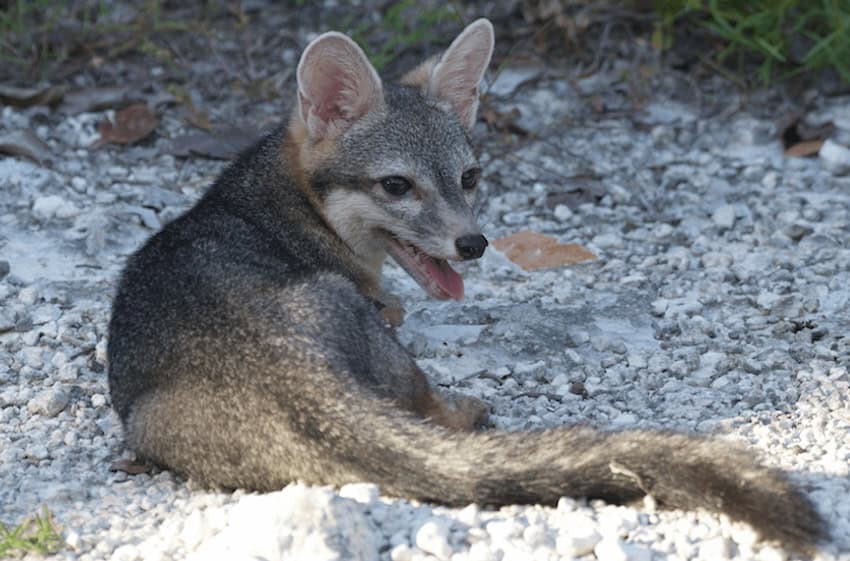
A tiny fox long feared lost has reappeared on the island of Cozumel, giving scientists what one calls an unusual “second chance” to save one of the world’s rarest canids.
In a paper published last month in the journal Neotropical Biology and Conservation, researchers reported the first confirmed sighting and photographs of the Cozumel dwarf fox in more than two decades.
An adult male was captured in September 2023 after locals reported a disoriented animal near Cozumel’s coastal highway, on the island of about 88,000 residents off Mexico’s Yucatán Peninsula.
Staff from the Fundación de Parques y Museos de Cozumel recovered the fox, kept it under observation for several days and conducted a full health check.
They released it in the Laguna Colombia State Reserve in southern Cozumel, a protected area chosen for its suitable habitat and distance from road hazards.
The Cozumel dwarf fox — a member of the family that includes wolves, coyotes, domestic dogs and other foxes — has inhabited the island for millennia but hadn’t been seen since 2001.
News of the fox’s “return” is breaking only now because the peer-reviewed study appeared May 4 and was picked up by media this month.

The fox belongs to the genus Urocyon — the same as the North American gray fox — but has shrunk dramatically after thousands of years of isolation on the island.
Subfossil remains indicate the fox is roughly 60% to 80% the size of its mainland gray fox relatives, which generally measure 80 to 110 centimeters (31 to 43 inches) and weigh roughly 3 to 7 kilograms (6.6 to 15 pounds).
The paper suggests isolation of the Cozumel fox began between about 5,000 and 37,000 years ago, possibly predating early Maya settlement.
Despite its long history on Cozumel and pronounced “insular dwarfism,” the population has never been formally described or recognized as a distinct species or subspecies.
Scientists say the finding confirms the fox still survives but likely in very low numbers. They do not know how many individuals remain, where they are distributed on the island or what role they play in Cozumel’s ecosystems.
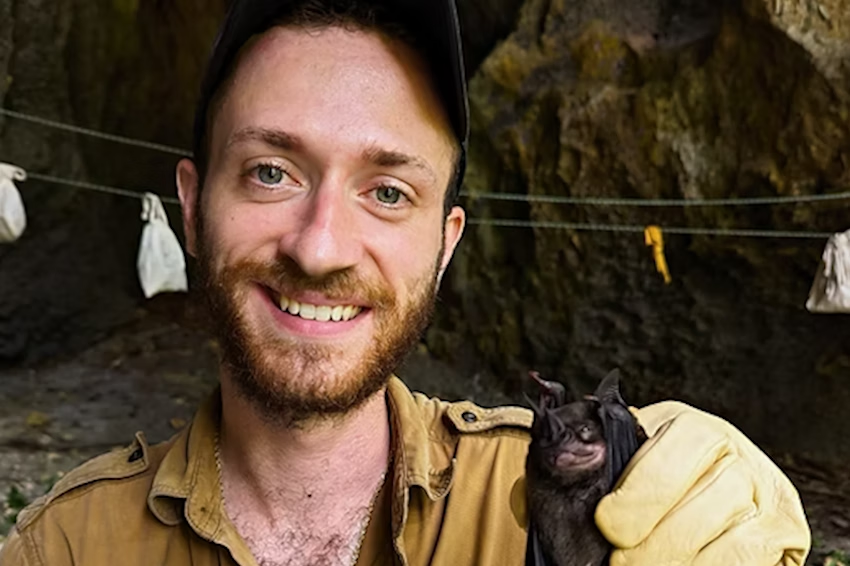
“The rediscovery of the fox is not a conservation success story yet, but it represents a second chance,” lead author Travis D. Bayer, a zoologist and Ph.D. student at the University of Rhode Island, said in the paper.
“One of the most important takeaways from this research is that species can quietly disappear without the world even realizing they are gone,” he added. “The biggest challenge facing the Cozumel fox is that we still know almost nothing about it.”
The authors are calling for targeted field surveys, population monitoring and genetic work, along with stronger protections for remaining habitat in southern Cozumel, where development, land-use change, invasive species and natural disasters continue to erode the island’s forests.
With reports from Infobae, Sci News and Publimetro