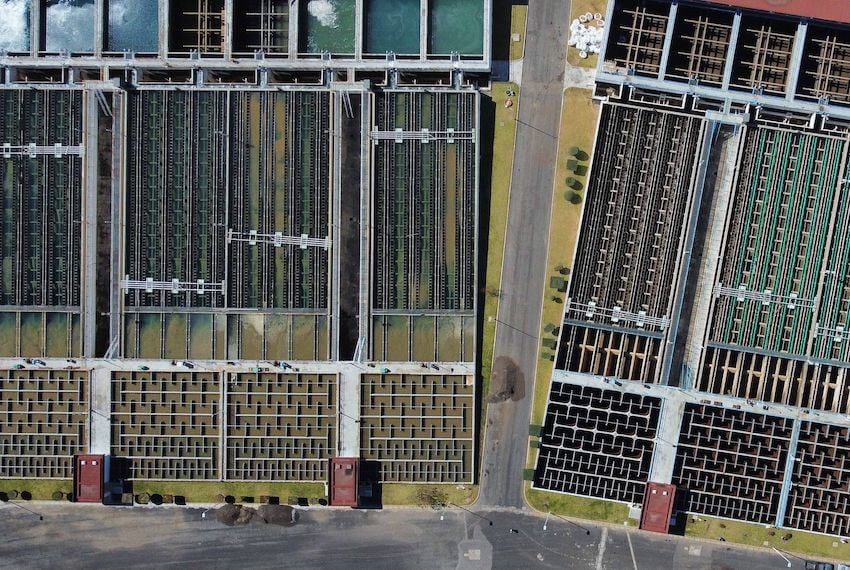
The Cutzamala system, which provides drinking water to Mexico City and Mexico state, is undergoing its first major upgrade in 40 years, with an investment of over 680 million pesos (US $39.6 million), the director of the Valley of Mexico Water Basin Authority (OCAVM), Citlalli Peraza Camacho, announced on Tuesday.
The investment is expected to extend Cutzamala’s lifespan for another 20 years, in order to continue providing drinking water to 5 million residents in the Valley of Mexico.

“The Cutzamala system has some of the largest pumping equipment in the world, and it typically has a lifespan of 15 to 20 years,” Peraza said. “No piece of equipment of this size has ever been replaced. Plus, the pieces are unique and haven’t been manufactured anywhere else.”
The Cutzamala’s water is collected in the Valle de Bravo, El Bosque and Villa Victoria dams in México state, and then transported 125 km to the system’s core, the Los Berros hydraulic water treatment plant, which is the largest in Latin America. There it undergoes a purification process before being pumped a further 95 km to Mexico City and other destinations in México state.
In 2025, the National Water Commission (Conagua) found that one of Los Berros’ 35 pumping units had considerable wear and needed replacing. The agency has since ordered 10 new spherical valves from Asia to upgrade the system at a cost of 259 million pesos ($15.1 million).
Although the system was functioning, early diagnosis helps prevent future shutdowns, especially in this case, because the valves take 24 months to manufacture, Pereza told the newspaper La Jornada.
Another 188 million pesos ($10.9 million) will be spent on the renewal of seven rotors, as well as four pumping units with a capacity of 1,700 liters per second.

The project got underway in 2025 and has now reached 20% completion, according to Conagua.
Other plans include the modernization of the Supervisory Control Center, the “brain of the Cutzamala system,” whose equipment, which dates back to 2000, is now obsolete.
The goal is to migrate to a SCADA (Supervisory Control and Data Acquisition) automation system, which has a projected lifespan of 10 years.
With reports from La Jornada, Milenio and La Razón