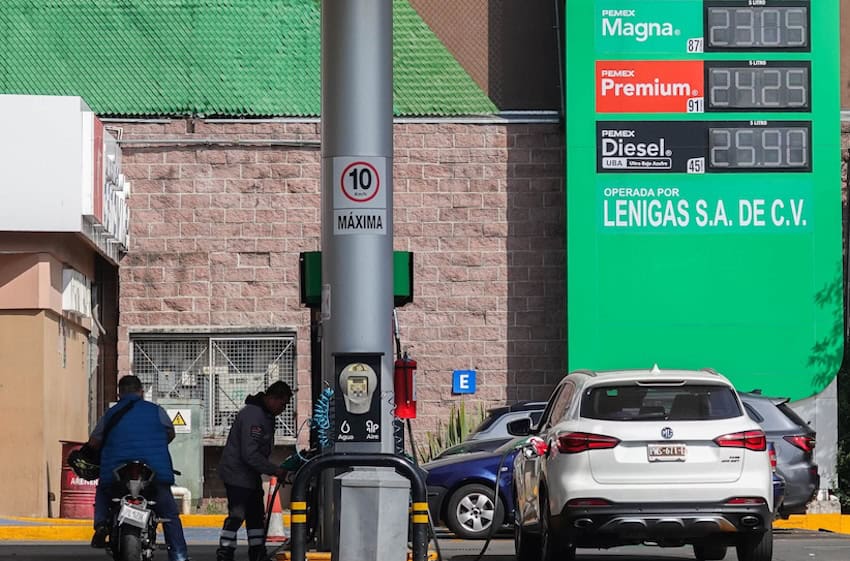
As part of her goal of digitizing the Mexican economy, President Claudia Sheinbaum said on Thursday that cash payments at gas stations and highway toll booths will be eliminated starting this year.
Sheinbaum said her administration is working with the the banking sector to standardize digitized payment procedures nationwide to promote their use, and especially with Banco de Bienestar to facilitate digital payments for all Mexicans.
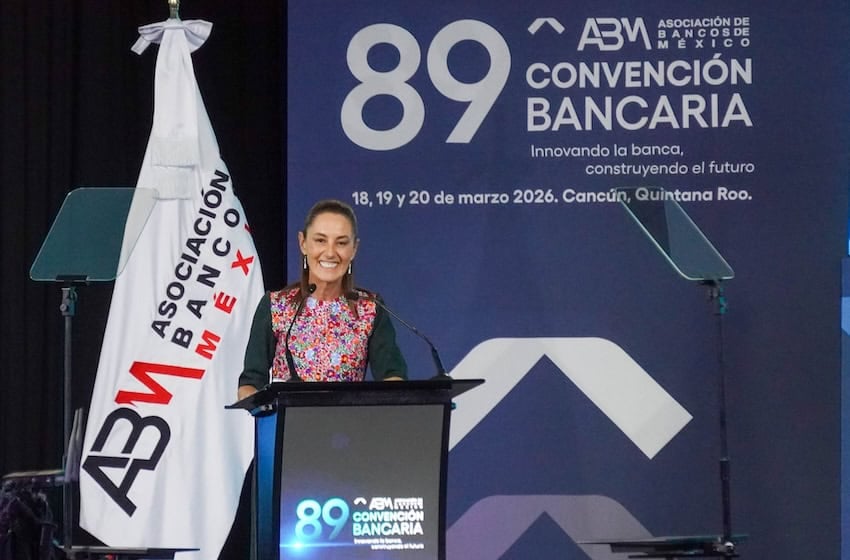
Banking Convention of the Mexican Banking Association in Cancún Thursday. (Presidencia / Cuartoscuro.com)
“Our goal this year is to make digital payment of gasoline and tolls mandatory,” the president said. “This will allow us to move forward with the digitization of the country through other schemes.”
Delivering the inaugural address at the 89th Banking Convention, Shienbaum also praised recent improvements to the CoDi system which can now be accessed through cell phones with zero commissions. CoDi (Cobro Digital) is a free, real-time digital payment platform developed by the Bank of Mexico, Mexico’s central bank, often called Banxico.
Also speaking at the convention, Banxico President Victoria Rodríguez said the central bank will stage a public consultation on reforms that would standardize the procedures for electronic fund transfers through mobile devices — another step toward universal digitization.
The government is also preparing to include the Banco del Bienestar in the digitization process by allowing certain government payments to be made digitally. Banco del Bienestar is a state-owned development bank aimed at providing financial services and promoting financial inclusion, especially for beneficiaries of federal social programs and residents in remote or marginalized communities.
The banking sector has also been lobbying for digitization policies to further reduce the use of cash, especially payments for public services. Cash is used for roughly 80% of transactions in Mexico.

The economic state of the nation
Sheinbaum’s speech also touched on the economic situation of the country, emphasizing a historic reduction in poverty, a strong currency, an increase in the minimum wage, a healthy financial system and a solid domestic market.
At the same time, she encouraged the banking sector to do more, especially by expanding credit and facilitating access to financing. Among Latin American nations, Mexico offers the least amount of credit for small and medium-sized enterprises.
“The banking sector still has much to offer the country,” she said, while also recognizing the Mexican Banking Association’s commitment to raising the level of credit from 38% to 45% of Gross Domestic Product (GDP) by 2030.
“The sector is stepping up, but we need it to give even more,” she said. “That’s why the best news … is that it is going to increase credit.”
Sheinbaum said her administration’s priority is to establish an economic climate conducive to sustainable growth in order to improve Mexicans’ quality of life.
The government’s historic 5.6 trillion-peso (US $313 billion) public and private mixed investment program can be the foundation for this growth, she said. The investments will target projects in eight strategic sectors, including energy, trains, highways, ports, health and water.
Other elements of economic policy mentioned by Sheinbaum include investment in the energy sector (to generate 30,000 MW of electricity by 2030, boost renewable energy and reduce dependence on natural gas) and new financing for technological and scientific innovation.
With reports from El Economista, Timer Noticias and El País