With the World Cup’s opening match in Mexico City less than three months away, migrant children in the capital are lacing up for a smaller but important tournament of their own.
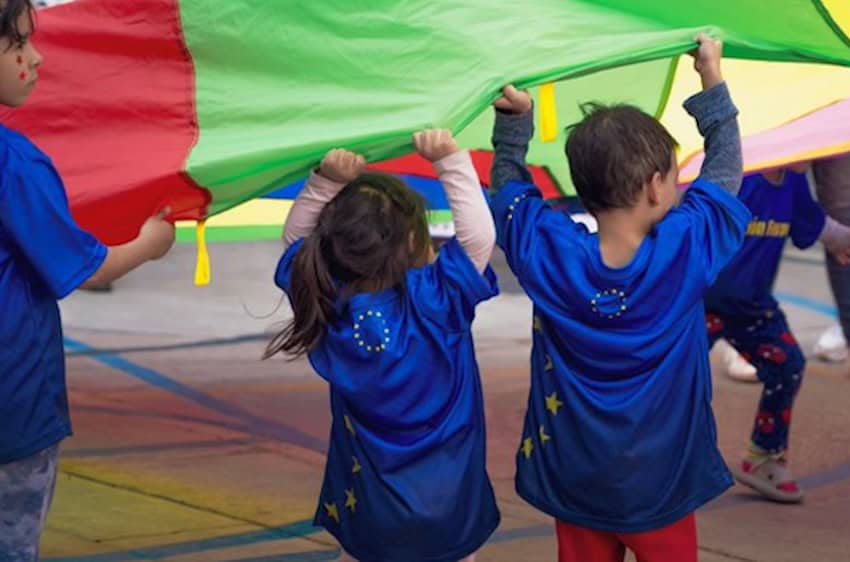
Since late February, hundreds of migrant, refugee and local children living in inner-city shelters have been training on improvised fields for “Goals for Inclusion,” a European Union–funded project that uses soccer to promote integration, protection and coexistence.
Con #GolesPorLaInclusión, el futbol se convierte en un espacio donde todas y todos construyen comunidad.
En albergues y espacios comunitarios de la Ciudad de México demostramos que la inclusión transforma.
La diversidad nos fortalece cuando jugamos en equipo. 💙⚽ @UEenMexico pic.twitter.com/hq9pyIrfSp— ACNUR México (@AcnurMexico) March 18, 2026
The initiative was launched this month by the EU Delegation in Mexico alongside the Mexico City government, the United Nations refugee agency UNHCR and the International Organization for Migration.
It youth soccer program will run through next month and culminate with a big tournament in Mexico City at the end of April.
Organizers say the focus is less on the final score than on offering safe spaces to children who have fled violence, poverty and political turmoil and who now face hostility, bureaucracy and exploitation in Mexico.

Around 300,000 migrants remain stranded in the country as tougher U.S. border policies in Donald Trump’s second term as U.S. president have sharply reduced crossings and left many families unable to move forward or go home, according to humanitarian groups.
“Sport has no borders. The ball is round here or there,” Venezuelan migrant Joel Orta told Reuters as his 8-year-old son, Matías, practiced in the courtyard of a shelter in Tepito, a Mexico City neighborhood.
“Goals for Inclusion” will take place at fields in two inner-city areas considered dangerous, Tepito and Vallejo, both north of central CDMX.
At CAFEMIN, a shelter in Vallejo where the project was officially unveiled, EU Ambassador Francisco André said, “In the European Union, we are convinced that all girls and boys have the right to grow up in safe spaces where they feel respected and included. And sport creates precisely that: a community where they learn about camaraderie, solidarity, generosity and respect.”
Mexico City officials say sports can bridge tensions between residents and new arrivals.
“Projects like ‘Goals for Inclusion’ demonstrate that sports can become a real bridge between people in situations of human mobility and host communities, generating environments of coexistence, protection and shared social responsibility,” said Temístocles Villanueva, the city’s coordinator of attention to human mobility, in a United Nations statement.
“Goals for Inclusion” will include 18 community clinics that blend drills with socio-emotional support and human rights education. The clinics at migrant shelters and city-provided facilities are framed as “safe spaces.”
“Sport is a tool for change, a tool for peace,” said Perla Acosta, director of Más Sueños, a nonprofit that focuses on using sports to better society. “It helps us build community, it helps us connect.”
The 2026 FIFA World Cup will begin June 11 in Mexico City with a Mexico–South Africa match and conclude July 19 in New Jersey. Matches will be played in Mexico City, Monterrey, the Guadalajara metro area and in 11 cities in the U.S. and two in Canada.
With reports from Reuters and United Nations Mexico