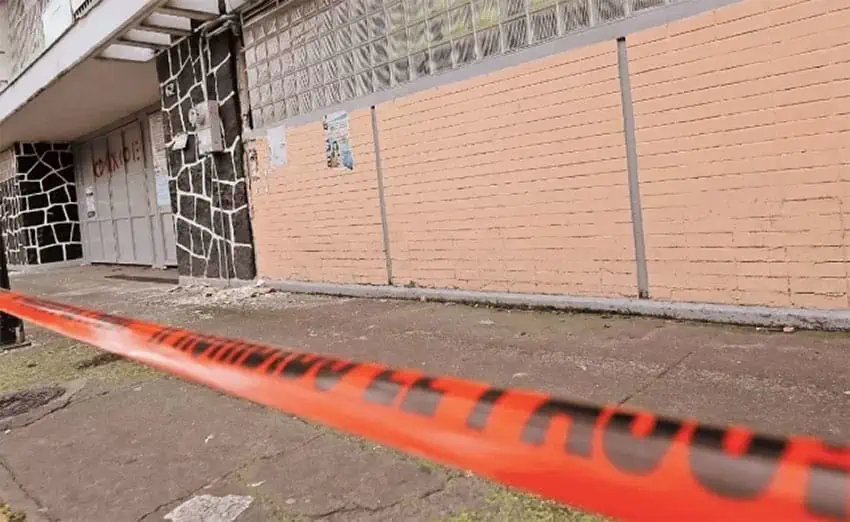
The government’s decision to disband its educational infrastructure agency and transfer the responsibility for school repairs to school communities poses a safety risk, experts warn.
President López Obrador announced on July 1 that during the 2019-2020 school year, funds for the construction, maintenance and repair of school buildings will be allocated directly to committees made up of teachers, parents and students.
He previously announced that the National Institute of Physical Infrastructure for Education (Inifed) would be dissolved.
Pablo Iván Ángeles Guzmán, a structural engineer and academic at the National Autonomous University, told the newspaper El Universal that the reconstruction of schools – 20,000 of which were damaged in the powerful earthquakes of September 2017 – should be managed by building professionals, not teachers and parents.
“There is a high risk that the rebuilding of schools will be at the discretion of people who are not professionals in construction and restoration,” he said.
Ángeles said that not reinforcing a damaged building enough, as well as attempting to strengthen one too much, both pose safety risks, explaining that it’s not good to have excessive steel rods or concrete “because they can also cause damage.”
“That’s why these jobs should be done by specialists . . . Specialists make mathematical models to simulate movements that could affect schools – earthquakes for example – in which we make load calculations in order to reinforce areas that could be damaged,” he said.

The Oaxaca branch of the Mexican Association of Engineers and Architects also warned of possible serious consequences stemming from the reconstruction of schools by unqualified builders without adequate architectural or engineering planning.
Bernardo Naranjo, a former official at the now-defunct National Institute for Educational Evaluation, acknowledged that Inifed had problems, including a lack of clear criteria about how funding should be distributed, but argued that the regulations it established for the construction and restoration of schools should be maintained.
No lives were lost in public schools in the 2017 earthquakes because they are “very safe,” if not modern or beautiful, he said.
“[Public] schools are designed to serve as refuges or shelters . . . if needed. That’s why they have stricter building regulations,” Naranjo said.
Nevertheless, there are 45,168 schools where students and teachers are at risk due to structural damage or because buildings were built without complying with the law, according to the Secretariat of Public Education (SEP)
The “potential vulnerability” of the schools is a particular risk in parts of the country where natural disasters such as earthquakes are more common, SEP said.
If repairs are not carried out to appropriate standards, the probability of students and teachers losing their lives in an earthquake – as occurred in 2017 with the collapse of a wing of Mexico City’s Enrique Rébsamen school – will only increase.
Source: El Universal (sp)