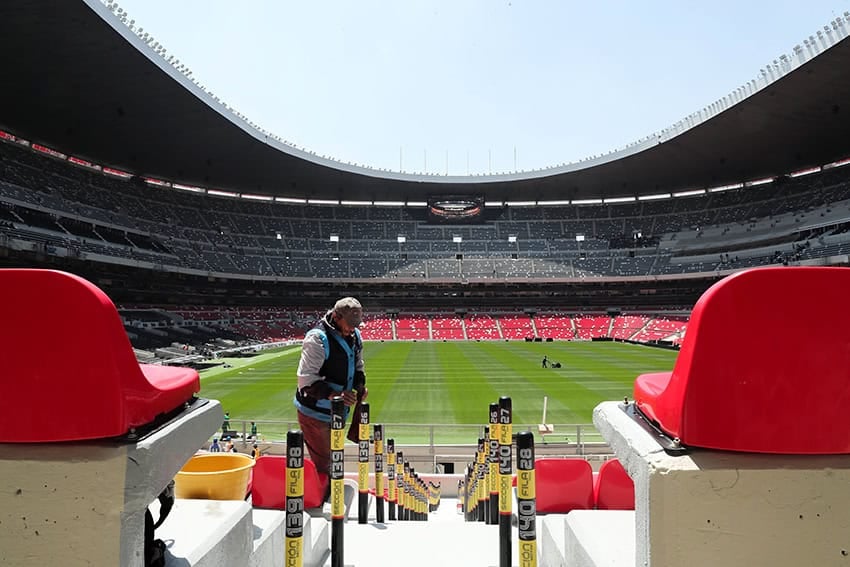
Soccer’s world governing body FIFA on Thursday formally received full control of Mexico City’s Banorte Stadium — better known as Azteca Stadium — only to learn that there remain logistical issues related to the arena’s box seats.
With the handover, the venue has now been officially renamed Mexico City Stadium for the duration of the World Cup as FIFA prohibits corporate-sponsored names, a long-standing policy intended to prevent sponsors not affiliated with the organization from receiving exposure.
Banorte Stadium management announced the administrative transfer in a social media post.
“Throughout the 2026 World Cup, the stadium will be known as ‘Estadio Ciudad de México,’ as mandated by FIFA. … [T]he stadium’s operation and communications will be handled through FIFA and its official channels,” it said.
The reassignment occurred two days later than originally planned as the stadium obtained special permission to delay the handover to allow Cruz Azul — one of the two Mexico City soccer clubs that call Banorte Stadium home — to stage a playoff game on Wednesday night.
While Banorte also celebrated the stadium’s nearly two-year renovation project with a separate social media post, FIFA immediately got to work effecting the name change along the roof of the venue and draping a banner over the Banorte Stadium lettering above the turnstiles on both sides of the stadium.

However, while World Cup organizers moved in to put the finishing touches on the historic venue, FIFA learned that an issue related to box seats has become more complicated.
In order to finance the construction of the stadium in the 1960s, boxes were sold to private investors in an arrangement that granted owners rights to use them at any and all events for 99 years.
As FIFA requires full and complete control of stadiums during the World Cup, box seat owners were informed they would not be permitted to use them during the tournament.
Mexico sought to arrange compensatory payments to those who ceded their rights to FIFA, but a large group resisted and in September 2025 Banorte Stadium management reached a deal with FIFA to grant box owners full access to their seats.
However, FIFA responded last month by saying it would prohibit box seat owners from entering the stadium with food and drinks and said it would not allow resale of seats in the boxes.
Roberto Ruano, a lawyer representing the luxury box owners, said some of his clients received messages that organizers were going to remove refrigerators, blenders and other personal property in the boxes as part of this new rule.
🏟️ ⚽️ El Estadio Banorte ya fue renombrado como “Estadio Ciudad de México” con motivo del Mundial de futbol, el cual arrancará el próximo 11 de junio
📸 #FOTOS: Fernanda Rojas | EL UNIVERSAL pic.twitter.com/DSKoTc8YRE
— El Universal (@El_Universal_Mx) May 15, 2026
On Wednesday, a federal judge granted box owners an injunction against the FIFA action.
Ruano celebrated the ruling and defended the box owners, saying that “no regulation from an international body (FIFA) can trample on the rights we have as Mexicans.”
He added that the contracts clearly stipulate that “seats and stands can be sold, rented or transferred, contrary to the threatening statements indicating that if these spaces were offered through any external channel, they would be suspended by FIFA.”
Meanwhile, FIFA has also taken control of Guadalajara’s Akron Stadium — renamed Guadalajara Stadium — and Monterrey’s BBVA Bancomer Stadium, now named Monterrey Stadium. Those stadiums will each host four World Cup matches, while Mexico City Stadium will host five games.
With reports from ESPN, Proceso, La Jornada, El País and Reform