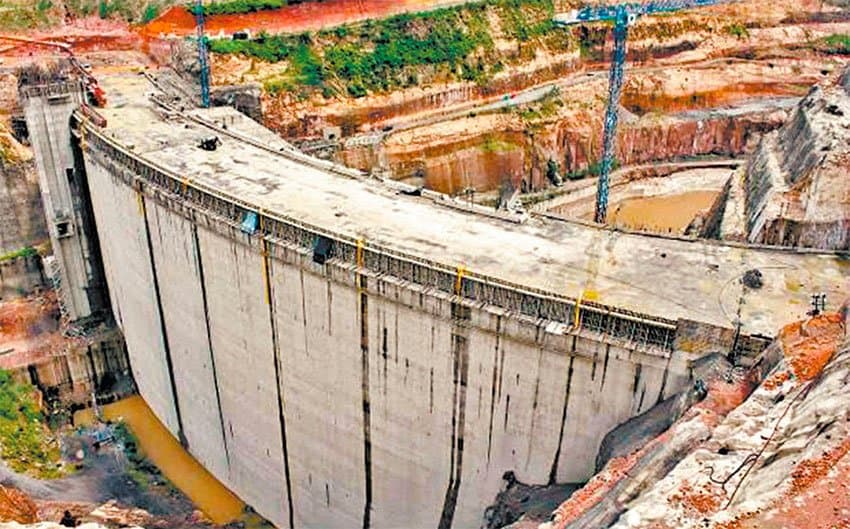
The federal government has reached an agreement with residents of two Jalisco municipalities that will allow the activation of a dam that has long been opposed by locals.
President López Obrador met on Sunday with residents of Temacapulín, Palmarejo and Acasico to discuss the possibility of putting the El Zapotillo dam into operation.
The first two communities are located in the northeastern municipality of Cañadas de Obregón, while Acasico is in the neighboring municipality of Mexticacán.
Residents have opposed the dam since former president Vicente Fox announced the project in 2005 because its operation would likely cause frequent flooding in the three towns, making them uninhabitable. Construction began in 2011 but the project was never completed due to community opposition and the legal action they took.
To mitigate the flooding risk, López Obrador in August proposed the operation of the dam at a reduced capacity. The president returned to Temacapulín on Sunday, where he also proposed the construction of a tunnel that will funnel water away from the towns to ensure they are not flooded in the case of heavy rain.
The residents consequently agreed to the activation of the dam – which will mainly supply water to the metropolitan area of Guadalajara – as long as its capacity doesn’t exceed the 42-meter mark, and as long as a range of other conditions, including the repair of homes damaged by construction of the dam, are met.
The National Water Commission (Conagua) had proposed the operation of El Zapotillo at a capacity of up to 80 meters. But Conagua chief Germán Martínez accepted the new limit and said the commission would review the technical details of the project with a view to putting the dam into operation.

“There is now a decision that the three towns won’t be flooded,” said López Obrador, who was accompanied at the meeting by Jalisco Governor Enrique Alfaro. “I believe that is progress … If [additional] budget is needed I can guarantee it,” he said
López Obrador said he would return to the region in a month to inaugurate the complementary projects required to complete the dam and ensure it can operate without flooding the three communities.
With reports from Milenio and Animal Político