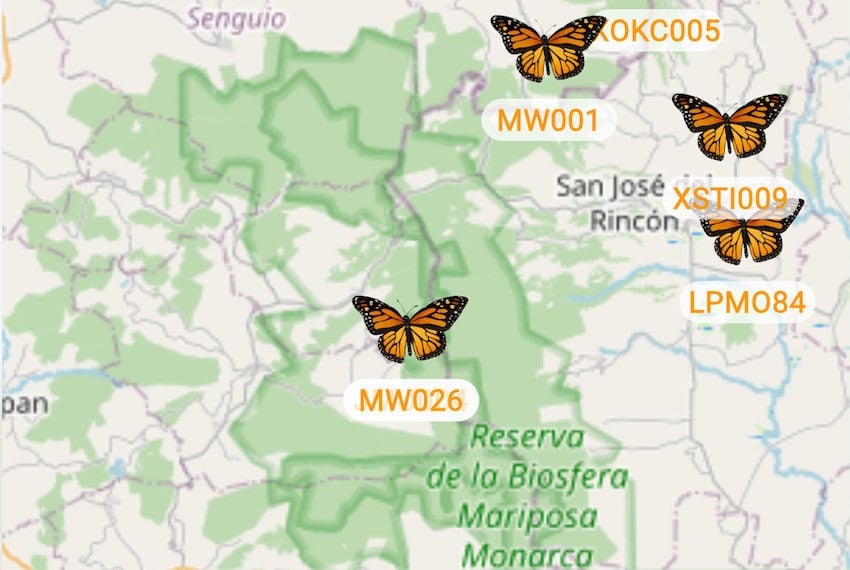
The first monarch butterflies tracked with solar-powered location tags have arrived in the oyamel fir forests of Michoacán, marking a scientific milestone for the conservation and study of their migration.
These early-arriving butterflies were released in late September in Lawrence, Kansas, in the United States, and traveled a migratory journey of more than 4,000 kilometers in 43 days.
During this time, they crossed Kansas, Oklahoma and Texas in the U.S. before entering Mexico through the state of Tamaulipas, where they sent out their first GPS signal in the country near the El Cielo Biosphere Reserve. From there, they continued through San Luis Potosí, Guanajuato, Jalisco, Querétaro and México state until reaching the Monarch Butterfly Biosphere Reserve, in the Sanctuary of El Rosario, Michoacán.
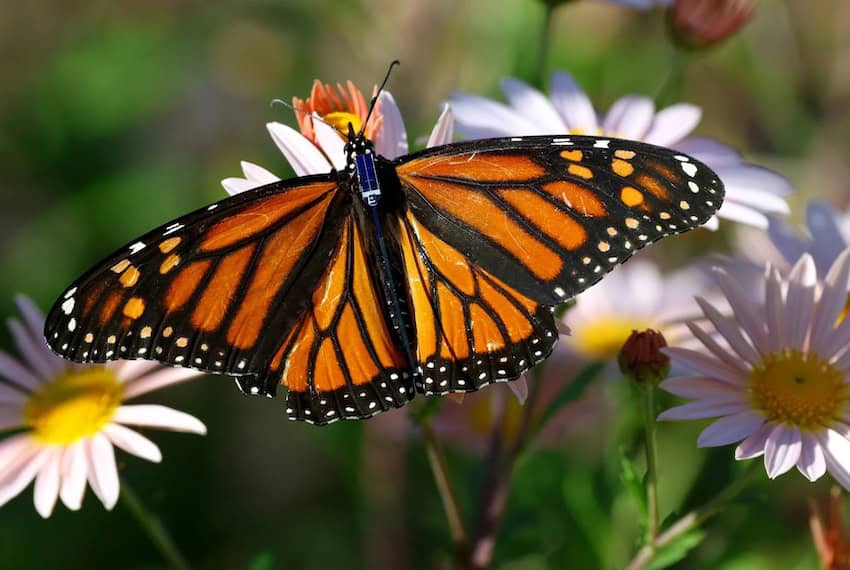
Weighing a mere 60 milligrams, the butterflies’ location transmitter is called BluMorpho and was developed by Cellular Tracking Technologies in collaboration with the Cape May Point Arts & Science Center.
Unlike existing insect-tracking models that can only be detected by special receivers, the novelty of this transmitter is that it uses the 2.4 GHz frequency, facilitating its connection with ordinary smartphones and computers.
This year, 500 butterflies have BluMorpho trackers, which were attached using a special adhesive that does not hinder their flight. With the data collected by the devices, researchers can gain a more accurate understanding of flight patterns, the butterflies’ length of travel and critical resting areas, as well as how these factors are altered by climate patterns.
Despite technological advancements, researchers have observed a drop in the number of butterflies that manage to reach Mexico to hibernate.

The primary causes, according to experts, are habitat degradation and extended drought conditions along their migratory route. Through GPS monitoring, scientists can now pinpoint these conservation challenges with greater precision, paving the way for more targeted and effective environmental interventions.
“With this technology, we saw this year how a monarch butterfly traveled along the east coast of the United States, passed through the Caribbean islands, and entered Mexico through Veracruz,” Jerónimo Chávez, member of the Profauna organization that helps track the specimens, explained to the newspaper El País.
Want to track the monarchs yourself? Check out the app Project Monarch on the App Store or Google Play.
With reports from Noticias Imer, La Jornada and El País