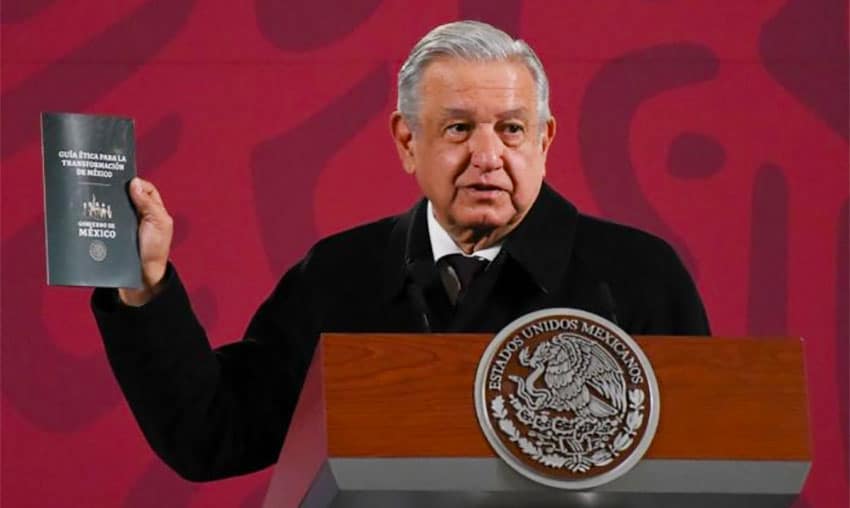
The federal government has published an ethical guide that suggests criminals and the corrupt “can redeem themselves through reflection, education and psychological therapy.”
“The crisis of Mexico is not just an economic crisis, it’s not just a crisis of material wellbeing,” President López Obrador said Thursday while presenting the Ethical Guide for the Transformation of Mexico.
“It’s also a crisis of the loss of cultural, moral and spiritual values. In recent times a whole process of degradation of public life arose – a decadence. To confront this degradation, this decadence, actions that improve material conditions aren’t enough; it’s also important to strengthen values and obtain wellbeing of the soul,” he told reporters at his morning news conference.
The president said the guide, which was drawn up by a committee of six people including his communications coordinator Jesús Ramírez, is similar to the Cartilla Moral, a 1944 booklet by celebrated Mexican writer and diplomat Alfonso Reyes, written at the request of the minister of education at the time.
The new guide was written “in light of the new times,” López Obrador said.
It contains teachings about 20 different values, principles and subjects including respect for difference, life, dignity, freedom, love, suffering and pleasure, the past and the future, gratitude, forgiveness, redemption, equality, truth, fraternity, laws and justice, authority and power, work, wealth and the economy, agreements, family, and animals, plants and things.
Redemption in the current day, the guide says, “means overcoming mistakes, awareness of wrongdoing and regret that implies recognition of guilt and intention not to commit a crime or immoral action again.”

It goes on to say, “From a humanist perspective, criminals and the corrupt can redeem themselves through reflection, education and psychological therapy.”
However, punishing criminals and the corrupt through means such as imprisoning them remains a possibility, the guide says.
The section on forgiveness says that he “he or she who grants it and he or she who receives it” is liberated, contending that people who forgive let go of pent-up bitterness, hate and the desire for revenge.
“To ask for forgiveness and to forgive are among the most difficult things in our relationships with others. There is a natural resistance to forgiving because he or she who does it humbles oneself, humiliates oneself or gives in,” the guide says.
“To ask for forgiveness if you acted poorly and to grant it if you were a victim of mistreatment, aggression, abuse [or] violence … will allow the release of guilt.”
López Obrador said that 8 million of the new ethical guides will be distributed to senior citizens across Mexico.
“The elderly, in a voluntary way, in their free time, can, if they want to, if they have the capacity to do so, pass on what this guide says to their children and grandchildren and analyze it with them … in order to strengthen our values.”
Source: El Universal (sp), El Financiero (sp), Reforma (sp)