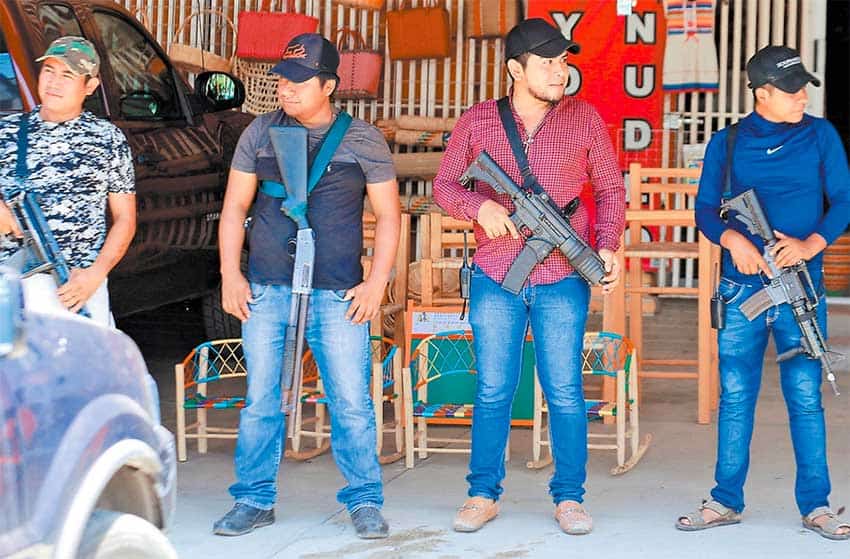
Representatives of community police forces that operate in 38 Guerrero municipalities and one in Puebla have spoken out against the entry of the national guard into their territory.
“The people of our communities don’t believe in a simple change of name or uniform of the police. There is no confidence that the national guard will work in favor of indigenous peoples and their communities,” said Sabrás Aburto, a spokesman for CRAC, an umbrella group of community police forces.
About 12,000 community police, or self-defense force members, operate in the Costa Chica, Tierra Caliente, Sierra, North and Central regions of the state.
Representatives told a press conference in the city of Tierra Colorada yesterday that their members won’t take orders from the national guard, whose creation has been approved by both houses of Congress and the legislatures of all 32 states.
“We say yes to coordination, no to subordination because our maximum authorities are at the community level,” they said.
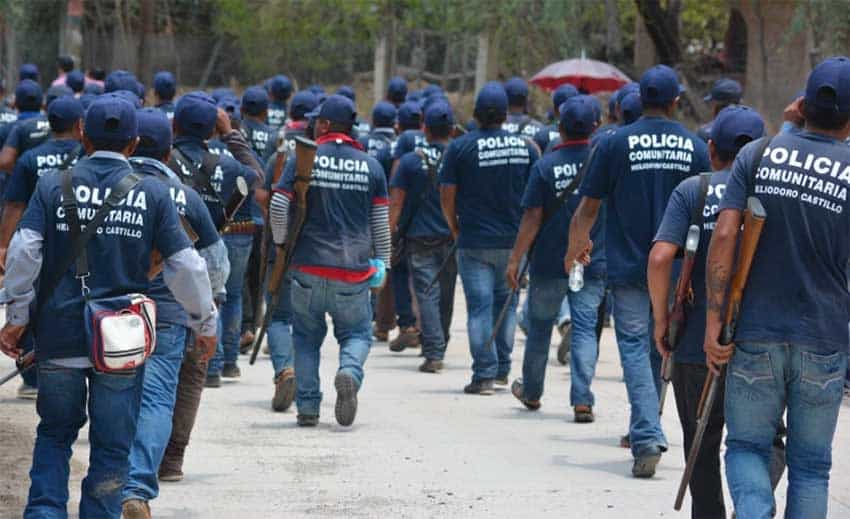
The representatives explained that they are opposed to the presence of the national guard in their communities because there is a history of complicity between federal security forces and criminal groups.
“State security forces have always been biased towards the government and the big crime bosses. It started many years ago and we don’t believe that it will change from one six-year term of government to the next,” they said.

They argued that the community police forces must be allowed to continue operating.
“We believe there is no reason why the government should proceed to disarm indigenous, Afro-Mexican or mestizo police who have been appointed at community assemblies to provide security,” they said, adding that municipal, state and federal security forces have been unable to guarantee the security of citizens in Guerrero.
If authorities attempt to disarm the police, the civilian population will step in to defend them, the representatives claimed.
“. . . If they attempt a disarmament, in a serious situation, people could even shoot. In any case, we will seek dialogue . . .” said Salvador Alanís Trujillo, a spokesman for the Guerrero Community Police Front.
Despite their opposition to the entry of the national guard – the centerpiece of the federal government’s public security strategy – the police representatives said they support and have confidence in President López Obrador.
“We declare ourselves in favor of the fourth transformation . . .” they said, referring to a term López Obrador uses to describe the profound change he says his government will bring to Mexico.
A total of 2,472 intentional homicides in Guerrero last year made the state the third most violent in the country.
Source: Milenio (sp)