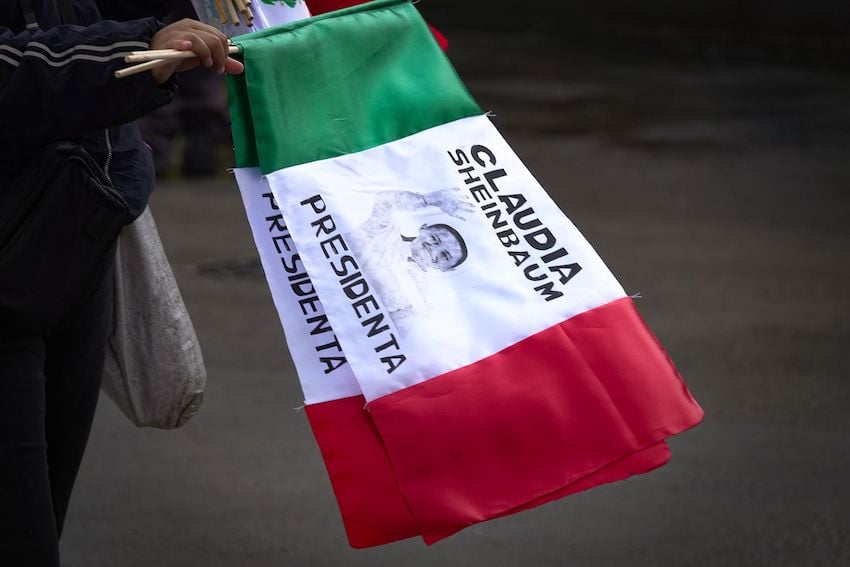
President Claudia Sheinbaum’s approval rating has declined to its lowest level since she took office, but Mexico’s first female leader is still extremely popular.
Those findings come from the latest Enkoll poll, conducted between Nov. 28 and Dec. 1 for the newspaper El País and Mexico City-based W Radio.

The poll of 1,201 Mexican adults at their homes found 74% approval of Sheinbaum’s performance as president, a decline of four points compared to the survey conducted by Enkoll in September.
The approval rating is the lowest detected by the eight national polls Enkoll has conducted since Sheinbaum took office on Oct. 1, 2024. It represents a decline of nine points compared to the president’s 83% approval rating in May, the highest of her term so far.
Enkoll’s latest poll also detected 24% disapproval of Sheinbaum’s performance, an increase of six points compared to the previous survey, and the highest level to date.
The decline in Sheinbaum’s approval rating is indicative — at least in part — of a difficult November for the president. On the first day of last month, Uruapan mayor Carlos Manzo was assassinated, triggering protests in the state of Michoacán.
The murder of the outspoken anti-crime crusader was also a major catalyst for large anti-government “Generation Z” protests that were held in cities across Mexico on Nov. 15.

Later in the month, truckers and farmers blocked highways across the country to protest insecurity on the national highway network, low purchase prices for crops and water legislation, which has now passed Congress.
Last Saturday, Sheinbaum led a rally in Mexico City’s central square, the Zócalo, to celebrate seven years of the fourth transformation (4T) political project, which officially commenced when former president Andrés Manuel López Obrador took office on Dec. 1, 2018. In part, the gathering was a response to the protests against the government last month, as well as the growing criticism of the Sheinbaum administration from opposition parties and others.
Sheinbaum is much more popular among older Mexicans than younger ones
Among the respondents to Enkoll’s poll who are aged 65 and older, 86% said they approved of Sheinbaum’s performance as president. Among those aged 55-64, the figure was 80%.
Mexico’s seniors are eligible for the federal government’s pension regardless of their wealth.
Separately, the Sheinbaum administration has created a new pension program for women aged 60-64, allowing them to receive a government payment every two months before they qualify for the old-age pension.
Among poll respondents aged 18-24 — i.e., members of Gen Z — only 61% said they approved of the president’s performance. Almost four in ten members of that cohort (37%) said they disapproved of Sheinbaum’s performance.
Among three other cohorts based on age, approval for Sheinbaum was as follows:
- 25-34: 70%
- 35-44: 79%
- 45-54: 69%.
Sheinbaum’s approval rating among women (75%) was slightly higher than among men (72%).
Among university-educated Mexicans, 60% said they approved of the president’s performance, whereas the figures were markedly higher among people whose highest level of educational attainment is primary school (81%), middle school (78%) and high school (71%).
Is Mexico’s ‘situation’ improving under Sheinbaum’s rule?
Asked whether “the situation of the country” has been improving or deteriorating since Sheinbaum took office in October 2024, 62% of respondents said it has been improving (48%), or that it remains as good as before (14%).
While 62% represents a strong majority, it is the lowest percentage detected by Enkoll polls during the term of the current government.
Around one-third of those polled by Enkoll in late November and early December — 34% — said that Mexico’s situation has been deteriorating under Sheinbaum’s rule (26%) or remains as bad as before (8%). The combined total of 32% is the highest detected since the government took office 14 months ago.
In terms of women’s rights, 79% of respondents said that Mexico’s situation is improving, while 75% said the same when asked to consider the government’s social support for citizens.
Sheinbaum has enshrined a range of rights for women in the Mexican Constitution, while the provision of support via welfare and social programs is a priority for her government.
Only 35% of those polled think that Mexico is improving in terms of its security situation, while 36% said that efforts to combat corruption are getting better. A majority of respondents said that Mexico’s security situation is worsening (51%), even though homicides have declined this year, and that efforts to fight corruption are deteriorating (54%).
One Morena party figure that has faced allegations of corruption and criminal association dating back to his 2019-2021 governorship of Tabasco is Senator Adán Augusto López Hernández, who also served as interior minister for two years during López Obrador’s presidency.
What is the Sheinbaum administration’s biggest achievement?
Asked to nominate the “main achievement” of Sheinbaum’s government, 38% of the respondents who approved of the president’s performance chose things that fall into the “social support” category.
They were:
- Social support: 14%
- Support for seniors: 13%
- The provision of scholarships: 9%
- Support for women: 2%.
Among the other top achievements cited by respondents were:
- The government has good proposals and works well: 7%
- The fight against insecurity: 5%
- Improving the Mexican economy: 3%
- Having a female president: 3%
- Perpetuating the fourth transformation initiated by ex-president López Obrador: 2%
What is the government’s biggest mistake?
Asked to nominate the government’s “main mistake,” 21% of respondents who disapproved of Sheinbaum’s performance chose things that fall into the “insecurity” category.
They were:
- A failure to combat insecurity and crime: 18%
- The government allying itself with drug traffickers or failing to stop them: 3%
Among the other “main” mistakes cited by respondents were that the government is:
- Not doing a good job: 11%
- Following the instructions left by López Obrador: 7% (The ex-president set much of Sheinbaum’s legislative agenda before he left office)
- Not combating corruption: 6%
- Demonstrating a lack of interest in the population: 5%
What is Mexico’s biggest problem?
Asked what Mexico’s “main problem” is, 45% of respondents cited insecurity. Within the same category, an additional 5% mentioned drug trafficking as the No. 1 problem, while 1% cited violence and organized crime. Thus, 51% of respondents believe that Mexico’s biggest problem is insecurity, drug trafficking or violence.
Grouped together, economic problems were cited as Mexico’s top concern by 20% of those polled. That percentage was comprised as follows:
- The economy/economic growth: 9%
- Lack of jobs: 5%
- Low salaries: 3%
- Poverty: 2%
- Inflation: 1%
Other respondents cited corruption (11%), “poor government” (5%) and medicine shortages (3%) as Mexico’s “main problem.”
Strong support for the 4T; majority has negative view of government’s response to Manzo’s assassination
Among the other findings of the latest Enkoll poll were that:
- 61% of respondents believe that Mexico’s situation has been better under the 4T governments of López Obrador and Sheinbaum than under previous PRI and PAN governments.
- 57% of respondents believe their personal situation has been better under 4T governments than under PRI and PAN governments.
- 42% of respondents believe that members of Generation Z were the main participants in the Nov. 15 protests (even though the majority appeared to be older people), while 36% think that members of groups opposed to the government were the largest cohort.
- 54% of respondents think that the recent protests will influence the government’s decisions a lot (31%) or somewhat (23%).
- 51% of respondents rated the federal government’s response to Manzo’s assassination as bad (29%) or very bad (21%).
- 34% of respondents believe that “all” the people responsible for Manzo’s murder will be punished, whereas 37% believe that only “some” of them will be held to account and 24% think that no one will be punished.
- 51% of respondents believe that the government’s “peace and justice” plan for Michoacán will be “very effective” (22%) or “somewhat effective” (29%), while 42% believe that it will be largely ineffective (28%) or not effective at all (14%).