A Senate bill meant to strengthen intellectual property protection has sparked controversy over possible digital censorship in Mexico, particularly as it could apply to parodies or satires aimed at the government.
The bill, sent to the Senate by President Sheinbaum in May and due to be voted on soon, entails amendments to the Federal Penal Code and the Federal Law for the Protection of Industrial Property (LFPPI).
The initiative is part of a broader set of reforms that, according to the federal government, aim to strengthen the criminal framework regarding intellectual property and align it with international treaties such as the United States-Mexico and Canada Agreement (USMCA).
Critics, such as PAN Senator Ricardo Anaya (in the video), have dubbed the bill the “Anti-Meme Law,” arguing that its wording could affect journalists, cartoonists, and content creators who use official elements in satirical works.
That same “Anti-Meme Law” moniker has also been applied to a separate but similar reform — an amendment to the Federal Copyright Law regarding the liability of internet service providers — currently under debate in the Chamber of Deputies.
Regarding the LFPPI, the opposition parties say they are concerned about the addition of Article 403 Bis, which establishes an offense related to the misuse of government identity.

The original wording penalized the commercial use of logos, domain names, graphic identities, or official symbols of governments and public bodies — including via digital means — to deceive people, with sentences ranging from three to seven years in prison and fines of up to 1.17 million pesos (US $65,000).
Following public criticism, voting committees amended the proposal by reportedly reducing the prison time to one to five years. More importantly, it was clarified that the offense would only apply to those who use the government’s image for commercial, deceptive, or fraudulent purposes.
Under the amended terms, content that uses an official logo or colors for satire, parody, criticism, or memes — and is easily recognizable as unofficial — would not constitute an infringement.
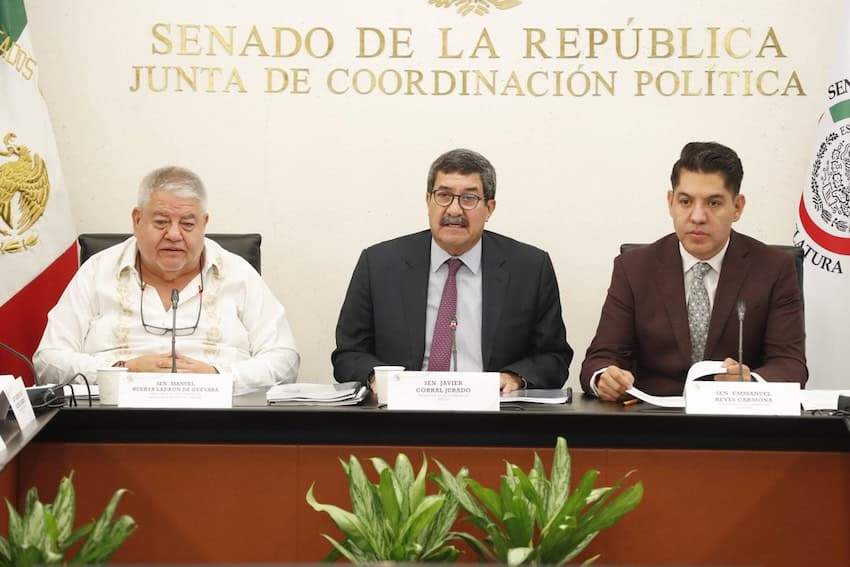
In a statement, Morena Senator Javier Corral said that the interpretation of the bill had been blown out of proportion.
“I want to reject the idea that jail time is being proposed for memes or parodies, and to clarify that this provision has nothing to do with regulating freedom of expression. That is not the case,” he said.
“The wording we are now proposing not only eliminates any ambiguity but specifically seeks to establish that the act of misleading or deceiving one or more persons [through the use of government logos] must have the commission of an unlawful act as its purpose.”
It is anticipated the bill would be approved under the new terms.
With reports from El Universal, Eje Central, and El Financiero