Drone footage shows tonnes of sargassum have accumulated on the beaches of Playa del Carmen, in the southeastern state of Quintana Roo.
However, as of June 18, there are beaches in Cancún — about an hour’s drive north along the Caribbean coast from Playa del Carmen — that are free of sargassum, according to local media.
Les comparto como luce Playa las Perlas en #Cancún🌊🏖️.
¡Un gran destino para disfrutar! Recuerden que #NiTodosLosDíasNiEnTodasLasPlayas hay sargazo en Quintana Roo. pic.twitter.com/cD1l3urr9I
— Mara Lezama (@MaraLezama) June 14, 2025
Though possibly temporary, that absence is welcome news; in recent weeks, a significant increase in the noxious seaweed had been reported on the Riviera Maya’s shoreline, due to changing weather conditions, marine debris and various other factors.

Overall, on June 5, the Navy Ministry reported that 4,236 tons of sargassum had been collected from the beaches of Quintana Roo.
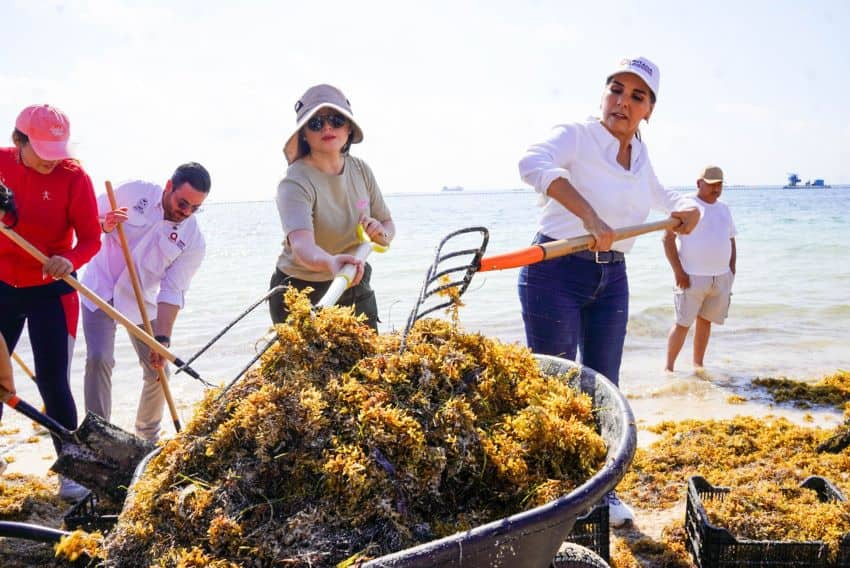
The Cancún City Council posted on its social media this week that it has launched a program called “Clean Cancún.” Working with volunteers, public services and the Federal Maritime-Terrestrial Zone (Zofema), it seeks to clean any sargassum that accumulates on the beaches of Benito Juárez (the municipality to which Cancún belongs).
Per Benito Juárez officials, Cancun’s currently pristine beaches notably include Marlín Beach and Las Perlas Beach. Quintana Roo Governor Mara Lezama proudly posted on X photos of the noticeably sargassum-free Las Perlas in her jurisdiction.
The Mexican Navy (Semar) is also conducting the 2025 Sargassum Response Strategy along the entire coast of Quintana Roo. One of the key elements of this program is coastal containment, which consists of installing barriers on beaches with a high incidence of grounding.
These structures use currents, waves and wind direction to redirect sargassum to specific points for extraction by manual or mechanical equipment. So far, 7,545 meters of containment barriers have been installed in the following municipalities:
Puerto Morelos: 2,310 meters
Playa del Carmen: 2,580 meters
Mahahual: 2,265 meters
Tulum: 390 meters
¡Playa del Carmen lucha contra el sargazo con todo! 💪🌊🧹 Brigadas, Marina y ciudadanos se unen para salvar las playas del Caribe mexicano 🏖️🇲🇽 ¡Más de 11 mil toneladas recolectadas! ♻️🟢https://t.co/hUrvN6NjmB pic.twitter.com/DLgigM1cRv
— 🔴 ESPACIO (@EspacioNoticias) June 18, 2025
Sargassum is a brown seaweed notorious for its negative effects on ecosystems, tourism and public health. It has indirect consequences for human health when it decomposes, releasing ammonia, methane and sulfuric acid. When it rots, it creates a sludge called “brown tide,” which reduces sunlight penetration and lowers oxygen levels in the water.
Such efforts to defend Mexico’s beloved Caribbean coast may soon be tested. Researchers from the National Autonomous University of Mexico (UNAM) have warned that some 100,000 tonnes could reach the Mexican Caribbean this year. Meanwhile, the Quintana Roo Sargassum Monitoring Network anticipates an increase of 40% (35,000 tonnes) compared to 2024, when some 25,000 tonnes were collected.
With reports from El País, Excelsior, Heraldo Quintana Roo and El Economista