A video that shows explosives being dropped on a civilian encampment in a forest in Michoacán has been posted to social media, one of multiple attacks on civilians in the Tierra Caliente municipality of Tepalcatepec on Monday.
The footage was filmed by a drone from which the explosives were believed dropped by members of the Jalisco New Generation Cartel (CJNG), who were allegedly operating the unmanned aerial vehicle.
The attack was carried out against an encampment of displaced people from the violence-plagued community of El Bejuco, said the newspaper El Universal.
The footage shows people running for their lives after the first explosion. Three more explosives are dropped from the drone, sparking fires in the forest. At least one person was injured, the newspaper said.
About halfway through the video, the pictures begin spinning wildly – a blurry, vertigo-inducing phenomenon that continues until the footage concludes. The cause: the drone was brought down by the camp dwellers and local authorities, El Universal said.

They were able to seize the drone’s footage, which later made its way to social media.
The CJNG is accused of perpetrating other attacks in Tepalcatepec on Monday, including one in El Bejuco. Another video posted to social media shows two heavily armed residents – members of a local self-defense group, according to the newspaper El País – hiding behind trees as a CJNG commando fires in their direction. Apparently knowing that they were outgunned, the residents fled.

The ensuing footage, which shows the two men making their escape through a forest, was described by El País as an “adrenaline rush” with “distorted and rapid images of branches and dry leaves” accompanied by a soundtrack of “omnipresent” gunfire.
Tepalcatepec is one of several municipalities in the Tierra Caliente region of Michoacán where the CJNG is engaged in a turf war with rival group Cárteles Unidos.
According to InSight Crime – a foundation dedicated to the study of organized crime – Cárteles Unidos is a criminal organization born out of an alliance between the Cartel de Tepalcatepec, Los Viagras and other groups intent on combating the advances made by the CJNG in Michoacán.
Tepalcatepec Mayor Martha Laura Mendoza last week appealed to federal and state authorities for help to combat insecurity.
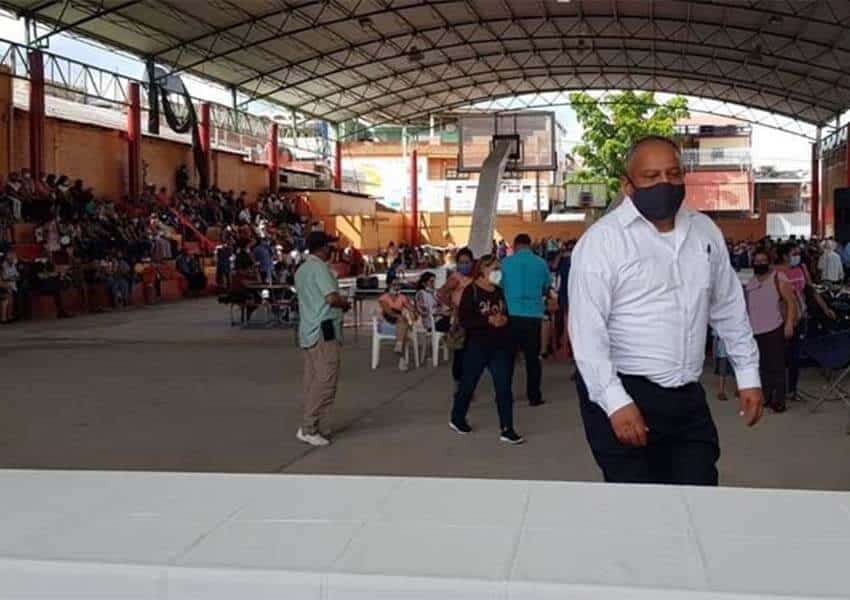
“… We’ve now had four months of insecurity, [but] nobody turns around to see [what’s happening]. … This is the only municipality where there are more than 3,000 displaced people,” she said. “Four months and … nobody provides a solution.”
The CJNG has carried out numerous recent attacks in the Tierra Caliente region of Michoacán, including other offensives in which they have used drones equipped with explosives.
Five men were decapitated after being murdered by CJNG members during a lengthy offensive in Tepalcatepec last September, while there was a series of attacks in the same municipality in November.
A cell of the Jalisco Cartel attacked the municipal seat of Chinicuila with explosive-carrying drones last December, spreading terror through the community before the National Guard responded and drove the attackers out of town.
Among the other Tierra Caliente municipalities where violence is a major problem are Coalcomán and Aguililla, where CJNG leader Nemesio “El Mencho” Oseguera Cervantes was born and raised.
Authorities have been accused of doing little to combat the high levels of violence in the region, and residents protested last September to demand military intervention to combat organized crime.
A month later, the federal government announced the deployment of 17,000 additional National Guard troops to the state, but as Monday’s offensive shows, little has changed in the Tierra Caliente, which borders two other violent states: Jalisco and Colima.
In terms of total homicides, Michoacán was the third most violent state in the first 11 months of last year with more than 2,200 victims. The only states with more murders were Guanajuato and Baja California. The CJNG, generally considered Mexico’s most powerful criminal organization, also operates in those states as well as many others across the country.
With reports from El Universal and El País