Jalisco looks set to become the 13th state in Mexico to decriminalize abortion after a federal court ruled against state laws that prohibit the voluntary termination of a pregnancy.
Reproductive rights group GIRE announced the ruling on social media on Thursday night, saying that a criminal court in the Guadalajara metropolitan area determined that articles in the state’s criminal code that “absolutely prohibit voluntary abortion” are unconstitutional.
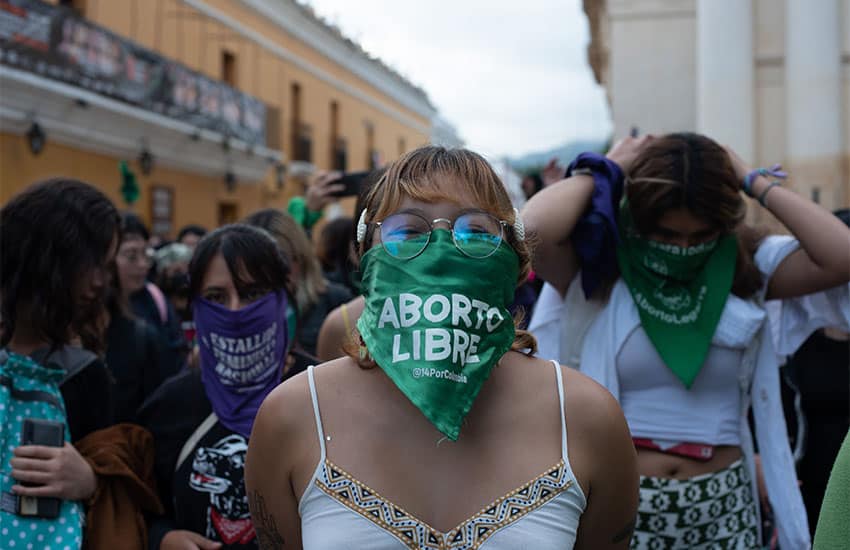
GIRE said that the court also determined that the Jalisco Congress must repeal laws that make abortion a crime.
The ruling — made in response to an injunction request filed by GIRE and six other organizations — came after the Mexican Supreme Court (SCJN) ruled in September 2021 that the criminalization of abortion is unconstitutional, setting a precedent for the legalization of early term abortion across Mexico.
Last September, the SCJN decriminalized abortion at the federal level, which prevented states from criminalizing medical personnel who provide abortion services.
Despite those rulings, only 12 of Mexico’s 32 states currently allow voluntary early-time abortion in all cases.
Abortion was legal in four states — Mexico City, Oaxaca, Hidalgo and Veracruz — at the time of the Supreme Court’s 2021 ruling, while an additional eight states have approved decriminalization since then. They are Coahuila, Baja California, Colima, Sinaloa, Guerrero, Baja California Sur, Quintana Roo and Aguascalientes.

GIRE said that the “achievement” in Jalisco is “part of a national legal strategy” aimed at preventing the criminalization of “any woman, trans man or non-binary person” who has an abortion as well as medical personnel and anyone else present at the time of the procedure.
The organization called on courts to rule on its injunction requests against state criminal codes in accordance with the “criteria and precedents” established by the Supreme Court in order to move toward “the recognition of abortion as an essential health service.”
Isabel Fulda, a deputy director of GIRE, told the El País newspaper last September that injunction requests aimed at the decriminalization of abortion had been filed in all states where the medical procedure hasn’t been legalized.
Se despenaliza el aborto en Jalisco por vía judicial.
¡Ya son 13! #AbortoLegalJalisco 💚 💚 💚 pic.twitter.com/BhDDbUKIr3— GIRE (@GIRE_mx) April 25, 2024
She said at the time that Mexico’s “most conservative states” could avoid the “political cost” of decriminalizing abortion because they would be simply acting in accordance with Supreme Court rulings.
Fulda also said that many states — even ones where abortion has been decriminalized by local legislatures — lack supplies and training for medical personnel to offer adequate abortion services.
“Implementation is still the big pending issue,” she said. “There is a big gap between whether abortion is allowed and whether it can actually be done.”