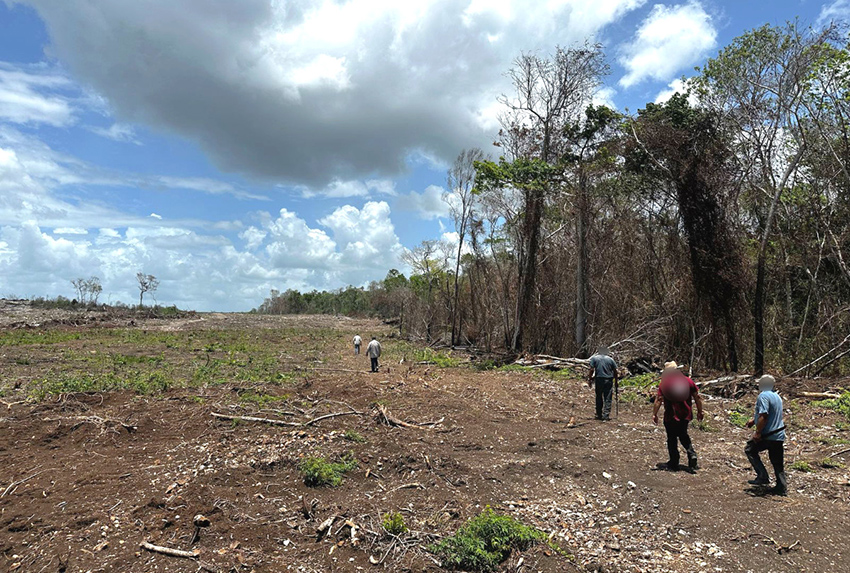
The Federal Attorney for Environmental Protection (Profepa) announced on Sunday that it is in the process of filing seven criminal complaints against Mennonite communities after more than 2,600 hectares of forest lands were illegally cleared in southeastern Mexico.
Profepa plans to charge the Mennonite groups with unauthorized land-use over the seven properties in the states of Yucatán, Campeche, and Quintana Roo where inspectors discovered the removal of trees and other vegetation.
🚫 Por el desmonte ilegal de 39.6 hectáreas de selva, en Tekax, Yucatán, la Profepa clausuró un predio que ya tenía camino nivelado y una superficie aplanada con maquinaria pesada. 🌳
🚜 Todas las actividades de cambio de uso de suelo fueron detenidas y estamos trabajando en el… pic.twitter.com/6EIwTE7xsf
— PROFEPA (@PROFEPA_Mx) July 7, 2025
The authorities closed off the properties in late June after Profepa’s May 28-June 14 investigation revealed the extent of the damage.

Profepa’s Office of Natural Resources Litigation and Environmental Justice and the Special Prosecutor’s Office for Environmental Crimes (FEIDA) in the Federal Attorney General’s Office (FGR) are taking the lead in the criminal case.
“[The lead agencies] have already filed two criminal complaints related to the violations identified,” Profepa told the newspaper El Economista, adding that five more cases will be filed.
If found guilty of violating land-use regulations and destroying flora in natural protected areas, the defendants could be sentenced to prison and/or have their property confiscated.
Three of the seven properties identified are in Quintana Roo, totaling 1,300 hectares, two are in Campeche (702 ha) and two are in Yucatán (606.4 ha), and all are within a region where Mennonite populations have been expanding. The Mennonites, an Anabaptist Christian community that dates back to the 16th-century Reformation, has had a presence in Mexico since the 1920s, mostly in the state of Chihuahua.
The inspections found that the Mennonite communities had clear-cut several native jungle trees and other plants listed as native species at risk, including mahogany, Thrinax radiata (Florida thatch palm) and Zumaia loddigesii (a species of orchid). Additionally, Profepa seized 108.5 square meters of round and square timber.
🚧 Del 28 de mayo al 14 de junio, inspectores de la Profepa realizaron operativos intensivos en predios forestales ubicados en Campeche, Yucatán y Quintana Roo, lo que derivó en la clausura de 7 predios por la remoción de vegetación y el cambio de uso de suelo en terrenos… pic.twitter.com/nXfmCkJn9B
— PROFEPA (@PROFEPA_Mx) June 30, 2025
“The Mennonites in Yucatán are genuinely a very serious environmental problem,” Environment Minister Alicia Bárcena said last month, adding that some members of the group had brandished weapons in an attempt to prevent the authorities from inspecting their properties.
In addition to the damage to the flora, environmental activists complained that the clear-cutting and the Mennonites’ heavy use of pesticides has caused a massive die-off of bees in the Yucatán Peninsula.
This prompted the Environment Ministry (Semarnat) to establish a program with local Indigenous communities and apiarists to protect the bee communities in the region, the Diario de Yucatán reported.
Óscar Rébora, the Quintana Roo environment minister, told El Economista that his office is working with Profepa with regard to an eighth property.
“We’re looking for a strategy to evict [the Mennonites] and restore the damaged properties,” he said.
However, restoration efforts might not work since the pesticides the Mennonites are using are very harsh on the soil, Rébora said.
Bárcena also criticized the groups for their excessive use of pesticides, though she admitted the pesticides are not illegal. “But they ought to be,” she said.
With reports from El Economista, Aristegui Noticias and Diario de Yucatán