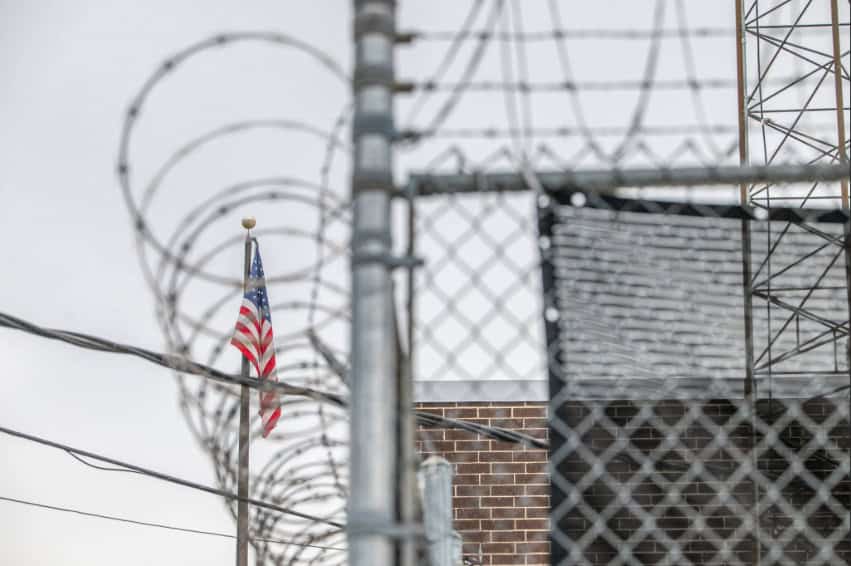
Last week, 56-year-old Emiliano Andrade-Covarrubias, a Dallas resident of decades and lawful green card holder, died at the Rio Grande Processing Center in Laredo, Texas. His daughter says staff at the center would not give him his heart, diabetes and blood pressure medications, and that he told her they ignored him when he reported trouble breathing and tightness in his chest. The Webb County Medical Examiner is performing his autopsy, and no cause of death has been released. He is the 18th Mexican national to die in U.S. immigration custody or during enforcement operations since January 20, 2025.
For those of you keeping track, that is 15 deaths of Mexican nationals in custody and 3 during enforcement operations — 18 in total since Trump took office for a second time. Human Rights Watch counted 52 deaths of people of all nationalities in ICE custody in the 500 days between January 20, 2025, and June 4, 2026, roughly three a month. AFP reports that at least 30 people died in U.S. migrant detention centers last year, the most since ICE was created.

It’s easy to write off the 18 deaths as statistics or soundbites in the daily news cycle. It’s easy to say they were “criminals that shouldn’t have been here in the first place.” So let’s look at the facts, drawing on a recent profile conducted by CNN.
- All 18 were men. The youngest was 19, the oldest was 68.
- Some had spent decades in the U.S. ICE says one entered in 1976, and another had lived here about 35 years, worked in construction and had three U.S. citizen children. Andrade-Covarrubias lived in Dallas for decades. Others arrived recently: ICE says one entered in 2022 and another in December 2023.
- ICE’s own descriptions of their records vary widely. One was sentenced in 2005 to 20 years for attempted sexual contact with a minor. Others were detained for driving without a valid license, littering or public intoxication. For several, CNN’s profiles cite no criminal charges or record.
- The 17 deaths CNN profiled occurred in at least 8 states. This suggests a pattern rather than a single “bad cop” or rogue department. The Department of Homeland Security denies that deaths in its facilities have increased and says detainees receive proper medical treatment.
There are an estimated 38 million people of Mexican origin living in the U.S. today. Given the current environment in the country, many in this community have a relative, friend or neighbor who is living in fear or has been mistreated.
Latino voters also helped elect the current administration. Trump won 46% of the Latino vote in 2024, according to exit polls, up from 32% in 2020. Pew research finds that approval among Latino voters who backed him has since fallen 27 points, to 66%. These figures cover Latino voters broadly, not Mexican-Americans specifically.
The key issue I am raising here is about how people should be treated.
This is not about whether one belongs to the left or right political party, or about opposing border control. I am not suggesting that a country shouldn’t enforce its borders. Of course it should. The border has not always been secure, and immigration policy has often been applied inconsistently or unfairly, if at all. Those convicted of crimes should be punished. Overstaying a visa is a violation of federal immigration law and should have consequences.

The issue is how people are treated once the government has them in its custody. Many Americans who agreed that “something needed to be done” have been repulsed by ICE tactics in their communities. U.S. politicians have not agreed on updated, sensible immigration policy in decades. But whatever the policy, a person in federal custody is the government’s responsibility. We have all read about ICE signing bonuses, hiring sprees, pressure to meet arrest quotas, the lack of collaboration with local authorities and expedited, insufficient training.
Consider the reverse. If one American were dying in a foreign government’s custody nearly every month, we would expect State Department warnings, a drop in tourism and a damaged reputation for that country. The comparison is not about crime or illegal migration. It is about deaths in the custody of a state. That is why Mexico’s government has demanded investigations and filed criminal complaints with U.S. prosecutors.
Many readers will hear “Americans killed in Mexico” and think of drug violence. That is a different matter. These deaths happened in government custody, under government responsibility. That is the standard we would demand for our own citizens abroad.
Neighbors, not enemies
Many Americans have Mexican neighbors and workers they value and live alongside. Many of those same Americans now feel anger over rising costs and failing institutions and leadership, on both the left and the right. In recent polling, nearly eight in 10 Latino voters said they were “very concerned” about the cost of food and consumer goods, above the roughly two-thirds of Americans overall.
Directing that anger at each other is a mistake. Americans can be forgiven for being overwhelmed by inflation, gas prices, interest rates, midterms, job-loss fears and AI risks. But whatever our views on immigration, we should not lose sight of how people are treated while they are in the government’s care.
What you can do
- If you are an American living in Mexico, try to understand the anger that locals might have towards the United States. Mexicans are watching their citizens die in U.S. custody, and their government has condemned the deaths and begun filing complaints with U.S. prosecutors. That anger is aimed at a policy and likely at government officials, not at you. It’s important to listen and acknowledge their frustrations.
- Write to your senators and congresspeople. Tell them the “how” of enforcement matters: medical care, transparency and accountability for deaths in custody are minimum expectations. Our immigration policy needed to change. Most people accept that now, but roughly three people dying in federal custody each month should make us all ask what is going on.
- Write to MND. We invite you to write us about how you see this issue where you live, or experiences you have had talking to locals in Mexico about this issue.
I sincerely hope that this will be seen not as a Republican or Democrat issue but one of basic human rights and decency, and as a result, be acted on quickly before there are more tragic incidents.
Travis Bembenek is the CEO of Mexico News Daily and has been living, working or playing in Mexico for nearly 30 years.