The largest drug bust of the current government recently occurred when the Mexican Navy seized 5.6 tonnes of suspected cocaine and arrested 15 people after a high-speed chase off the coast of Colima.
A video released by the navy shows go-fast boats speeding across the water before the suspected smugglers were detained. A navy helicopter tracks the vessels.
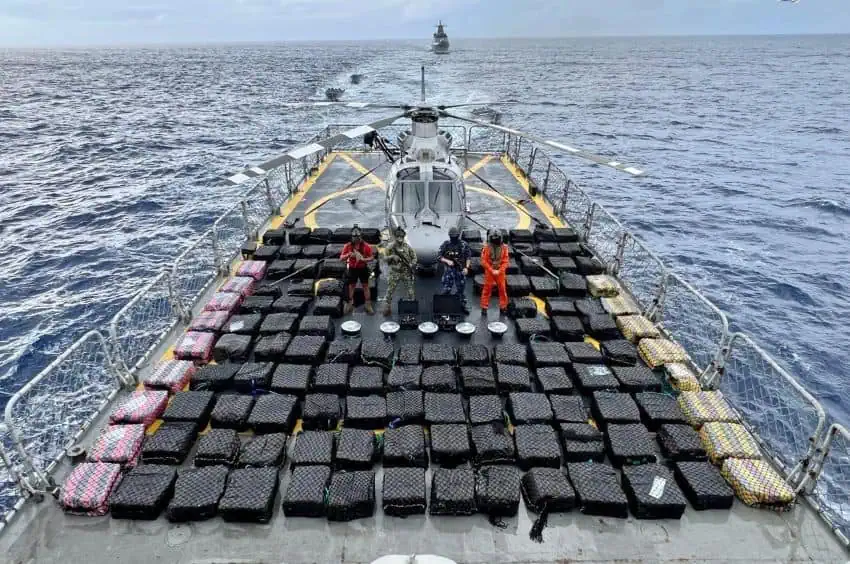
The Naval Ministry (SEMAR) said in a statement last Friday that personnel on board a navy vessel and supported by a Panther helicopter seized 126 packages containing 5.6 tonnes of “presumed” cocaine after intercepting three speedboats in the Pacific Ocean southwest of Manzanillo, Colima.
That quantity of seized narcotics “represents the biggest confiscation in a single event during the president’s administration,” SEMAR said in reference to the 2018-24 period of government. Photos of the illicit haul were posted to the navy’s social media accounts.
SEMAR said that 1,100 liters of fuel were also seized and 15 “alleged lawbreakers” were detained. The suspects and their illicit cargo were taken ashore and turned over to the Federal Attorney General’s Office, SEMAR said. It didn’t identify the detainees or disclose their nationalities.
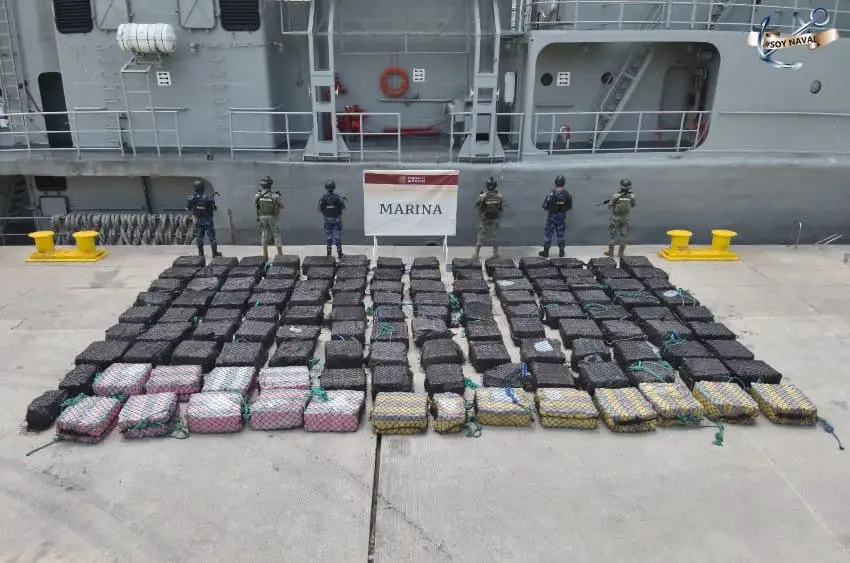
In a “second event” outlined in the same statement, the Navy Ministry said that navy personnel seized an additional 32 packages of “presumed” cocaine adrift in the Pacific Ocean southwest of Lázaro Cárdenas, Michoacán.


Those packages — seen toward the end of the navy video — weighed approximately 1.6 tonnes. Navy personnel also seized a “small vessel” with three outboard motors. No arrests were reported.
SEMAR didn’t specify when the two drug seizures took place, saying only that they occurred in recent days.
The navy frequently seizes narcotics at sea. Among its seizures this year was a 1.5-tonne cocaine confiscation off the Pacific coast of Guerrero in July, a 3-tonne cocaine bust off the Caribbean coast of Quintana Roo in May and an almost 2-tonne cocaine interdiction off the Pacific coast in April.
Organized crime groups use a variety of transportation modes to move cocaine from South America to Mexico and then into the United States.
According to the United Nations Office on Drugs and Crime, “cocaine is typically transported from Colombia to Mexico or Central America by sea and then onwards by land to the United States and Canada.”
In a 2021 report, the Organization of American States outlined seven maritime drug trafficking routes between South America and Mexico or Central America. Five of those routes terminated in Mexico, including in the states of Chiapas, Guerrero and Sinaloa.
Mexico News Daily