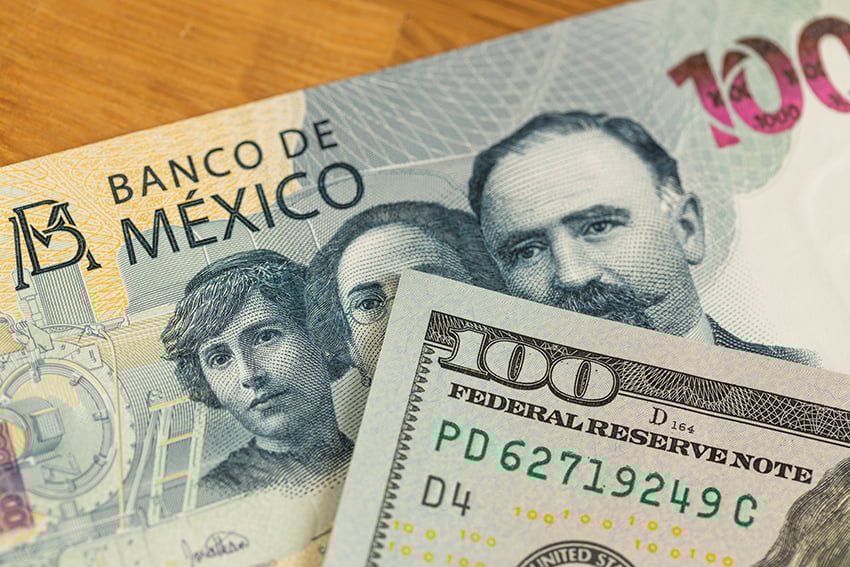
Last year was a good one for the Mexican peso, as it ranked among the world’s best-performing emerging market currencies in 2025.
Mexico’s currency closed the year around 18 pesos per dollar, with an appreciation of close to 14% against the greenback — its best performance since before 1994, when the current free-floating exchange rate regime was established.
Before that, the next-best year was 2023, when it appreciated 13% against the dollar, largely due to the Bank of Mexico maintaining a restrictive monetary policy for an extended period. This approach allowed speculative positions favoring the Mexican peso to continue accumulating, as investors anticipated an attractive interest rate differential compared to other economies.
In the broader landscape of major currency pairs, the Mexican peso stands as the sixth best-performing currency in 2025. The top five include the Russian ruble at 30.4%, the Hungarian forint at 17.6%, the Swedish krona at 16.7%, the Czech koruna at 15.5%, the Colombian peso at 14.3%, and the Mexican peso at 13.8%.
In contrast, the currencies that depreciated the most against the dollar were the Argentine peso with 40.8%, the Turkish lira with 21.5%, the Indian rupiah with 5%, the Indonesian rupiah with 3.4%, and the Hong Kong dollar with 0.2 percent.
A little help from the dollar
The superpeso’s comeback is not entirely attributable to domestic factors. The dollar, as measured by the dollar index, has fallen steeply amid interest rate cuts by the Federal Reserve, fiscal concerns and President Donald Trump’s trade policy.

Mexican stocks end a banner year, even outperforming Wall Street
“As long as the dollar does not regain clear momentum and Mexico’s macroeconomic data remains solid, this range can continue to function as an equilibrium zone for the exchange rate,” Diego Albuja, market analyst at the broker ATFX Latam, said in a report.
Structural factors such as nearshoring, foreign direct investment and the resilience of Mexican exports also bolstered the demand for the Mexican peso.
“In the case of Mexico, the peso has found support in the resilience of economic activity and in the expectation that the interest rate differential will remain attractive, even as the market begins to discount gradual adjustments in U.S. monetary policy in 2026,” Albuja added.
Meanwhile, Felipe Mendoza, CEO of IMB Capital Quants, told the newspaper El Economista that President Claudia Sheinbaum’s foreign policy has helped prevent sudden changes.
“Claudia Sheinbaum’s messages reiterating a diplomatic stance regarding the crisis between the United States and Venezuela, and her confidence that the USMCA review will prevail over scenarios of a breakdown, help to anchor expectations and prevent abrupt movements,” Mendoza said, adding that the structural weakness of the dollar and the still-attractive interest rate differentials compared to developed economies are also boosting the peso.
With reports from El Economista and Proceso