
Most of Mexico is in the grip of a “firearms pandemic,” Foreign Affairs Minister Marcelo Ebrard said Thursday.
Speaking in Mexico City at a conference on arms trafficking, Ebrard said that authorities have seized almost 56,000 guns since the beginning of 2020. He indicated that significant numbers of weapons have been confiscated in the vast majority of states.
“There are states in the republic, Yucatán and Oaxaca for example, where we’ve found very few [guns], except for in one part of the Isthmus [of Tehuantepec],” he said, referring to a region of the latter state.
“Outside there and the mountains of the north [of Mexico], our entire country is going through a firearms pandemic of different degrees of intensity,” Ebrard said.
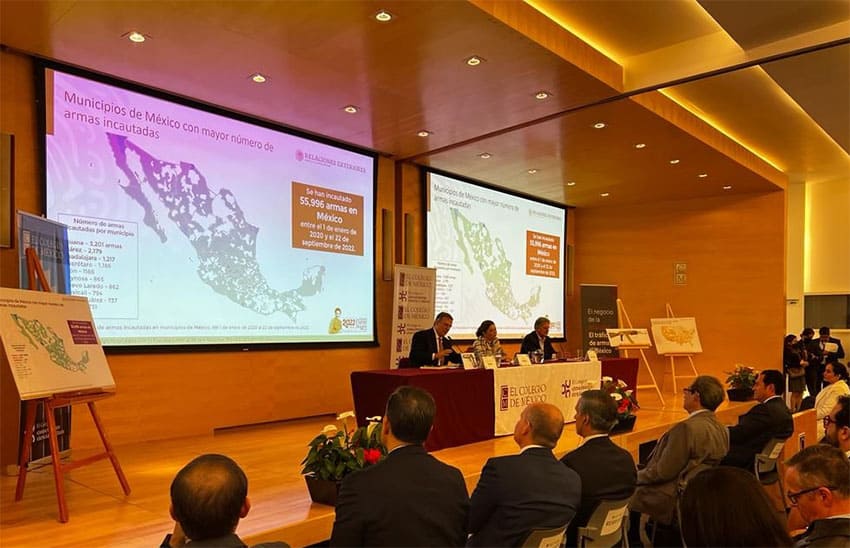
The foreign minister presented a map that showed where high numbers of guns were seized between January 1, 2020 and late September 2022. More than 3,200 firearms were confiscated in Tijuana — one of Mexico’s most violent cities — while almost 2,200 were taken off the streets of Ciudad Juárez.
Over 1,000 weapons were seized in three other cities — Guadalajara, Querétaro and León — while Reynosa (865), Nuevo Laredo (862), Mexicali (794), Cancún (737) and Celaya (731) were also hotspots for firearm confiscations.
Ebrard said it was no surprise that so many weapons were seized in Tijuana given that the border city has one of the highest murder rates in the country. He reiterated his view that the United States needs to do more to stop the flow of firearms into Mexico, asserting that combating the smuggling of guns can help the government to achieve its goal of further reducing homicides.

Ebrard said late last year that reducing violence in Mexico will be very difficult if the United States doesn’t do more to stop the illegal flow of weapons into the country, while he asserted last month that U.S. authorities should be checking vehicles leaving that country with the same thoroughness as they check those entering the U.S.
The foreign minister suggested Thursday that stopping the southward flow of weapons is a far easier task than combating the entry of drug precursors to Mexico and the northward flow of narcotics to the United States.
“The effort the United States has to make to drastically reduce the flow [of firearms] to Mexico is very small compared to the effort Mexico has to make to control precursor chemicals and [the flow of] drugs that reach the United States,” Ebrard said.
“… In other words, we’re not asking them to carry out a huge, difficult, complex, almost impossible operation,” he said.
After attending high-level security talks with United States officials in Washington last month, Ebrard said that Mexico and the U.S. had “a common plan for 2023: … to drastically reduce the trafficking of weapons to Mexico and … to increase controls on precursor chemicals and the movement of fentanyl [to the United States].”
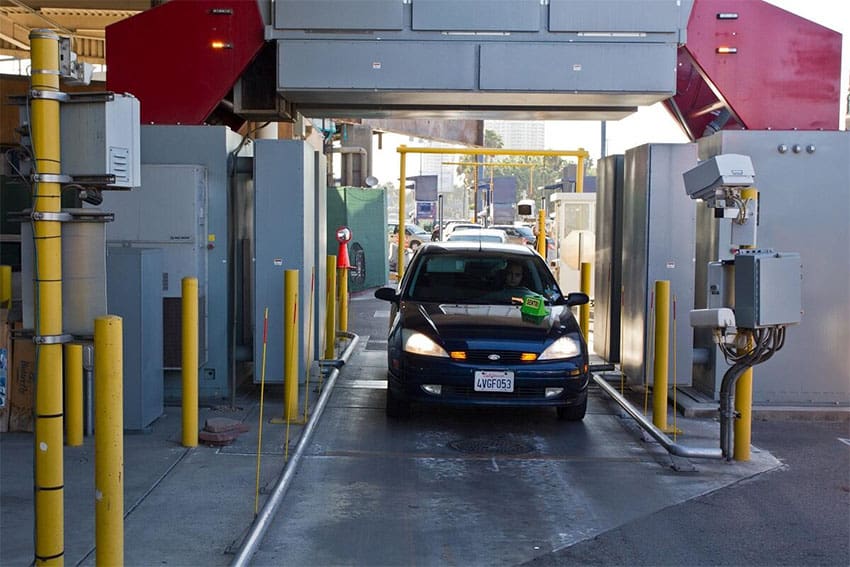
The federal government believes that more than 200,000 guns are smuggled into the country each year, meaning that for every firearm seized since 2020, about 10 crossed the border into Mexico.
Official data published by the newspaper Milenio this week shows that Mexican and U.S. authorities seize just a tiny fraction of that number at the two countries’ shared border. U.S. Customs and Border Protection data shows that that agency confiscated just 982 firearms during the 2022 U.S. fiscal year, which ended September 30.
Mexican customs officers seized just 416 guns in northern border states during the same period, meaning that authorities of both countries confiscated a grand total of 1,398 firearms during 12 months — 0.7% of the estimated 200,000 weapons that flow into the country annually.
Ebrard asserted Thursday that Mexican authorities “won’t allow” U.S. firearms seizures to remain so low, and suggested that Mexico could even pay for equipment to facilitate inspections of Mexico-bound vehicles. “I hope it doesn’t get to that, that we’ll reach some agreement,” he said.
President López Obrador and U.S. President Joe Biden said in a joint statement earlier this year that Mexico and the U.S. are “committed like never before to completing a multi-year joint U.S.-Mexico border infrastructure modernization effort for projects along the 2,000-mile border.”
Mexico committed to invest US $1.5 billion on border infrastructure while the U.S. pledged $3.4 billion for projects at its southern and northern borders. Those investments should improve both countries ability to detect illegal goods such as weapons and drugs.
In addition to pressuring the United States government, Mexico is seeking to hold U.S. gun manufacturers and vendors to account for the role they play in illegal arms trafficking. The federal government announced last month that it would appeal the dismissal of its lawsuit against United States gun manufacturers, which it accuses of negligent business practices. It has also filed a separate suit against five gun stores in Arizona, accusing them of involvement in illegal arms trafficking to Mexico, where firearms are used to commit tens of thousands of homicides annually.