Inflation continues to rise in Mexico, with the annual headline rate approaching 5% in the first half of March.
The national statistics agency INEGI reported on Tuesday that the annual headline inflation rate was 4.63% in the first 15 days of the month, up from 4.02% across February. Compared to the second half of February, inflation was 0.62% in early March.
It appears almost certain that inflation will rise for a third consecutive month in March, after increases in both January and February.
The annual headline rate reported by INEGI on Thursday came in well above the 4.37% median forecast of analysts polled by Bloomberg.
INEGI also reported that Mexico’s annual core inflation rate in the first half of March was 4.46%, down from 4.50% across February. That reading excludes inflation for food and energy, whose prices tend to be volatile.
The publication of the inflation data for the first half of the month comes just two days before the Bank of Mexico (Banxico) board will decide whether to cut, maintain or increase the central bank’s benchmark interest rate, which is currently set at 7%. The bank targets 3% inflation with tolerance of a 2-4% range.
In a post to X on Tuesday morning, the director of economic analysis at Banco Base, Gabriela Siller, wrote that the Bank of Mexico “should be cautious” and maintain its key interest rate at 7% after its board’s monetary policy meeting this Thursday.

Ahora que la inflación se disparó por la guerra en Irán y por la inseguridad pública en México, vale la pena recordar como se calcula la inflación y cómo puede combatirse.
Abro hiloLa inflación es la tasa de crecimiento de los precios, que se estima con el índice nacional de…
— Gabriela Siller Pagaza (@GabySillerP) March 24, 2026
Cutting the interest rate “would be a serious monetary policy error,” she asserted after writing that it’s “possible” that the bank may in fact need to raise its key rate in the coming months.
What’s driving inflation in Mexico?
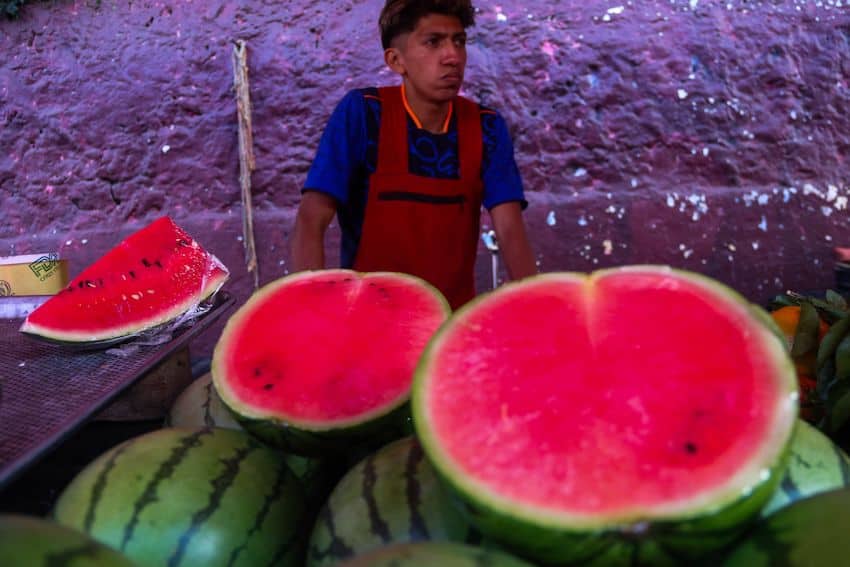
INEGI’s data shows that annual inflation for agricultural products (fruit, vegetables and meat) was 9.69% in the first half of March. That rate is derived from inflation of 23.91% for fruit and vegetables and 0.57% for meat.
Annual inflation was 5.91% for processed food, beverages and tobacco, 3.16% for non-food goods, 4.49% for services and 1.76% for energy, including electricity and gasoline.
Compared to the second half of February, energy prices (excluding electricity) rose 0.61% due to a rise in gasoline and diesel prices. The newspaper El Economista reported that fuel prices have gone up due to the increase in international oil prices since the start of the Iran War at the end of February. The federal government last week secured a deal with gas station owners to renew a gasoline price cap agreement for a further six months as it seeks to ease cost-of-living pressures for Mexicans.
On X, Siller wrote that inflation had shot up due to war in Iran and “public insecurity in Mexico,” but didn’t elaborate on either reason. Extortion is one crime that contributes to inflation in Mexico.
The highest inflation rate for any category monitored by INEGI between the second half of February and the first half of March was 8.34% for fruit and vegetables, whose prices can fluctuate wildly depending on climatic conditions. Growers of such produce, including avocados and limes, are among those targeted by extortionists.
Analysts divided over whether Banxico will cut or maintain 7% rate
15 of 29 analysts polled by Bloomberg expect the Bank of Mexico board to vote in favor of maintaining Banxico’s key interest rate at 7% at this week’s monetary policy meeting, while 14 are anticipating a 25-basis-point cut to 6.75%.
On Feb. 5, the Banxico board ended a streak of interest rate cuts at 12 consecutive monetary policy meetings by deciding to maintain the 7% rate.
The Bank of Mexico said in a statement at the time that the board took into account “the need to continue evaluating the impact of the fiscal adjustments implemented at the beginning of the year, as well as the behavior of the exchange rate, the weakness of economic activity, and the level of monetary restriction [already] implemented.”
In the same statement, Banxico forecast an average annual inflation rate of 4% in the first quarter of 2026. Considering that inflation was 4.02% in February and 4.63% in the first half of March, it looks likely that the central bank’s forecast will turn out to be an underestimation.
With reports from El Economista and El Financiero