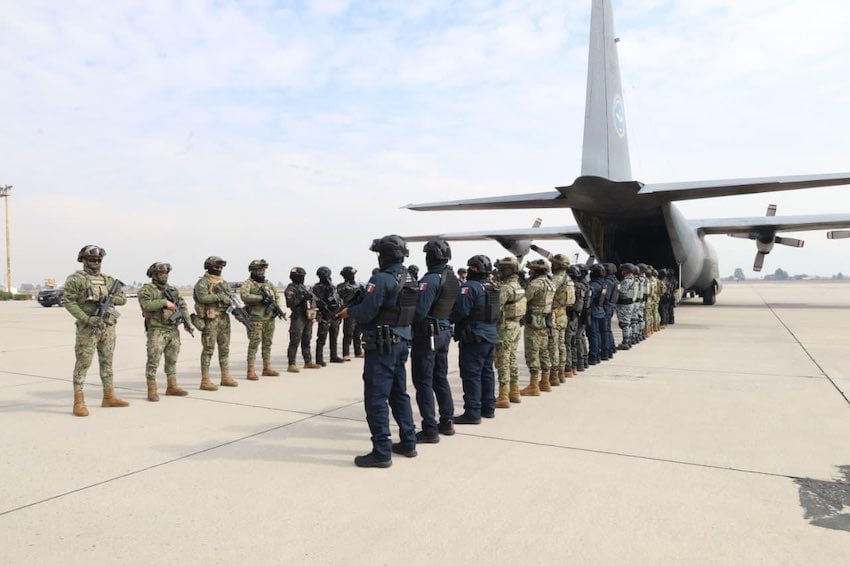
The Mexican government on Tuesday sent 37 convicted and alleged criminals to the United States, the third large transfer of imprisoned cartel figures to the U.S. since President Claudia Sheinbaum took office.
The latest transfer came amid heightened security tensions between Mexico and the United States, as President Donald Trump said earlier this month that the U.S. military would begin “hitting” Mexican cartels on land. It appeared to be an attempt by the Mexican government to appease the Trump administration, which has recently ramped up pressure on Mexico to do more to combat cartels and the narcotics they traffic to the U.S.
Mexican Security Minister Omar García Harfuch announced the prisoner transfer on social media, writing on X that “37 operators of criminal organizations who represented a real threat to the security of the country” were flown to various cities in the United States on seven Mexican military planes.
“The action was carried out in accordance with the National Security Act and under bilateral cooperation mechanisms, with full respect for national sovereignty,” he wrote.
García Harfuch said that the Mexican government received a commitment from the U.S. Justice Department that it would not seek the death penalty against any of the transferred prisoners, among whom are members or alleged members of various criminal groups, including the Jalisco New Generation Cartel (CJNG), the Sinaloa Cartel, the Northeast Cartel, the Beltrán Leyva Organization and the Gulf Cartel.
With the transfer of the prisoners — all of whom were wanted by U.S. authorities — “92 high-impact criminals” have been sent to the United States during the current administration, the security minister said.
Those people “will no longer be able to generate violence in our country,” García Harfuch wrote in a post that included footage of heavily armored Security Ministry vehicles leaving the Altiplano maximum security prison in México state. The transferred prisoners were held in various prisons in Mexico prior to being put on military planes to be flown to the U.S.

The Sheinbaum administration’s first large transfer of cartel figures to the United States occurred last February when 29 people, including notorious drug lord Rafael Caro Quintero, were sent north. A second transfer of 26 organized crime figures occurred in August.
Mexico transfers 26 cartel figures to US in second major prisoner handover this year
Since Sheinbaum took office in October 2024, the Mexican government has ramped up enforcement against cartels, arresting tens of thousands of suspects, seizing large quantities of drugs and weapons and dismantling around 2,000 clandestine drug laboratories.
It has recently won praise for its efforts from U.S. Ambassador to Mexico Ron Johnson, who wrote on social media last week that the security relationship between the United States and Mexico is the “most cooperative and mutually beneficial … in decades.”
Who was transferred to the US on Tuesday?
García Harfuch said that the criminal group operators were transported to Washington D.C, Houston, New York, Pennsylvania, San Antonio and San Diego.
Among the prisoners transferred to the U.S. were Ricardo González Sauceda, identified as a regional leader of the Northeast Cartel, and Pedro Inzunza Noriega, father of the second-in-command of the Beltrán Leyva Organization.
Inzunza, known as “El Señor de la Silla” (The Lord of the Chair), was arrested on Dec. 31. He is accused of running a drug production and trafficking network, primarily dealing in fentanyl, with a direct impact on the U.S. market. The U.S. Justice Department noted last May that “Pedro Inzunza Noriega and his son, Pedro Inzunza Coronel, are charged with narco-terrorism, drug trafficking and money laundering as key leaders of the Beltran Leyva Organization (BLO), a powerful and violent faction of the Sinaloa Cartel.”
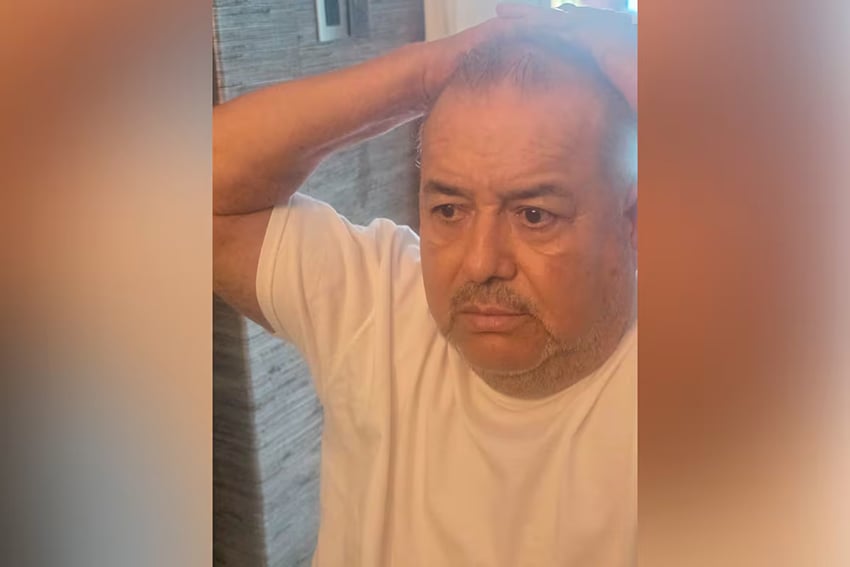
Another prisoner sent to the U.S. on Thursday was Juan Pablo Bastidas Erenas, allegedly a logistics operator for the BLO. The Reforma newspaper reported that he had a “direct relationship” with Fausto Isidro Meza Flores, aka “El Chapo Isidro,” leader of the BLO.
Among the other crime figures sent to the U.S. were:
- María Del Rosario Navarro Sánchez, the only woman transferred to the U.S. on Tuesday. The Associated Press reported that she is “the first Mexican citizen to face charges in the U.S. for providing support to a terrorist organization, after being accused of conspiring with a cartel,” namely the CJNG.
- Daniel Alfredo Blanco Joo, an alleged Sinaloa Cartel logistics operator accused of smuggling drugs into the U.S.
- José Luis Sánchez Valencia, an alleged CJNG member who is reportedly an uncle of Nemesio “El Mencho” Oseguera Cervantes, the Jalisco Cartel’s top leader.
On Wednesday, the U.S. Department of Justice published a full list of the 37 “fugitives” taken into custody in the United States on Tuesday evening.
“Among the fugitives taken into U.S. custody are prolific human smugglers, violent arms traffickers, and alleged members of dangerous drug cartels,” the Justice Department said.
“This is another landmark achievement in the Trump Administration’s mission to destroy the cartels,” said U.S. Attorney General Pamela Bondi.
“These 37 cartel members — including terrorists from the Sinaloa Cartel, CJNG, and others — will now pay for their crimes against the American people on American soil,” she said.
An ‘offering’ to the US?
Carlos Pérez Ricart, an organized crime expert and academic at the Center for Research and Teaching in Economics, told The New York Times that the latest transfer of prisoners is “an offering” to the Trump administration.
He said that the handover of 37 people on Tuesday is “far from a magic solution” to ward off pressure from Trump. “But at least the Mexican government is buying itself some time,” Pérez told the Times.
David Mora, a Mexico analyst at the International Crisis Group, told the Associated Press that as pressure increases from the Trump administration, “as demands from the White House dial up,” the Mexican government “needs to resort to extraordinary measures, such as these transfers.”
The federal government has rejected that it is giving in to pressure from the U.S. president by making the prisoner transfers.
On Wednesday morning, Sheinbaum said that the U.S. Justice Department requested the transfer of the prisoners, but the decision to send them north was a “sovereign” one taken by her government.
“Lo primero: conveniencia para México”, dice Sheinbaum al explicar el envío de 37 capos a Estados Unidos. Menciona que aunque fue a pedido del Departamento de Justicia de EU, fue una decisión “soberana”. pic.twitter.com/BXLEd4vNOn
— Emeequis (@emeequis) January 21, 2026
“[The interests of] Mexico are put first, above all else, no matter what others may ask for. It is a sovereign decision and is analyzed based on considerations of security policy,” she said.
After the first transfer of prisoners last February, García Harfuch said there was a risk that some of the 29 defendants sent to the U.S. could have been released from prison if they remained in Mexico. Judicial corruption has long been a problem in Mexico, although the current government asserts that its judicial reform, including the popular election of judges, will remedy the situation.
Opposition lawmakers and legal experts have “disputed the political and legal grounds for the prisoner transfers,” Reuters reported.
However, Pérez, the Times reported, “said that the legal and political debate surrounding the transfers have subsided since the first one last year, in part, because Mr. Trump’s military action in Venezuela has made his threats more real.”
Still, National Action Party (PAN) lawmaker Kenia López, president of the Chamber of Deputies, called for transparency regarding the legal procedures involved in the transfer on Tuesday. PAN Deputy Héctor Saúl Téllez asserted that extradition processes aren’t being respected, and called on the government to explain whether there is an “agreement that allows this kind of handover” or whether it is ceding to pressure from Trump.
The latest transfer of the prisoners came eight days after Sheinbaum spoke to Trump by telephone. On Wednesday morning, Sheinbaum said that the handover wasn’t related in any way to her conversation with her U.S. counterpart.
She requested the call in light of Trump’s remarks about striking cartels on land, and after speaking with the U.S. president asserted that U.S. military action in Mexico could be ruled out.
With reports from Milenio, Reforma, The New York Times, AP and Reuters