The relationship between Mexico and the United States is passing through a moment as delicate as it is peculiar.
From the White House, Donald Trump wields immense power and uses it without hesitation to extort Mexico on every possible front. The logic is brutally simple: The Mexican government is prepared to concede almost anything in order to safeguard the renegotiation of the USMCA and preserve the promise of low tariffs.
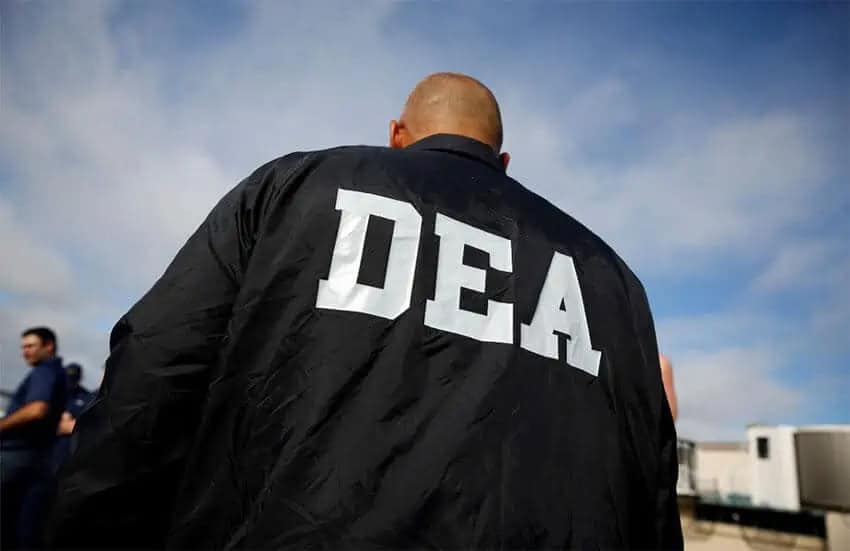
That willingness to yield has created fertile ground for a variety of U.S. agencies — each pursuing its own agenda — to push forward positions that had been closed to them for years. Among them, none has been more persistent than the Drug Enforcement Administration.
During the previous administration in Mexico, the DEA was shut out: Joint operations were curtailed, drones were grounded, and overall police cooperation with Washington was scaled back. Today, however, the window has reopened. Faced with the urgency of maintaining economic stability and eager to avoid confrontation, Mexico’s government has become more inclined to make concessions, and the DEA is seeking to regain the prominence it lost both inside and outside the United States.
The problem is that, of all U.S. agencies, the DEA is the one that has most consistently shown contempt for Mexican sovereignty. It is no coincidence that its mere mention provokes unease among Mexican bureaucrats and officials. Unlike other agencies with which cooperation, while difficult, is still possible, the DEA has insisted on imposing its punitive vision of the “war on drugs,” regardless of the costs its actions have inflicted south of the border.
It must be stated clearly: far from being a factor of peace, the DEA has been a driver of violence. Its primary goal — to reduce the flow of drugs reaching the United States — stands in sharp contrast with Mexico’s fundamental objective: to reduce criminal violence within its own territory. These are not only different goals, but in many cases outright contradictory. Recent history shows that the obsession with cutting drug flows to the north often translates into greater violence to the south. As I demonstrated in my 2022 book “Cien años de espías y drogas” (“One Hundred Years of Spies and Drugs”), U.S. enforcement strategies have consistently generated more violence in Mexico than they have prevented.

The DEA’s metrics are, in large measure, Mexico’s failures. Each spectacular seizure celebrated in Washington usually translates into violent reconfigurations among cartels, surges in homicides, or waves of institutional corruption in Mexico. The agency has little interest in those collateral effects. Its gaze is fixed on indicators that serve to justify budgets before the U.S. Congress, not to alleviate the crisis of violence that is bleeding Mexico dry.
This is why any discussion of cooperation must begin from an elementary principle: the United States is an indispensable partner, but it cannot unilaterally dictate the rules. Cooperation cannot be built on the DEA’s agenda, nor on the political needs of Washington’s most conservative sectors. It must be the result of shared interests, defined jointly and in a manner that respects Mexican sovereignty.
Anything else would be a profound mistake. Even more so in a context where rumors circulate of potential unilateral interventions, whether through armed drones or covert operations on Mexican soil. Any such attack, regardless of its immediate effects, would place President Sheinbaum in an untenable position and would derail the negotiations her government is pursuing with Washington for a broader framework of security cooperation.
Accepting that logic would mean turning back decades.
It would mean returning to the years when the DEA operated in Mexico with near-total discretion, as though Mexican territory were simply an extension of its jurisdiction. It would mean opening the door to an endless cycle of impositions, failures, and violence.
Mexico cannot — must not — fall into that trap.
Bilateral cooperation is necessary, but not at any cost. To accept a DEA-led intervention or to tolerate unilateral operations would be to sacrifice sovereignty in exchange for the illusion of stability. In Mexico’s political history, that illusion has never yielded anything good.
Carlos A. Pérez Ricart is a professor and researcher in the Division of International Studies at the Center for Research and Teaching in Economics (CIDE) in Mexico City, where he directs the the certification program Design and Implementation of Public Policy for Security and Justice CIDE-LAB-CO.