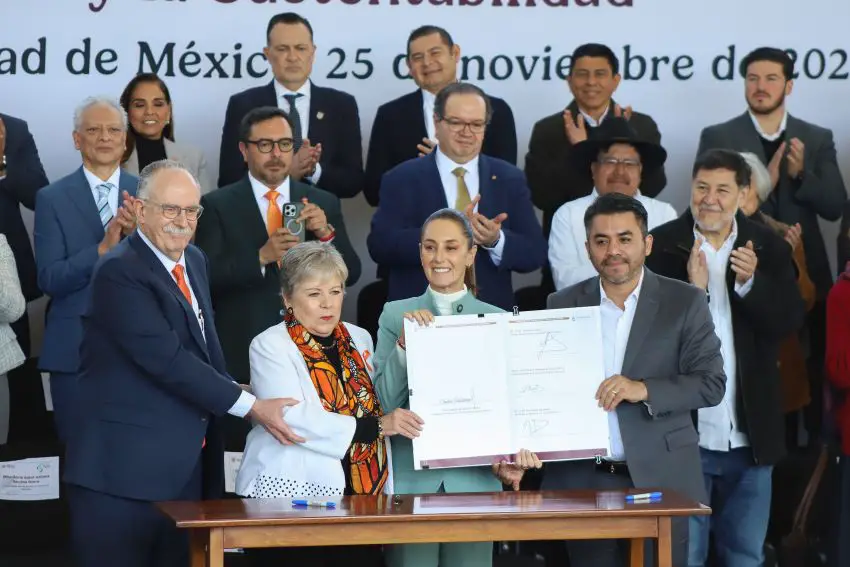
President Claudia Sheinbaum and Mexico’s 32 governors signed a National Human Right to Water Agreement on Monday, a pact that aims to ensure equal access to water for Mexico’s public while also increasing agricultural and industrial efficiency and sustainability.
The private sector joined as a voluntary participant, committing to cede contractual rights to at least 126 million cubic meters of water and promising to invest 21 billion pesos (more than US $1 billion) in infrastructure and technology improvements.

Federal water districts and irrigation sectors have also agreed to cede control over 2.8 billion cubic meters of water.
During the signing ceremony, Efraín Morales, director of Mexico’s National Water Commission (Conagua), said the accord seeks to “move past the mercantilist vision of water and recognize it as a human right and a strategic asset.”
President Sheinbaum and other speakers at the event emphasized the need to recognize the intrinsic link between social equality, economic growth and the environment.
“We must no longer view water as a commodity. It is a right,” Sheinbaum said, according to Radio Fórmula. “Every Mexican should have access to adequate water … We must guarantee sufficient water for food production, for social and industrial development … and institute a plan that provides sustainability and equitable development for the long term.”
The agreement is derived from the government’s National Water Plan 2024–2030 — presented by Sheinbaum at her press conference last Thursday, a federal initiative to reassess hundreds of thousands of Mexico’s water concessions, clean up some of Mexico’s most polluted rivers, improve agricultural irrigation technology available to the nation’s farmers, and build water infrastructure projects – including a desalination plant in Baja California and flood mitigation projects in Mexico’s flood-prone southeast.
The historic accord signed Monday by Mexico’s governors recognizes access to water as a human right, declares water a national asset and outlines benchmarks for sustainability, as well as reclamation and purification.
“This agreement is just the beginning of a permanent effort to ensure Mexico has a sustainable and equitable future with regard to water,” Morales said, according to the magazine Fortuna.
The pact includes plans to reinforce the nation’s hydraulic infrastructure, sets standards for water treatment plants, conserves and protects wetlands, establishes river cleanup projects and promotes reforestation and forest conservation endeavors.
Mexico’s water crisis
Last year, Conagua’s Drought Monitor indicated that more than 80% of Mexico’s territory is facing a water crisis, one that, according to the newspaper La Jornada, affects more than 35 million people.
Last year, Mexico City’s water supplies were so low that the global press was talking about a “Day Zero” when the metropolis would run out of water.
The drought is threatening 104 of the nation’s 757 drainage basins. In addition, of Mexico’s 653 aquifers, 114 are overexploited, according to Conagua. Plus, two-thirds of sites that Conagua monitors were classified as contaminated or heavily contaminated last year.
“It is past time that we manage water more efficiently, that we incentivize treatment and re-use,” Environment Minister Alicia Bárcena told La Jornada. “The willingness to participate voluntarily is a great sign, and it should result in more productive agricultural and industrial sectors while also ensuring a more equitable distribution.”
In addition to the give-back from the private sector, Sheinbaum said water contracts for industrial use would also be restricted and even restructured, the news outlet Infobae reported. Going forward, concessions would strictly prohibit alternate uses of water that do not benefit the public.
With reports from Fortuna, Radio Fórmula, Infobae and La Jornada