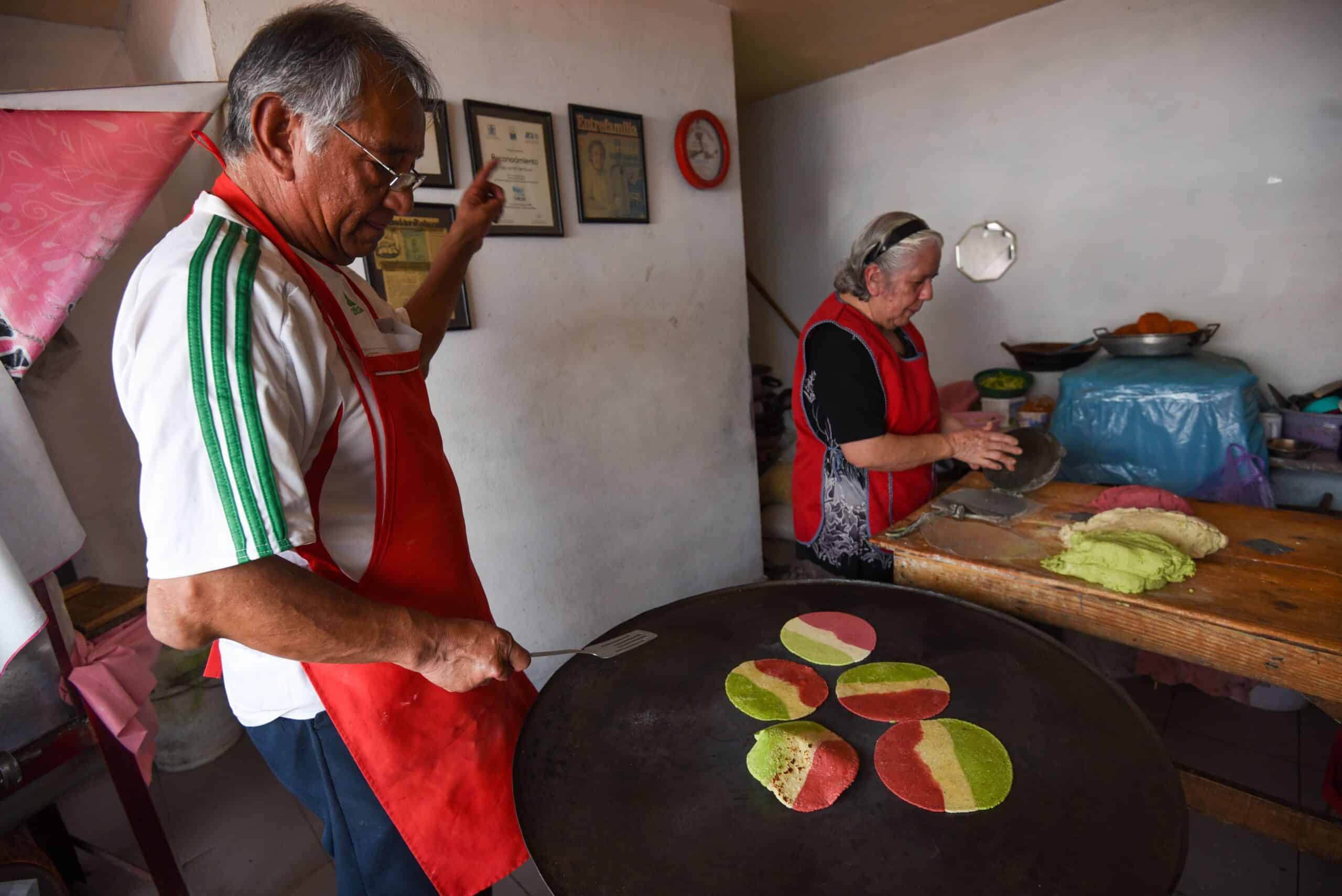
Bilateral communications were front and center in Mexico the week of Sept. 7, with developments running the gamut from encouraging to combative. U.S. President Donald Trump’s remark that Mexico has “nothing” the United States needs beyond “hot tamales” and “tomatoes” caught fire over the weekend, unleashing a fresh round of provocations from Trump, Vice President JD Vance and Secretary of State Marco Rubio in the days that followed.
Mexico, however, continued to highlight trade and security collaboration with its northern neighbor, though the PISA test results and next year’s midterm elections sparked more conversations at home. Meanwhile, the annual inflation rate ticked up to 3.26% — as expected according to Banxico, which forecasts inflation of 3.5% by the end of 2026. President Claudia Sheinbaum remained optimistic through it all, especially as her administration makes its plans for 2027. Overhead, punishing heat baked Mexico’s northern border states even as monsoon rains drenched the Pacific coast and center of the country.
Didn’t have time to catch this week’s top stories? Here’s what you missed.
2027 budget takes shape
On Monday, Finance Minister Édgar Amador Zamora submitted a 10.6-trillion-peso (US $627.8 billion) budget proposal for 2027 to Congress, an increase of about 1% in real terms over this year. Amador framed the package around “five pillars” — economic growth, protecting government priorities, strengthening revenue, more efficient spending and fiscal discipline. The government is banking on those pillars to shrink the budget deficit to 3.9% of GDP next year from an estimated 4.1% in 2026, even as public debt climbs to 55% of GDP. No new taxes or fuel-price hikes are planned.
Health care gets a 10.9% real-terms boost to 1.1 trillion pesos, largely for IMSS-Bienestar infrastructure and medicine supply, while education rises about 7% to 1.3 trillion pesos to fund new schools. Pension and welfare programs get just over 1 trillion pesos, and debt servicing alone eats up 1.6 trillion pesos — roughly one of every seven pesos the government spends. Security agencies see an 11.6% bump to 331.4 billion pesos, while Pemex funding falls 69.2% as the state oil company pushes toward self-sufficiency.
The National Electoral Institute (INE) is the biggest percentage winner of all, with an 87.5% real-terms increase ahead of 2027 midterm elections, while the Energy Ministry, the National Human Rights Commission and the Federal Electricity Commission absorb the steepest cuts. Sheinbaum said the following day that she is “very satisfied” with the package and that growth could exceed the official forecast of 1.5-2.5%, citing anticipated stability in trade relations with the U.S. and Canada.
Sheinbaum optimistic about Mexico’s 2027 growth prospects: Wednesday’s mañanera recapped

Homicides continue to fall
Security officials reported this week that daily homicides fell 53% in August compared to September 2024, the final month of the López Obrador administration, making it the least violent August since 2015.
More than 67,000 people have been arrested for high-impact crimes since Sheinbaum took office, though Security Minister Omar García Harfuch cautioned that “the job is not done.” Days later, from Tuxtla Gutiérrez, the president highlighted a 63% drop in Chiapas’s homicide rate since Gov. Eduardo Ramírez Aguilar took office, alongside nearly 10,000 arrests in the southern state. The same briefing revealed the discovery of a clandestine hospital the Jalisco New Generation Cartel (CJNG) used to treat injured members.
Olmeca Refinery notches record month
Pemex’s Olmeca Refinery in Tabasco posted its best month yet for fuel production in July, averaging 252,498 barrels per day, a 78.8% jump over June. Gasoline output rose even more sharply, up nearly 128% month-over-month, after equipment fires forced repairs earlier in the year. Despite the milestone, the plant — which began operating approximately two years ago — is still running at roughly two-thirds of its 340,000-bpd capacity.
Fox and PRI’s Alito Moreno join forces
In a striking political reunion, former President Vicente Fox met with PRI leader Alejandro “Alito” Moreno to discuss “the need to build a strong opposition” ahead of 2027 midterms — 26 years after Fox became the first opposition candidate to sweep the once-dominant PRI out of the presidency, and years after he called the party “black vipers, vermin and tadpoles.”
Morena, for its part, dismissed the pairing as “the reorganization of the power elite,” saying in a statement that “they change the names, they invent new organizations, but behind the facade, it’s the same old faces.” The PRI, which ruled Mexico for 71 years, now holds just two of the country’s 32 governorships — the same number as the much smaller Citizens Movement (MC) party.
At her Monday press conference, Sheinbaum branded the reunion “PRIAN” politics dating to the “neoliberal” era of former President Carlos Salinas de Gortari, and called Fox a “traitor of democracy” — a jab tied to his role in Mexico’s disputed 2006 election.
Bilateral high points
Trade and security cooperation produced some of the week’s more encouraging bilateral news. Mexico’s exports to the U.S. hit a monthly record in July: US $60.55 billion worth of goods were sent north, pushing Mexico’s share of the $332.92 billion U.S. import market above 18%.
Goods from Mexico now make up almost one-fifth of the US import market
Along the border, Mexican and U.S. forces carried out “High Eagle,” a binational operation to detect and disable drones cartels use to surveil authorities near Tijuana and San Diego. And though bad weather grounded Commerce Secretary Howard Lutnick’s flight to Mexico City on Wednesday, he and Sheinbaum still held a video call on USMCA negotiations that Economy Minister Marcelo Ebrard described as “cordial” and “very useful,” with talks on steel, aluminum and automotive tariffs continuing ahead of a fourth bilateral review round.
Bilateral low points
Other exchanges were considerably more combative. Over the weekend, Trump proposed to rename New Mexico “New America,” despite having no legal authority to rename a U.S. state, drawing pushback from the state’s Democratic leaders. Later in the week, from Ecuador, U.S. Secretary of State Marco Rubio doubled down on claims that cartels control “vast territories” of Mexico, hinting the threat may eventually have to be “confronted one way or the other.” Sheinbaum shot back on Thursday morning, telling Rubio to keep Mexico out of U.S. midterm politics and calling his remarks electorally motivated. Rounding out the week, U.S. Vice President JD Vance labeled the Mexican flag “a symbol of the far left” after a protester interrupted his convention speech in Dallas, telling the man to “get your ass over there” if he loved Mexico so much.
Poor PISA scores spark a debate over screens
New results from the OECD’s Programme for International Student Assessment (PISA), given to 7,843 students across 297 Mexican schools, showed that four in 10 15-year-olds — 41.8% — scored below the basic level in science, math and reading, more than double the 19.7% OECD average and Mexico’s worst showing since 2009.
Mexican students averaged 388 points in math, 408 in reading and 414 in science, all well below OECD averages of 463, 461 and 482, and the country has shed seven points in both math and reading since the 2022 test. The decline wasn’t unique to Mexico — the OECD’s education director called it part of a “dramatic” global drop, particularly in reading — and Mexican students still reported unusually high curiosity (80%, versus a 24% global average who called school “a waste of time”). Education International, the global teachers’ federation, pinned the broader slide on shrinking attention spans, heavy AI use and a worldwide teacher shortage. China, Singapore, South Korea, Estonia and Canada topped the rankings.
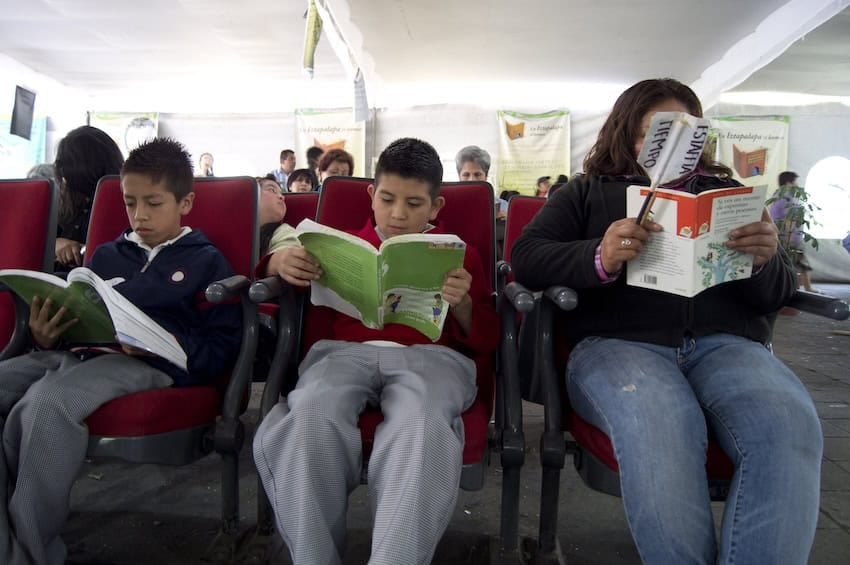
Education Minister Mario Delgado blamed excessive screen use for the drop in reading comprehension — arguing that “screens make it easy to ‘read’ or consume images” — while defending the New Mexican School curriculum model and promoting traditional games like yo-yos, marbles and spinning tops as a substitute for phone time. He conceded the PISA sample was “statistically representative” even as he questioned whether the test amounts to a comprehensive evaluation of Mexican education. Sheinbaum later told reporters Mexico will roll out new math and reading textbooks next year, including poems and short stories, and push a “return to pencil and paper,” tying the effort to new national guidelines already restricting cellphone use in schools.
Education Ministry, UNESCO team up on AI in schools
Also this week, Mexico’s Education Ministry signed a letter of intent with UNESCO to guide the “responsible” rollout of artificial intelligence in classrooms, with the U.N. body offering technical assistance, teacher training and research support. Officials said the goal is to ensure AI supports, rather than substitutes for, teaching and critical thinking, and the deal also opens the door to new rules on cellphone use in schools.
Mexico prepares for El Grito and Independence Day
With the country’s 216th independence anniversary approaching, more than 18,000 members of Mexico’s armed forces are readying for the Sept. 16 military parade through Mexico City, featuring drones, horses, dogs and a float marking the country’s World Cup hosting duties this past June and July. The holiday kicks off the night before, with Sheinbaum leading the Grito de Independencia from the National Palace balcony and Tejano band Intocable headlining a concert in the Zócalo.
Festivities and gritos will ring out from cities across the country, including in Sinaloa, whose capital city of Culicán will hold a public celebration of Independence Day for the first time in two years.
Points of 🇲🇽 pride
- A 20-year-old engineering student from a Chihuahua farming family, Luis Ángel Robles Morales, won a national innovation award for an irrigation filter that is already helping 500 drought-stricken farmers use water more efficiently.
- Forward Julián Quiñones and Club América’s Scarlett Camberos earned historic Ballon d’Or nominations, marking the first time two Mexican players — and a Mexican club — have featured on the shortlist for world soccer’s top individual honor.
Mexico News Daily
This story contains summaries of original Mexico News Daily articles. The summaries were generated by Claude, then revised and fact-checked by a Mexico News Daily staff editor.