Storms swirled around and within Mexico this week as a political misstep by Governor Mauricio Kuri in Querétaro became a national controversy.
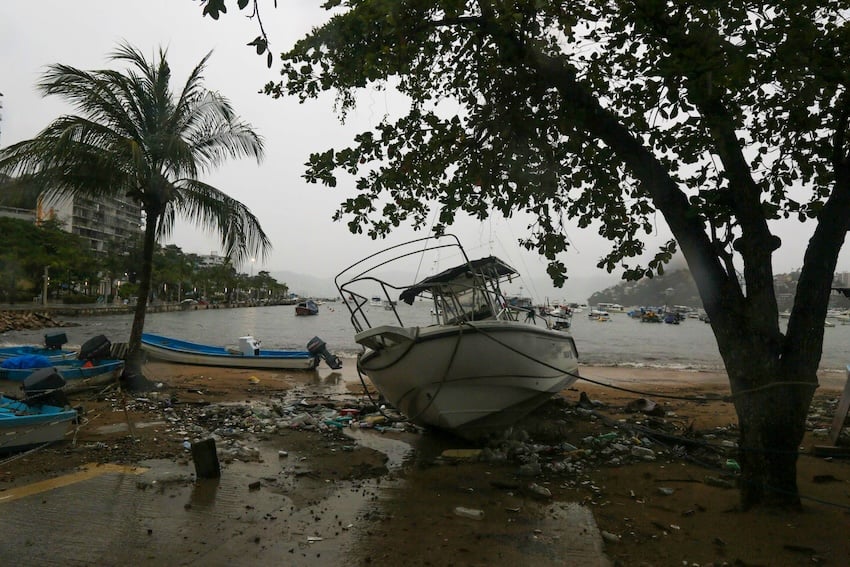
Simon, currently located off the Pacific coast of Jalisco and Colima, is now a Category 4 hurricane and will make landfall this weekend. Hurricane Isaias swept past the Yucatán Peninsula and landed near Destin, Florida, on Friday evening. Far out in the Pacific, Tropical Storm Rachel, which briefly reached hurricane strength, stayed clear of the Mexican coastline on Saturday but was expected to weaken and send its remnants toward Baja California and the U.S. Southwest.
On land, President Claudia Sheinbaum reacted swiftly to the surprise inauguration in Querétaro of a binational security institution that received direct support from the United States. According to the federal government, the project was never disclosed to or authorized by the corresponding Mexican authorities.
In Nayarit, searching mothers helped authorities uncover an alleged “extermination center” near Tepic, where investigators found a makeshift burner and a pit containing the remains of recently cremated bodies. Officials haven’t said how many people died or tied the site to a criminal group. The discovery underscored Mexico’s disappearance crisis, with more than 130,000 people registered as missing.
Didn’t have time to catch this week’s top stories? Here’s what you missed.
Police academy controversy
Sheinbaum opened the week by questioning an “International Police Training Academy” in central Mexico, whose cornerstone Gov. Mauricio Kuri and U.S. Ambassador Ronald Johnson laid Oct. 2. She said such a project can’t exist without federal authorization and asked why the military, the Security Cabinet and the Foreign Ministry weren’t invited.
A leaked letter then showed Kuri had told Foreign Affairs Minister Roberto Velasco only that Johnson would visit Querétaro, calling the interactions ceremonial and never mentioning the academy. The Foreign Affairs Ministry replied that any security training project with a foreign government needs prior approval from the High-Level Security Group (GANSEG), which hadn’t been granted. It also offered to help Querétaro seek it.

On Tuesday, Sheinbaum said federal officials had approved nine Querétaro–U.S. cooperation projects since December 2021, but not this one. She cited the state’s security minister, who said the facility would bring specialized training from U.S. agencies. Johnson had called it a “State Interdiction Academy” and noted more than US $10 million in U.S. support for Querétaro police over the past decade. The episode drew parallels to April’s alleged CIA involvement in a Chihuahua drug lab raid. Both states are governed by the opposition National Action Party (PAN).
On Thursday, Sheinbaum met with U.S. business leaders at the National Palace, with Johnson in attendance, but said security would be handled separately. She said Johnson had agreed to meet Velasco soon, and Security Minister Omar García Harfuch told legislators that bilateral cooperation is subject to Mexican law.
Hurricane Simon threatens Jalisco and Colima
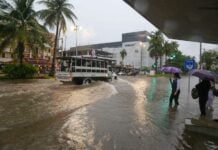
Simon strengthened into a Category 4 hurricane on Saturday morning, with sustained winds of 230 km/h (145 mph). The U.S. National Hurricane Center (NHC) said the eye could pass near or over Mexico’s west-central coast late Saturday or Sunday, though its track remained uncertain. Civil Protection chief Laura Velázquez said the impact zone could be Cihuatlán, La Huerta, Tomatlán, Cabo Corrientes or Puerto Vallarta in Jalisco, or Manzanillo, Colima.
A hurricane warning covers Punta San Telmo, Michoacán, to Punta Mita, Nayarit. Rainfall could reach 20 to 38 centimeters, with isolated totals of 64 centimeters. Authorities set up command centers in Puerto Vallarta, Cihuatlán and Manzanillo, began evacuations in the flood-prone Jalisco community of El Rebalse and suspended classes in 22 Jalisco municipalities Friday and Monday. Simon could be the second hurricane to make landfall in Mexico this Pacific season, after Polo.
On the Atlantic side, Isaias became the season’s first hurricane Wednesday night, the latest first hurricane in the 60-year modern era. It was forecast to make U.S. landfall Friday evening, with no Mexico landfall expected, though it dumped heavy rain on the Gulf coast and Yucatán Peninsula states. It followed Mexico’s first hurricane-free Atlantic September since 1994, a contrast with a Pacific that had produced nine hurricanes by Wednesday. Experts point to a “super” El Niño, which warms Pacific waters and raises wind shear in the Atlantic.
Sheinbaum presents presidential decrees regarding nationality and social media
On Wednesday, Sheinbaum signed a decree formalizing a constitutional reform that requires exclusive Mexican nationality for presidential, gubernatorial and Mexico City mayoral candidates. The ban takes effect from 2028, after gubernatorial elections in 17 states next June. Citizens Movement (MC) Sen. Luis Donaldo Colosio Riojas criticized the reform for creating “two categories of Mexicans.”
On Friday, after a fatal machete attack at a Torreón school, the government presented a decree on “safe digital environments” for minors. It bars platforms from showing or recommending content that promotes hate speech, violent extremism, sexual exploitation, suicide, self-harm, eating disorders, cyberbullying and illegal conduct. Sheinbaum said it would be published in the official gazette next Tuesday or Wednesday after legal review to ensure it doesn’t exceed the executive branch’s authority.
Border deployment and gunfire incident
Mexico sent 500 Army and National Guard troops to the Tamaulipas border after U.S. Coast Guard personnel were fired upon from the Mexican side Sept. 26 and returned fire. The U.S. ordered 500 soldiers to the Texas side.
The Foreign Affairs and Defense ministries described the twin deployments as part of a “Concurrent Operation,” backed by two UH-60 helicopters, drones and anti-drone equipment in five Tamaulipas municipalities. The Navy is also participating through “Operation Saber.” No injuries or damage were reported in the shooting.
Mazatlán gets elite reinforcements as violence persists
The federal government formed a Special Operations Group of 29 Defense Ministry soldiers to work within Mazatlán’s municipal police after repeated troop deployments failed to stem the violence. The unit follows a wave of homicides, armed attacks and explosive assaults that led officials to urge caution between 3 and 10 p.m. The city also bought 50 bicycles for soldiers and National Guard members.
Then came Thursday’s shooting at El Castillo prison, which killed nine inmates and a 2-year-old boy and injured 16 prisoners. Alleged Sinaloa Cartel figure “El Owen” was reportedly among the dead. Sheinbaum said the Security Cabinet is working with interim Sinaloa Governor Graciela Domínguez to strengthen the state’s prisons.
Inflation edges up
Annual headline inflation rose to 3.45% in September from 3.26%, the highest since May but well below March’s 4.59% peak. Core inflation eased to 3.75% from 3.88%. Fruit and vegetable prices jumped 8.78% annually, while meat prices fell 4.46%. The Bank of Mexico held its benchmark rate at 6.50% two weeks ago and meets again Nov. 5.
Investment news
Fixed capital investment grew 6% annually in July, the fastest pace in two years, driven by construction. Private sector investment growth hit a 30-month high, though the total remains 2.35% below its July 2024 record. Spending on Mexican-made machinery and equipment fell 8% from January to July, while imported equipment rose 3.5%.
In Nuevo León, Gov. Samuel García announced US $600 million for industrial infrastructure, mainly data centers in Apodaca and Pesquería. That brings 2026 foreign investment in the state to $136.6 billion by his count.
Bárcena says ‘not yet’ to fracking in Mexico
On Tuesday, Environment Minister Alicia Bárcena told lawmakers the conditions for fracking “do not exist” and that Sheinbaum hasn’t authorized pilot tests. Only testing for deep saline water has been approved. Government scientists identified the Sabinas-Burro-Picachos basin as the only viable site, but nonprofit CartoCrítica says all the fresh water needed there would come from basins lacking available supply.
4 economy headlines to know
- Mexico’s trade surplus with the U.S. rose 21.2% to US $155.87 billion from January to August, as exports hit a record $419.34 billion. Only Vietnam posted a larger surplus. The government faces a tough negotiating backdrop, with the U.S. having declined to renew the USMCA trade agreement in its current form, in part due to its deficit with Mexico, which the Trump administration views as an unacceptable imbalance.
- The International Monetary Fund raised its growth forecasts to 1.5% for 2026 and 1.8% for 2027, citing a strong second quarter, but urged fiscal consolidation.
- Auto parts output hit a record US $10.85 billion in July, up 7.15%. Vehicle production, however, fell 15.1% in September, its steepest drop since 2021, and car exports declined 11.85%.
- Finally, a Citi survey of Mexico-based analysts sees the peso at 18 per dollar at the end of 2026 and 18.50 at the end of 2027, after the currency fell 6% in September.
Mexico News Daily
This story contains summaries of original Mexico News Daily articles. The summaries were generated by Claude, then revised and fact-checked by a Mexico News Daily staff editor.