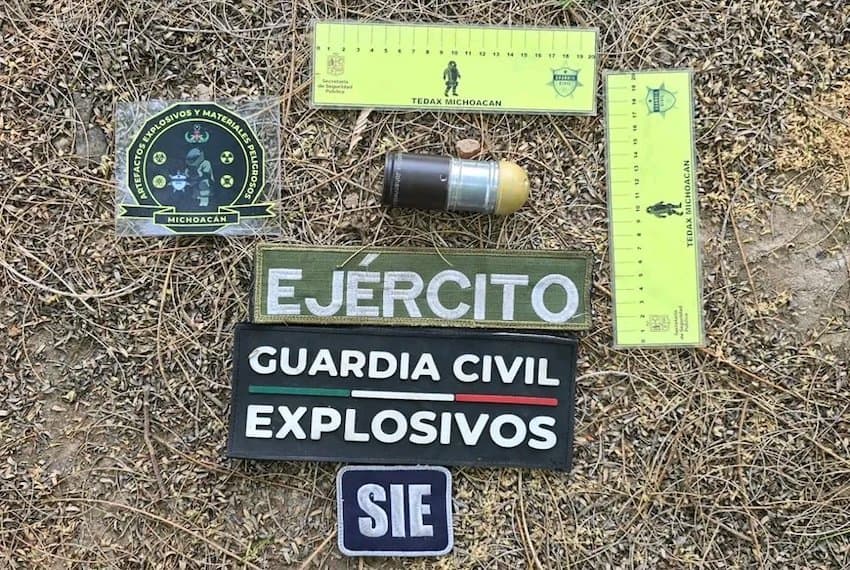
The number of improvised explosive devices (IEDs) located, seized and deactivated by state authorities in Michoacán more than doubled last year, indicating that criminal groups’ use of the makeshift bombs is becoming more prevalent.
According to data from the Michoacán Security Ministry, 1,645 IEDS were neutralized by state authorities last year, an increase of 122.5% compared to 2024. The figure doesn’t include IEDs seized and deactivated by federal security forces such as the army and National Guard.
Crime groups that operate in Michoacán, including the Jalisco New Generation Cartel (CJNG) and Los Viagras, attach IEDs to drones to carry out aerial attacks and also use the devices as landmines and car bombs.
In 2023, the Michoacán government created a police task force called the Explosive Devices and Dangerous Materials Specialized Group to combat the use of IEDs, whose detonation has claimed the lives of civilians, police officers and soldiers in the state.
The newspaper El Universal reported that the group’s efforts are mainly concentrated in the Tierra Caliente and Sierra Costa regions of Michoacán, where organized crime activity is particularly prevalent.
According to Carlos Roberto Gómez Ruiz, chief of the specialized group, the use of IEDs by cartels and other criminal groups is now common.
“All the criminal factions are using these kinds of explosive devices,” said Gómez, who was quoted by El Universal in a Jan. 15 report.

“Not just here in the state [of Michoacán], in the whole country. Unfortunately, it is a common practice,” he said.
The New York Times reported last September that “like other armed groups around the world,” cartels in Mexico “combine old and new weapons to deadly effect.”
“Drones circle overhead in Michoacán, while roads and footpaths used by soldiers and civilians alike are seeded with IEDs,” the newspaper wrote.
“Over the past two years, the state has recorded more mine explosions than anywhere else in Mexico, a chilling marker of the drug war’s evolution.”
🇲🇽 | The use of homemade explosives has become common practice among criminal groups in Michoacán, particularly for the Jalisco Cartel. How has this use evolved over the years? Learn more here: https://t.co/BLksuegmKV pic.twitter.com/ijqUFfyDxU
— InSight Crime (@InSightCrime) January 19, 2026
In November, the federal government launched “Plan Michoacán for Peace and Justice,” a 57-billion-peso (US $3.2 billion) initiative devised in response to the murder of the mayor of Uruapan on Nov. 1 and general insecurity in the state.
Between Nov. 10 and Jan. 12, 198 IEDs were seized by federal and state security forces involved in the implementation of the plan, according to the federal government’s security cabinet.
IED attacks in Michoacán
Improvised explosive devices have been used in numerous attacks in Michoacán in recent years. Among the fatal incidents are:
- The explosion of a car bomb outside a community police station in the town of Coahuayana last month that killed six people, including three police officers. The Michoacán Attorney General’s Office attributed the attack to members of the CJNG.
- The explosion of a landmine in the municipality of Los Reyes last May that claimed the lives of eight members of the National Guard. The location where the landmine detonated is part of an area where both the CJNG and the Cárteles Unidos (United Cartels) are vying for control, El Universal reported.
- The explosion of a land mine on a lime farm in the municipality of Buenavista last February that claimed the lives of two workers, including a 15-year-old boy.
- The death of four soldiers in the municipality of Aguililla in a May 2024 attack that was perpetrated by landmines, firearms and drones carrying explosives. The attack was attributed to the CJNG.
With reports from El Universal