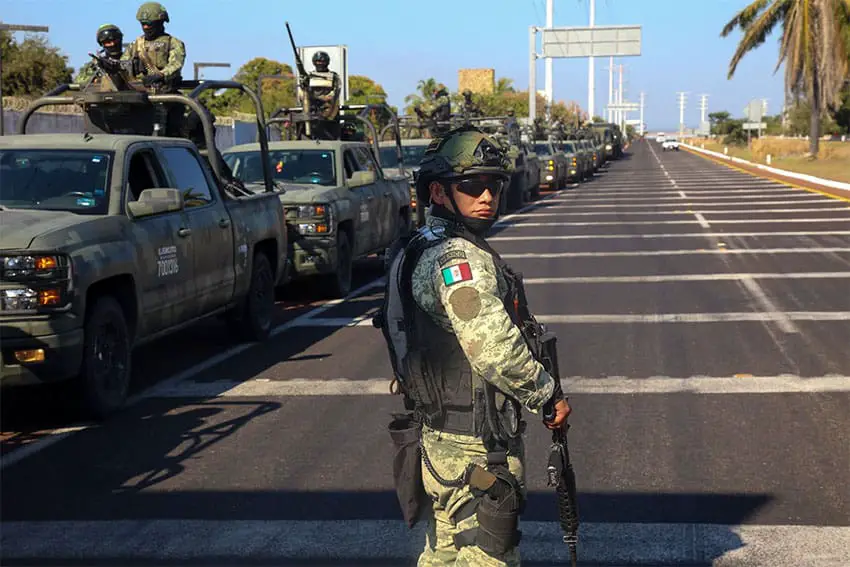
The Supreme Court (SCJN) has ruled that the military doesn’t need to report arrests it makes to civilian security authorities.
The court’s ruling on Tuesday came in response to a claim of unconstitutionality filed by the National Human Rights Commission (CNDH) against part of the National Law on the Registration of Arrests.
The CNDH challenged the law on the basis that it excused the military of the responsibility to report the arrest of presumed criminals. The commission argued that the right to legal certainty, among other rights, and the principle of legality could be violated by the absence of that responsibility.
However, the SCJN ruled that under the National Law on the Registration of Arrests, the military itself is obliged to immediately register the detentions they complete in the relevant database. Therefore, the armed forces must be given access to the arrest registry, the court said in a statement.
It ruled that the military — which has been authorized to carry out public security tasks until 2028 — “is not obliged to give notice of an arrest to a police authority so that said authority creates the registration.”
Independent Senator Emilio Álvarez Icaza slammed the Supreme Court’s ruling in a Twitter post.
“The @SCJN established today that the armed forces … [carrying out] security tasks are not obliged to inform a police authority of the arrest of a person. And it leaves the registration [of an arrest] up to the goodwill of the military. Military opacity to violate human rights now has legal endorsement. Grave,” he wrote.

The non-government organization Human Rights Watch recently warned that the federal government’s militarized security policy risks facilitating abuses by security forces while failing to reduce violent crime.
However, a poll conducted late last year indicated that almost three-quarters of Mexicans agree with the government’s plan to continue using the armed forces for public security tasks until 2028.
With reports from El Universal, El Financiero and Infobae