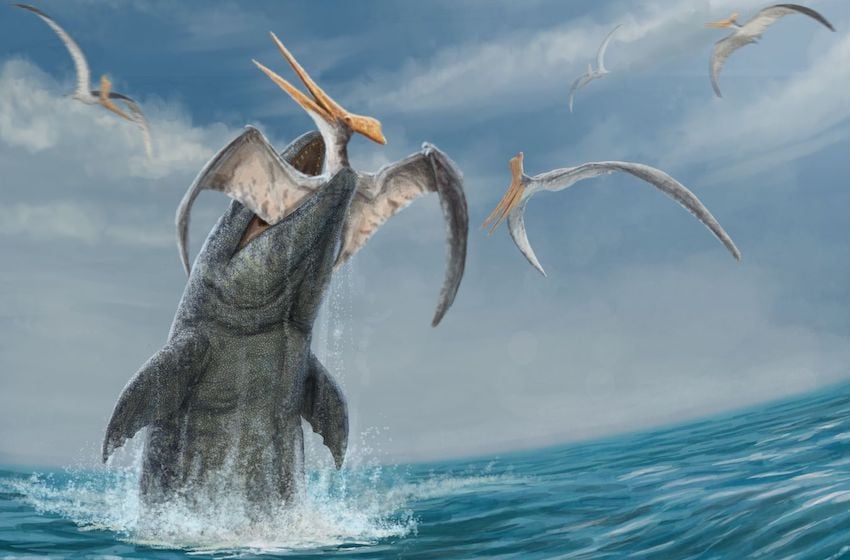
A skull dating back to the age of the dinosaurs — pulled from Cretaceous-era rock in northern Mexico 25 years ago — has led to the definition of a new species of marine reptile, scientists announced earlier this month.
The fossil from the newly named species, Prognathodon cipactli, was unveiled by a team of Mexican and British paleontologists as part of a study in the German geosciences journal Neues Jahrbuch für Geologie und Paläontologie.
The unveiling occurred on March 17 at the Desert Museum in Saltillo, the capital of the northern state of Coahuila.
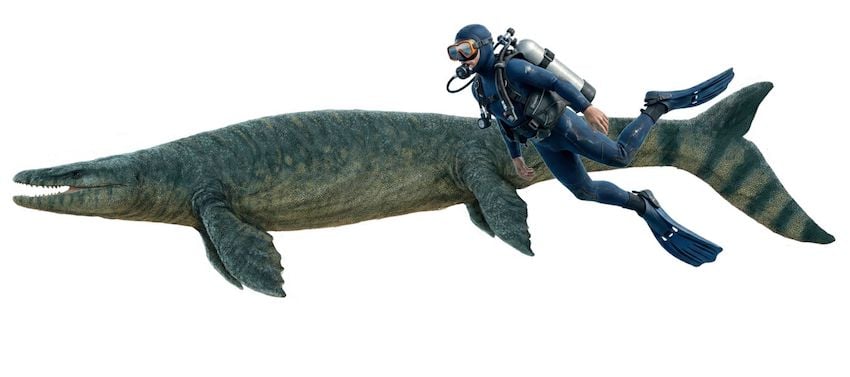
Estimated at 5 to 6 meters (16 to 20 feet) in length with powerful jaws, the prehistoric “sea monster” — so deemed by the Mexican newspaper El País — existed about 70 million years ago, when ocean waters covered much of what is now northeastern Mexico.
The fossilized skull belonged to a mosasaur, a group of large, extinct marine reptiles related to modern lizards and snakes that dominated the oceans near the end of the age of dinosaurs, researchers said.
It lived alongside dinosaurs in the Late Cretaceous period (roughly 100.5 million to 66 million years ago) but is a separate branch of reptiles.
With deep jaws, robust teeth and a short snout, P. cipactli was adapted to crush and seize large, resistant prey such as big fish, other marine reptiles and shelled animals.

The skull was discovered in 2001 in outcrops of the Méndez Formation, a geologic area in northeastern Mexico composed mainly of marine sedimentary rocks (good for preserving fossils). It’s near Linares, Nuevo León.
Only the skull was recovered, and the original site has not been refound, but the fossil is considered relatively complete for a mosasaur skull.
Héctor Rivera-Sylva, chief of paleontology at the Desert Museum, said mosasaurs “dominated the world’s oceans, occupying the ecological role now held by large marine predators such as sharks or orcas.”
He added that the “relatively small size of the animal suggests that adaptations for capturing large prey evolved first, and only later did some species reach gigantic sizes.”
After being described for years as coming from an indeterminate mosasaur, the specimen was reexamined in the new study, which identified features firmly placing it in the genus Prognathodon, known for its powerful bite.
Its new species name has a strong cultural resonance. Cipactli refers to a primordial aquatic creature of Aztec mythology, a half‑reptile, half‑fish being that the gods split to create the Earth and the sky. It is also a Nahuatl word often translated as “crocodile.”
The discovery adds to a growing list of fossils from Coahuila and neighboring states, where land predators such as Xenovenator espinosai and marine hunters like Prognathodon cipactli point to a complex web of top-of-the-food-chain predators in sea and on shore.
With reports from El Universal, Infobae and El Sol de Laguna