The Education Secretariat (SEP) has issued a warning against the use of alternative, ideologically loaded textbooks developed by the CNTE teachers’ union.
The SEP said in a statement that the National Commission of Free Textbooks (Conaliteg) has the sole authority to print and distribute textbooks for use in public schools, and no other organization can replace those official materials.
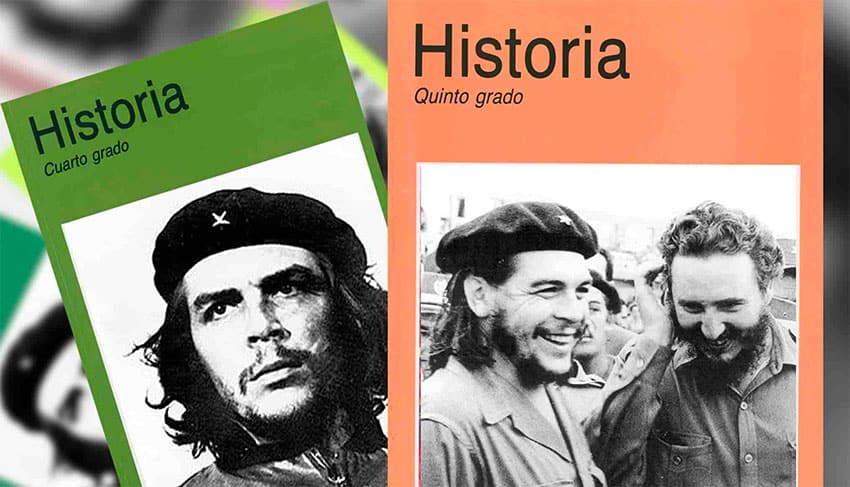
The CNTE union has developed 48 textbooks with a clear ideological bent for use by primary and secondary school students.
Among the content of the books are critiques of the “neoliberal economic model” implemented in Mexico by past governments and biographies of former Cuban president Fidel Castro and revolutionary hero Che Guevara.
The CNTE plans to distribute texts for the 2019-2020 school year to more than 6,000 public schools in Michoacán that have already adopted the union’s education model.
The books are part of a wider alternative education plan developed by the dissident teachers’ union that it will present to President López Obrador during a meeting scheduled for September 10.
Members of the CNTE, which vehemently opposed the previous government’s educational reform, have expressed their desire to expand the union’s alternative program.

But blocking any attempt to do that will be the conservative National Parents Union (UNPF), which yesterday called on the federal government to put an end to the distribution of CNTE’s alternative textbooks and implementation of its education program.
“We think it’s very dangerous that the CNTE . . . has an indoctrination plan based on concepts that don’t stand up to factual analysis. It doesn’t frighten us that they want to talk about Russia or Marx, it concerns us that they want to lie to students about issues that don’t stand up to critical analysis . . .” said UNPF president Leonardo García Camarena.
“These kinds of proposals must be stopped . . . As parents, we don’t want to be pushed to accepting [education] models on which we haven’t been consulted . . .”
García charged that the federal government has been gradually ceding ground to the CNTE and that President López Obrador has opened the doors of the National Palace to a “tiny, radical and blackmailing group.”
He said the union has already achieved the elimination of teacher evaluation and that the quality of instruction given to students will suffer as a result.
Education specialists and lawmakers also spoke out against the CNTE’s plan to distribute alternative textbooks.
Alma Maldonado, an education researcher at the National Polytechnic Institute, said the distribution of the books threatens children’s rights.
“It jeopardizes the right to receive an education based on books made by the experts at Conaliteg, who are serious people that have the academic foundation to produce educational texts,” she said.
Maldonado argued that the government could set a dangerous precedent if it allows the CNTE books to be distributed and used.
“. . . It will set an example that any school, state or group [can] hand out the textbooks it wishes.”
Juan Carlos Romero Hicks, leader of the National Action Party in the lower house of Congress, told the newspaper El Universal that the CNTE’s distribution of textbooks is illegal.
“It’s flagrant illegality because education decisions correspond to the SEP, to state [education] secretariats. It’s a legal outrage that is part of the [CNTE’s] thoughtless and anarchic activism that doesn’t respect the pupils; it’s part of the miserable anarchy that the CNTE has built since 1979,” he said.
Romero added that there is no space for the CNTE to negotiate with the SEP because “what’s illegal doesn’t go ahead, it’s not a matter of whether ‘I like it or not.’”
Source: El Universal (sp)