The Federal Attorney General’s Office (FGR) announced Tuesday that it had dismantled four “illicit fuel processing centers” across three states, dealing another blow to the illegal fuel trade in Mexico.
In a statement, the FGR said that in coordination with the federal Security Ministry, the National Guard and the logistics subsidiary of state oil company Pemex, it carried out “strategic actions to identify and dismantle” the makeshift refineries.
Cuatro centros de procesamiento de huachicol fueron desmantelados por fuerzas federales en los estados de San Luis Potosí, Hidalgo y Morelos.
Las labores de inteligencia e investigación, así como el intercambio de información permitieron ubicar dichos inmuebles.#LaJornadaBC… pic.twitter.com/rnCHPFjVSu
— La Jornada Baja California (@LaJornadaBC) August 4, 2026
Two of the illegal fuel processing facilities were located in San Luis Potosí, one was in Hidalgo and another was in Morelos.
The FGR said they were detected thanks to intelligence and investigative work, “operational actions” and the exchange of information between different agencies of the federal Security Cabinet. No arrests were reported at the four facilities that were shut down. The Reforma newspaper reported that they were “already apparently abandoned” when they were raided.

Around 1 million liters of crude and fuel seized
The FGR said that it launched an investigation after receiving anonymous tip-offs about a “warehouse-style facility” in San Luis Potosí city where tanker trucks “constantly” entered.
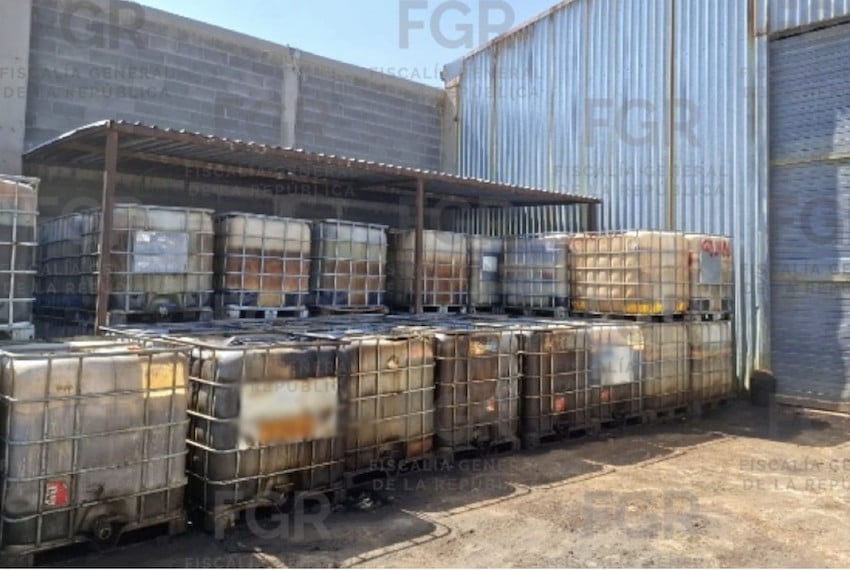
Federal authorities executed a search warrant at the property and seized eight tanks, each with a capacity of 80,000 liters, as well as a range of other equipment and machinery, the FGR said.
At the same property, authorities also confiscated between 500,000 and 600,000 liters of oil, “various documents” and a pickup truck, the Attorney General’s Office said.
Federal authorities raided another property in Laguna de San Vicente, San Luis Potosí, that the FGR said was “possibly used to carry out activities related to the illicit processing of hydrocarbons.”
Laguna de San Vicente is a small town on the shore of a lagoon of the same name in the municipality of Villa de Reyes, located south of San Luis Potosí city on the border with the state of Guanajuato.
The FGR said that authorities seized 18 vertical tanks at the Laguna de San Vicente property along with “two fuel production lines,” approximately 40,000 liters of crude oil and diesel, a sulfuric acid sample and “various documents.”
The Attorney General’s Office said it also received information about a facility in Tizayuca, Hidalgo, that was “probably used” to process fuel.
In Tizayuca, located in southern Hidalgo on the border with México state, the FGR said that authorities found 32 containers with a capacity of 1,000 liters and 25 containers with a capacity of 5,000 liters. In addition, they found and seized 456,300 liters of “possible fuel or chemical products, various documents, an electronic device, monitors and computer equipment.”
The FGR shut down a fourth illicit fuel processing center in Cuautla, a city and municipality in Morelos that is notorious for extortion.
The Attorney General’s Office said it received a report about a property in Cuautla from which a “strong smell” of fuel and chemicals emanated, and where tanker trucks, “escorted by pickup trucks,” constantly entered.
The FGR said that authorities seized six samples of fuel from containers as well as “various documents” and “check stubs.”
It didn’t specify the quantity of fuel seized at the property in Cuautla.
The latest blow to the illicit fuel trade
The announcement of the dismantling of the “illicit fuel processing centers” in San Luis Potosí, Hidalgo and Morelos comes after two similar facilities were shut down last month in Cadereyta, Nuevo León, and Reynosa, Tamaulipas. The facility in Reynosa was located just 1.5 kilometers from National Guard barracks.
Mexican authorities have carried out a number of other operations against the illicit fuel trade this year. They include seizing more than 100 tanker trucks and over 82,000 liters of petroleum products in Minatitlán, Veracruz, in February, and dismantling, in April, a criminal network that was smuggling up to 1.5 million liters of fuel per week. Unlike many other busts, suspects were arrested during raids related to the dismantling of said criminal network.
Fuel theft, mainly from Pemex pipelines, and fuel smuggling — including via a tax evasion scheme known as huachicol fiscal — are major problems in Mexico.
However, authorities have made some headway in combating the problems. Pemex’s losses due to fuel theft in the first quarter of 2026 declined almost 30% annually to 3.81 billion pesos (US $220.7 million), according to the state-owned company’s own data, and authorities regularly seize large quantities of contraband fuel. Meanwhile, various people have been arrested in connection with fuel smuggling, including high-ranking members of the Mexican Navy and a couple from Utah who allegedly smuggled US $300 million worth of crude oil from Mexico into the U.S. in collaboration with Mexican criminal organizations. In addition, former Baja California Governor Ernesto Ruffo was arrested last month on organized crime, fuel theft and tax evasion charges.
Despite the progress, there is plenty of work still to be done to combat the illicit fuel trade in Mexico, an activity that Mexican drug cartels diversified into years ago.
In a June 30 statement announcing sanctions against two Mexican nationals and nine entities allegedly tied to a Jalisco New Generation Cartel-linked fuel theft scheme, the U.S. Treasury Department said that “[p]ublic reporting suggests that a quarter to a third of all fuel sold in Mexico may be illicit.”
The Treasury Department also said that activities related to fuel theft and smuggling “are currently the most significant non-drug revenue source for Mexican cartels and other illicit actors.”
With reports from El Sol de México and Reforma