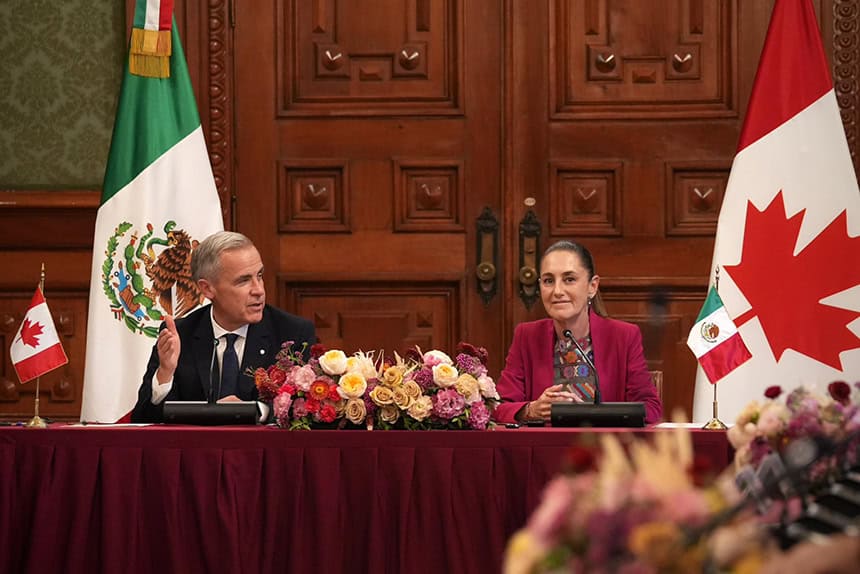
Canada is betting against American dominance and Mexico may pay the price.
In the past week, Canadian Prime Minister Carney has struck “strategic partnerships” with China and Qatar and delivered explosive remarks at the World Economic Forum in Davos.
The consequences could be far-reaching.
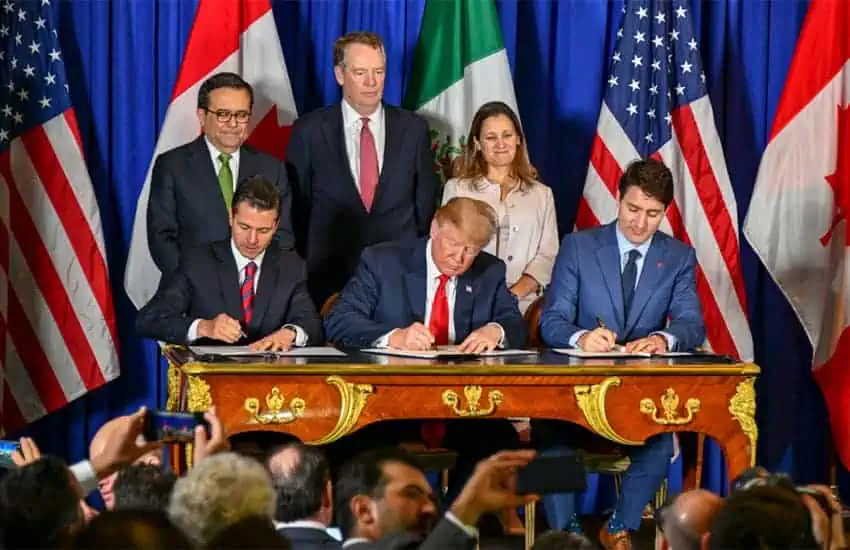
At stake is the critical $1.9 trillion USMCA free trade deal. The continental free-trade agreement, which replaced NAFTA in 2020, undergirds much of North America’s economy.
This year, it has come up for review. With official negotiations slated to launch imminently, any action could derail the deal.
As USMCA review nears, Canada branches out
Carney’s whirlwind week began with a trip to Beijing, the first in nearly a decade by a Canadian Prime Minister. There, he announced a “landmark” trade deal with China — unfreezing relations with a country he called “Canada’s biggest security threat” last spring.
The deal, though limited in scope, is a symbolic shot at the U.S.

Canada will lower tariffs on electric vehicles, set in tandem with the U.S. two years ago, in exchange for agricultural market access as well as energy purchase and auto investment discussions.

More important than the deal, however, is its framing.
Carney called his trip to China the “foundation of a new strategic partnership” for the “new world order” — a phrase Chinese officials often use themselves to reference what they consider is American decline. “The multilateral system has been eroded,” he went on to say, and “coalitions of like-minded countries” with “focused areas of cooperation” can replace it.
He followed that with the announcement of another strategic partnership with Qatar, before delivering a forceful speech at Davos. Without naming U.S. President Donald Trump, Carney referenced American hegemony and accused “great powers” of using economic integration as weapons. The rupture, he said, in the “rules-based international order” will “not be restored.”
Leaders from around the world gave a standing applause.
Mark Carney in Davos: This is the speech of a statesman – a riposte to Trump and to western defeatism pic.twitter.com/57ptXIiDrD
— Lionel Barber (@lionelbarber) January 20, 2026
Having received advance notice of the China deal, Trump reacted immediately, first saying that the USMCA is “irrelevant,” then that the U.S. “doesn’t need Canadian products.” He didn’t walk back either comment.
A divorce seems unlikely for the U.S. and Canada: 75% of Canada’s exports still go to the U.S., while China is a distant second at 4%. However, any breakup’s collateral damage is likely just beginning.
Bad timing for Mexico
For Mexico, the timing couldn’t be worse. With the imminent launch of the USMCA review, the U.S., Canada and Mexico are set to renew, renegotiate, immediately terminate or sunset the free trade agreement.
Though it’s early days, a fifth option seems increasingly plausible: The current three-way agreement could fracture into bilateral deals.
While the USMCA is critical to all three countries, Mexico — both the most export-dependent and U.S. market-dependent, with 81% of all exports going to the U.S. — has the most to lose if the pact splinters. About 85% of all Mexican exports enter the U.S. duty-free because of the USMCA.
By comparison, 30% of all U.S. international trade is from the USMCA. For the United States, this does not amount to as much as Mexico; just 11% of U.S. GDP comes from exports. U.S. business leaders argue that exports alone fail to capture the USMCA’s value; for them, the supply-chain cost savings and integrated continental infrastructure create a major economic advantage for the United States.
Referencing this support among the American business community, Mexican President Claudia Sheinbaum has so far remained optimistic on the deal’s review. “Those who most strongly defend the [USMCA] are American businesspeople,” she said.
Still, it may not matter.
Trump and his U.S. Trade Representative Jamieson Greer have mulled breaking the USMCA into bilateral agreements since last year. The rationale is clear: Bilateral deals hand the U.S. significant leverage — even at the risk of costly supply-chain disruption.
Recognizing this, Canada is diversifying. Beyond China and Qatar, Carney has accelerated trade negotiations with ASEAN, Mercosur and at least 10 other countries. On offer are the energy superpower’s rich mineral resources, large domestic market with high per-capita spending, scaled logistics infrastructure, and a ready-to-invest coffer of funds.
Mexico lacks these advantages. American market access is a key pillar of Mexico’s value proposition, especially in a friend-shoring global investment environment. Capitalizing on this, Mexico has carefully aligned itself closer to the U.S. in recent years.
Those close U.S. ties may now backfire for Mexico.
What are Mexico’s options?
As Canada builds itself out, Mexico is finding itself increasingly locked in. After years courting Chinese manufacturers — notably BYD’s now-postponed $2 billion plant — Mexico raised tariffs on non-free-trade agreement countries (including China) up to 50%. Meanwhile, security cooperation with Washington continues to intensify.
As the USMCA review begins, expect the U.S. — flush with leverage — to demand more investment screening mechanisms, expanded security operations, stricter rules-of-origin, invasive labor provisions and even foreign policy alignment.
Mexico is now the top buyer of U.S. goods, beating out Canada
Already, the USMCA limits certain foreign policy moves; Article 32.1 restricts free trade deals with “non-market countries” — code for China. But newer U.S. deals go further, introducing “poison pills” that transform agreements “from purely commercial instruments into tools for managing partner countries’ broader foreign policy orientation,” according to analyst Simon Evenett of Global Trade Alert.
At Davos, Carney offered a framework for escape from this dynamic. “Middle powers must act together because if we’re not at the table, we’re on the menu,” he said. “When we only negotiate bilaterally with a hegemon we negotiate from weakness. We compete with each other to be the most accommodating.”
“This is not sovereignty,” Carney concluded. “It’s the performance of sovereignty while accepting subordination.”
Mexico’s choice will be binary: Accept these sovereignty-limiting demands or lose American market access. While Canada can credibly threaten to walk away, Mexico cannot.
The tradeoff goes unstated. Does deeper U.S. integration bring greater prosperity? President Sheinbaum argues yes — North American unity is essential to “compete with China.”
Still, her rhetoric may not be enough.
“Remember, Mark,” Trump said on Wednesday, “Canada lives because of the United States.” Carney’s moves could still invite retaliation; the risks, for both Canada and Mexico, are sky-high.
As Carney walks his tightrope between Washington and Beijing, Mexico may find its options narrowing. The question is no longer if middle powers can chart their own course, but whether Mexico still has the choice.
Logan J. Gardner is a Wharton-educated content strategist, writer, photographer and filmmaker based in Mexico City. Sign up to receive his newsletter, Half-Baked, peruse his blog or follow him on Instagram for more.