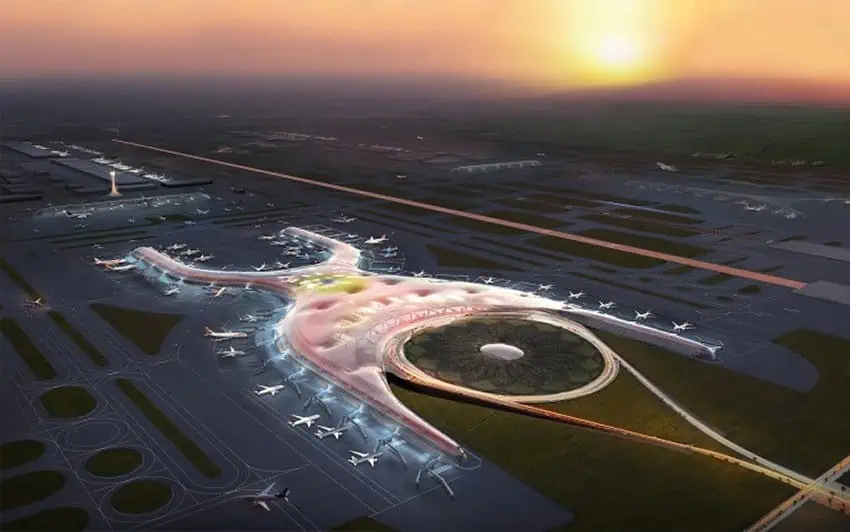
The Felipe Ángeles International Airport (AIFA) is an austere facility in the boondocks whereas the previous government’s canceled airport project would have been a “state-of-the-art” hub, according to an Australia-based aviation analysis and research company.
Centre for Aviation (CAPA) said in a report that the canceled US $13-billion Texcoco airport project would have replaced the busiest airport in Latin America – the saturated Mexico City International Airport – with a “new, single-site and state-of-the-art facility.”
The airport would have been open by now except it was “abruptly abandoned, partly completed and at huge cost, by the incoming president in 2018,” CAPA said, referring to Andrés Manuel López Obrador’s decision to cancel the project following a legally questionable referendum held a month before he took office.
López Obrador repeatedly claimed that the previous government’s project was plagued by corruption, too expensive and being built on land that was sinking, but CAPA posited that he held a spurious referendum on the airport and then canceled it for political reasons.
In its report, entitled Mexico City’s new airport opens – ‘mission accomplished,’ or is it?, the research firm noted that the replacement is “a converted military base out in the boondocks beyond city limits, where the military remains.”
The airport, which opened March 21, was built by the army on the Santa Lucía Air Force base, located about 50 kilometers north of downtown Mexico City in México state. The site of the canceled airport is about half that distance northeast of the historic center.
CAPA acknowledged that the AIFA – part of a three-pronged plan to meet air travel needs in the greater Mexico City area – at least opened on time, but observed that it has few air services and scant interest from international airlines.

“One of the issues facing the airport as it attempts to attract new airlines is its distance from downtown, the central business district and the southern suburbs,” the report said.
CAPA raised concerns about the lack of transport connections to the AIFA given that a new highway connection and rail link have not yet been completed.
Centre for Aviation said that it is probable that the AIFA will be compared to the Montréal–Mirabel International Airport, located 40 kilometers northwest of the Canadian city.
That airport, it said, failed to attract sufficient passenger flights due to its location and for that reason became a cargo-only airport in 2004.
CAPA said the AIFA will be able to handle 20 million passengers annually in its first phase of operations and 40 million per year in its second phase, although only 2,000 passengers per day, or fewer than 1 million per year, are currently using it due to the low number of flights.
“In 2052 it is expected to serve approximately 90 million passengers a year,” the company added, citing a figure that would be well above the record 50.3 million passengers who used the Mexico City International Airport (AICM) in 2019.
CAPA acknowledged that the success or otherwise of the new airport will contribute to the overall perception of the performance of AMLO, who has unsurprisingly championed the AIFA – one of his pet projects.
“Halfway through the president’s six-year term of office, the success or failure of the Felipe Ángeles International Airport may well turn out to be President [López] Obrador’s ultimate legacy,” CAPA said.
The federal government also intends to upgrade the AICM and the Toluca airport in order to increase their capacity and meet what was growing demand for air travel before the coronavirus pandemic began.
With reports from Reforma