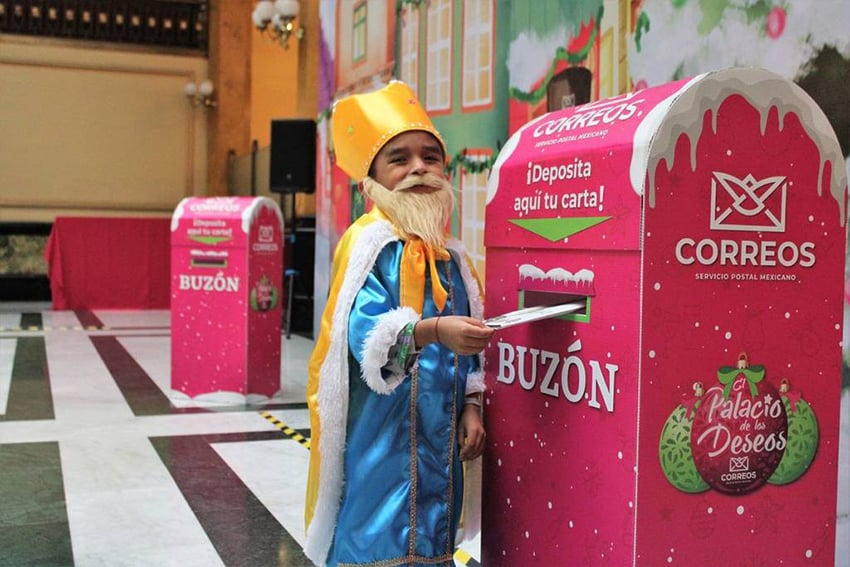
The towering marble halls of Mexico City’s historic main post office have once again transformed into the “Palace of Wishes,” inviting children to send free letters to Santa Claus and the Three Wise Men this holiday season.
The program — run by Correos de México, the postal service of Mexico — launched this week and will run through Jan. 5, 2026.
La magia está por llegar… ✨
En Palacio Postal estamos listos para celebrar contigo esta Navidad 🎄Muy pronto descubrirás todo sobre el Palacio de los Deseos…
Prepárate para enviar tu carta al Polo Norte y a los Reyes Magos 🤩🤩#PalacioPostal #PalacioDeLosDeseos… pic.twitter.com/L3Ej0v0ovr— Palacio_Postal (@Palacio_Postal) December 9, 2025
The base of operations is Mexico City’s grand Palacio Postal, or Postal Palace, located in the Historic Center across the street from the Palacio de Bellas Artes. It’s an active postal facility as well as a popular place to visit for its ornate architecture and interior.

From 10 a.m. to 4:30 p.m. daily, children can attend a workshop there that teaches how to address envelopes correctly, the role of sender and recipient information, and the importance of postage.
Staff will explain all this while youngsters prepare their letters destined for the North Pole or the Wise Men (Reyes Magos).
In Mexico, children have long written letters to the Three Wise Men, asking for gifts to be delivered on Jan. 6, Día de Reyes, or Three Kings Day in English.
That’s when children in Mexico traditionally receive holiday presents, said to be from the Magi (often called the Three Wise Men or Three Kings), who are described as having brought gifts to the baby Jesus.
This is in contrast to the United States, Canada and other countries where presents are typically exchanged on Dec. 25.
In recent years, however, many Mexican children also write to Santa Claus, often sending separate wish lists to both, and receiving presents on Christmas morning (or Christmas Eve) as well as Jan. 6.
Participation at the Postal Palace is free, though a Christmas kit — including special stationery and one seasonal postage stamp — is available for 30 pesos (US $1.67). The kit is available at post offices all over Mexico.
To receive a reply, children writing from anywhere (not just the Postal Palace) must include their own address, the destination of their “wish letter” (Santa Claus or the Three Wise Men) and proper postage.
Violeta Abreu González, director of Correos de México, recently unveiled the new, 15-peso seasonal stamp, one inspired by the Mexican tradition of Christmas posadas — a candlelit neighborhood procession that reenacts Mary and Joseph asking for shelter, ending with prayers, food and beverages, and a star-shaped piñata.
The stamp includes images of romeritos (a holiday dish of tender seepweed sprigs bathed in mole poblano), buñuelos (fritters dusted with cinnamon sugar), ponche (a warm fruit punch that’s often spiked) and aguinaldos (small goody bags).
“Celebrating like this is not a new custom,” Abreu González said as quoted by the media outlet Chilango.com. “It is an identity that has been passed down from generation to generation and that new families must keep alive.”
Organizers said responses to children may take about a month, as Santa and the Wise Men receive many, many letters from around the world.
With reports from Chilango.com and El Heraldo de México