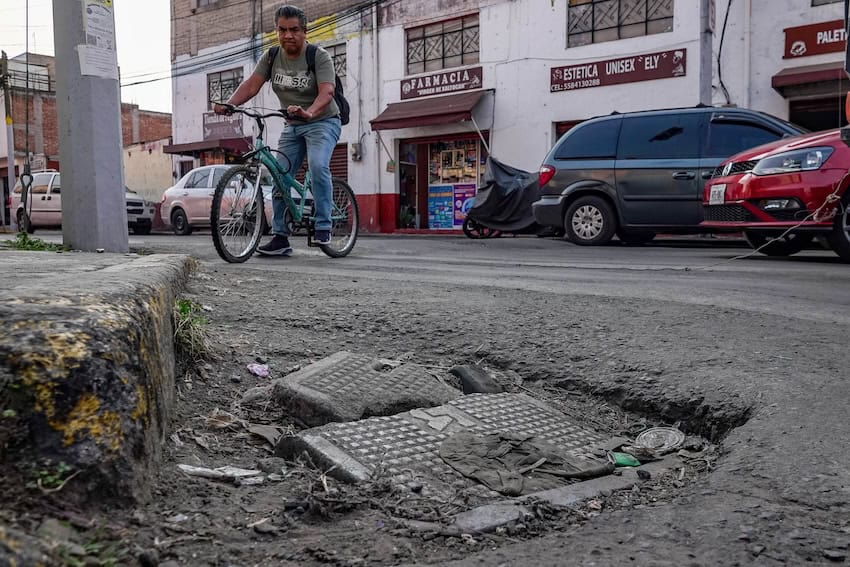
For residents of Mexico’s cities, potholes remain the primary concern, followed by the supply and delivery of drinking water, insufficient public lighting and traffic congestion.
According to the latest National Survey of Urban Public Safety conducted by the national statistics agency INEGI, 82.7% of those surveyed considered street potholes to be the most important problem in Mexican cities.
The survey was carried out by interviewing adults in more than 27,000 homes across 91 urban areas from Feb. 23 to March 13.
Although Security Minister Omar García Harfuch and others focused on the reduction of the perception of insecurity when the survey was first published in late April, a deeper dive into the data by the newspaper El Economista examined how other details might impact the country’s economy.
The fact that more than eight out of 10 adults expressed such concern about potholes while worries about crime fell from 56.6% to 52.1% should be instructive for authorities, who tend to spotlight insecurity.
Of the 91 urban areas where the survey was taken, El Economista pointed out that potholes were identified as the No. 1 concern in 81 of them. It also found that in the northern city of Ciudad Obregón, Sonora, 99.8% of respondents said potholes were their top concern.
In addition to being a priority for constituents, the issues identified as top concerns by the public ought to be recognized as disincentives to attracting investment, particularly for the largest local economies in the country.

After potholes, 59.2% of respondents identified failures and leaks in the drinking water supply as a top concern. This was followed by worries over insufficient public lighting (56.3%), frequent traffic congestion (53.6%) and then criminal activity. The fifth-ranked concern among urban residents was overcrowded or poorly served hospitals (51.4%).
Other issues identified in the survey results were street drains clogged by accumulated waste (50.6%), neglected parks and gardens (41.2%), deficiencies in the public drainage network (40.9%) and poor public transport service (39.9%).
With reports from El Economista and Infobae