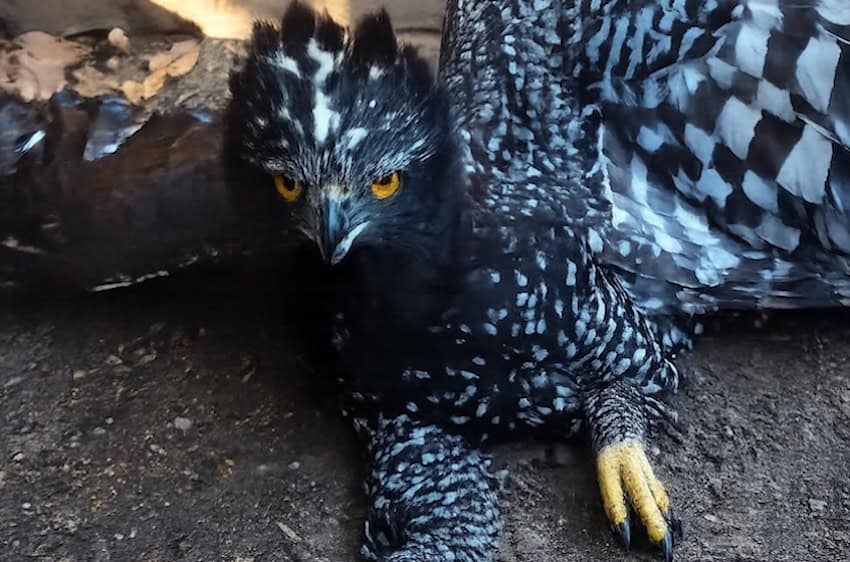
The first confirmed sighting of a black hawk-eagle — an apex raptor listed as endangered in Mexico — has been recorded in a nature reserve in the state of Querétaro.
The finding in the Sierra Gorda Biosphere Reserve marks a significant expansion of the species’ known range, authorities said.

The National Commission of Natural Protected Areas (Conanp) reported this week that the Águila Tirana — known locally as the tyrant eagle and in English as the black hawk-eagle — was documented for the first time in the protected area in northern Querétaro.
The agency said the finding resulted from ongoing biological monitoring and coordination with residents of the Ayutla ejido in the municipality of Arroyo Seco.
The species had not previously been officially reported in the region, which lies more than 150 kilometers from its historically documented range — the lowland and mid-elevation tropical forests of Mexico’s southeast, particularly along the Gulf of Mexico.
In a press release, Conanp described the raptor as an apex predator in tropical ecosystems, noting its presence reflects healthy habitat conditions within the reserve.
The Sierra Gorda landscape includes canyon systems with oak forests and seasonally dry tropical forests that form part of the Sierra Madre Oriental biological corridor.

Listed as an endangered species and protected under Mexican law, Spizaetus tyrannus depends on the conservation of tropical and cloud forest ecosystems and habitat connectivity for survival. Authorities said its role as a top (apex) predator helps regulate prey populations and maintain ecological balance.
The discovery adds to a series of notable eagle-related conservation developments in Mexico in recent years. In 2026, officials confirmed a golden eagle nesting site in Coahuila, while in 2025, the mystical-looking harpy eagle — long believed extinct in the country — was documented in Chiapas.
While eagles carry deep national symbolism — notably the golden eagle depicted devouring a snake on a cactus in Mexico’s flag — the black hawk-eagle is a distinct species and not Mexico’s national symbol.
Globally, conservation groups such as BirdLife International estimate there are between about 50,000 and 500,000 mature black hawk-eagles, classifying the species as least concern.
But while the bird of prey is still common in tropical forests from Mexico to northern Argentina, the species appears to be in decline and is treated as endangered within Mexico’s borders due to habitat loss.
With reports from La Jornada and Infobae