The Quintana Roo government and the state’s tourism industry have rejected President López Obrador’s assessment that the arrival of sargassum on Caribbean coast beaches is not a serious issue, declaring that the problem is in fact “extremely serious.”
In addition to dismissing the president’s evaluation, Tourism Secretary Marisol Vanegas Pérez said that it would be “very worrying” if the federal government doesn’t release more resources to combat the arrival of the seaweed on the Quintana Roo coastline.
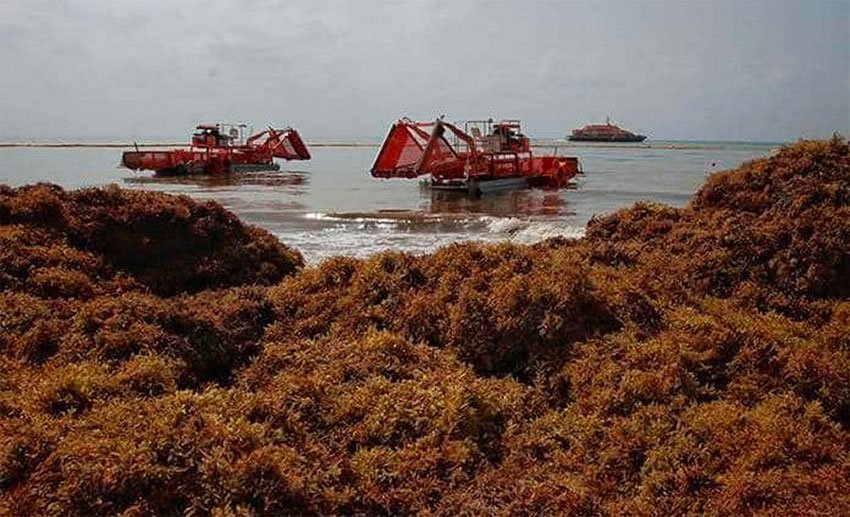
Navy Secretary Rafael Ojeda announced yesterday a 52-million-peso (US $2.7-million) anti-sargassum plan, which includes the installation of new barriers to keep the weed from reaching beaches as well as the construction of vessels to collect it at sea.
But both Vanegas and Governor Carlos Joaquín González believe that the funding is insufficient – it represents just 5.2% of the 1 billion pesos (US $52 million) the state government has said is needed to implement a comprehensive strategy against the invasion of the smelly and unsightly seaweed.
Asked yesterday whether his administration anticipated more federal money to be forthcoming, Joaquín responded: “yes, of course, we expect more resources.”
But it appears unlikely that the federal government will commit to providing anywhere near the level of funding sought by its state counterpart, which earlier this month declared a state of emergency due to the large amounts of sargassum washing up on beaches.
At his daily press conference yesterday, López Obrador recalled that shortly after he took office last December he was presented with a proposal for an exorbitantly priced anti-sargassum plan.

“What they were seeking was to be able to award contracts without calling for bids, to do business with the problem. That’s finished now . . .” he said.
Despite the unwillingness to allocate larger sums of money to the issue, Navy Secretary Ojeda asserted that the sargassum issue is being treated as a “state problem” for the first time, with a coordinated response from the three levels of government.
However, hotel owners remain less than satisfied with the authorities’ efforts.
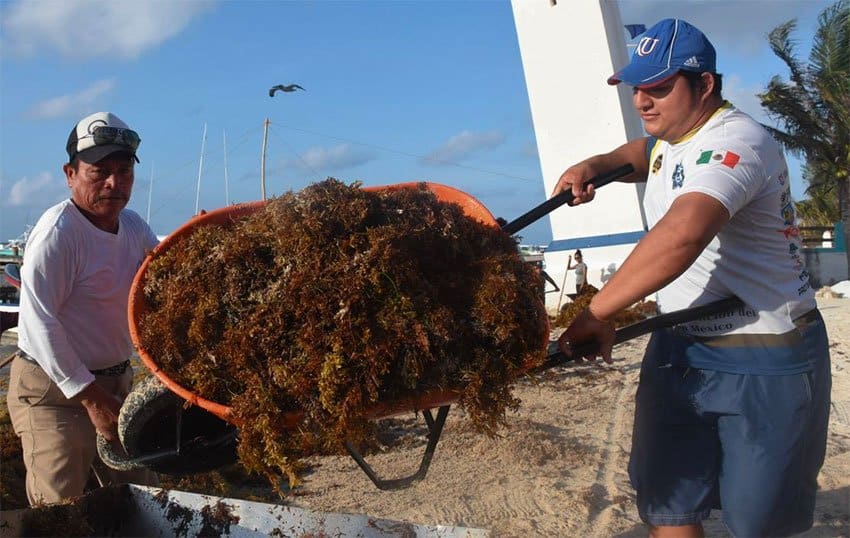
After describing the government response as “slow” and “uncoordinated” last month, hotel owners reiterated that they are still spending their own money – up to 3 million pesos (US $156,200) a month in some cases – to keep beaches free of sargassum.
Hoteliers who spoke to the newspaper El Financiero also rejected López Obrador’s minimization of the gravity of the situation, stating that the problem “isn’t serious, it’s extremely serious.”
They said hotel occupancy levels in destinations such as Cancún and the Riviera Maya have fallen between 3% and 7% and that some businesses, such as restaurants and providers of beach activities, have lost up to half their normal revenue as a result of the tourism downturn caused by the sargassum invasion.
Roberto Cintrón Gómez, president of the Hotels Association of Cancún and Puerto Morelos, said that most tourists who vacation in Quintana Roo expect sunny weather and clean beaches, explaining that seeing the coastline covered with sargassum “causes disappointment” among visitors.
Nevertheless, visitor numbers during the summer vacation period are expected to be strong, according to the state tourism secretary.
Based on airline bookings and hotel reservations that have already been made, Vanegas predicted just over 3.3. million visitors during the summer months, a figure that would be similar to that recorded in the same period last year.
Source: El Economista (sp), El Financiero (sp)