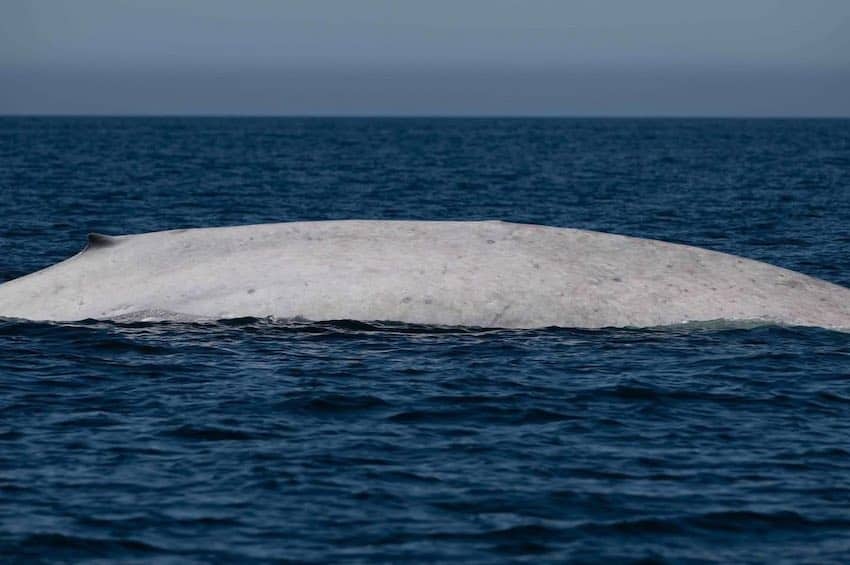
The sighting of an albino blue whale off the Baja Californian city of Loreto marks an unprecedented milestone for marine biology, the National Commission for Natural Protected Areas (CONANP) announced on Friday.
The blue whale (Balaenoptera musculus) sighting took place in Loreto Bay National Park (PNBL) and caps an unprecedented whale watching season, with at least 30 different blue whales having been identified within the protected natural area this past winter.
Albinism is a hereditary genetic condition, which manifests in the partial or total absence of melanin, the pigment responsible for color in the skin, eyes and hair. The condition is extremely rare, and while the percentage of blue whales with the condition is uncertain, albinism affects roughly 0.0025% of humpback whales.
Among the whale sightings this season was a mother whale and calf, “underscoring the critical importance of Loreto as a vital area for the breeding and refuge of this species,” CONANP stated.
The blue whale is considered “endangered” by the International Union for Conservation of Nature Red List of Threatened Species, making the recording of whale sightings extremely important for the species’ conservation.
The PNBL has increased its photo-identification and monitoring efforts in recent years, viewing the work as essential to increasing knowledge about the presence and movements of whales in the region.
Loreto, the Baja Peninsula Pueblo Mágico, makes the BBC’s top 20 list of world destinations

Scientists at PNBL aim to conduct scientific research without disturbing the natural cycles of the marine mammals, as well as promote a sustainable approach to whale watching among tourists.
The PNBL noted that, unlike in previous years, the whales in Loreto Bay have been cruising and feeding closer to shore.
They attribute this change in behavior to a large upwelling of nutrients that has boosted the availability of krill, the primary food source for the blue whale, which needs to consume up to four tonnes daily to survive.
The abundance of food closer to shore has allowed enhanced observation of the mammals and indicates that the marine ecosystem in the region is healthy and productive.
Overall, it has been a successful whale watching season on the Baja California peninsula, with the reporting of over 500 gray whales in residence at the El Vizcaíno Biosphere Reserve, in Los Cabos, in Baja California Sur.
With reports from La Jornada and El Financiero