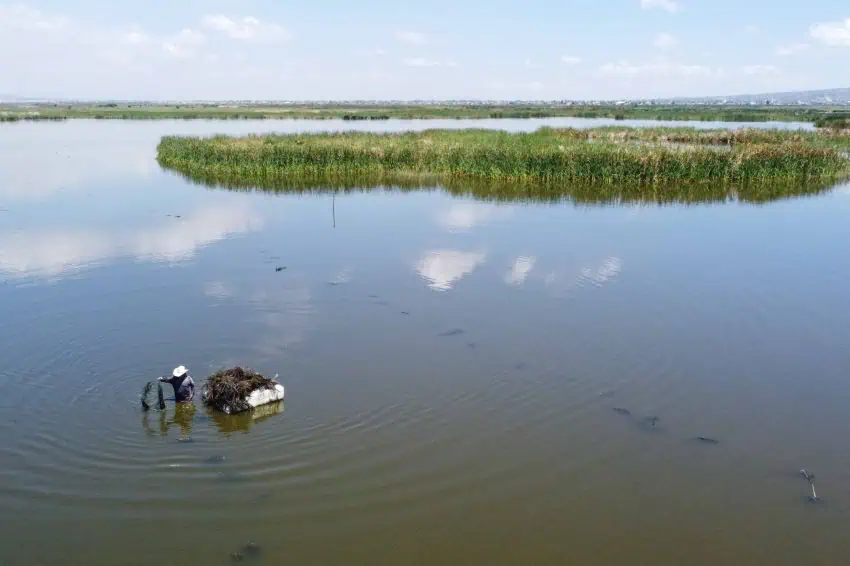
Heavy summer rains in central Mexico are revitalizing Lake Texcoco, submerging the remnants of the partially built Mexico City airport project and marking a symbolic turn in a decades-long debate over land use and ecological restoration.
According to the National Commission of Natural Protected Areas (CONANP), nearly two months of persistent rainfall have brought water levels in Lake Texcoco to depths reaching four meters.
La estructura del aeropuerto de Texcoco está hoy totalmente inundada convirtiéndose en un cuerpo de agua de un ecosistema que nunca debió ser desecado.🧵 pic.twitter.com/ycYy85sGZj
— César Pineda (@cesarpinedar) July 7, 2025
The waters have covered the partially constructed terminal and the concrete foundations left after work on what was to be a new Mexico City International Airport was abruptly cancelled nearly seven years ago.
Being built on an ancient lakebed in Texcoco, México state, the airport was the signature infrastructure project of former president Enrique Peña Nieto (2012-2018).

The controversial U.S. $15-billion project was canceled by Andrés Manuel López Obrador near the start of his six-year term in 2018, following a public referendum and a widely criticized four-day consultation on the project.
Since then, Lake Texcoco has been inaugurated as an ecological park last August and subsequently designated as an Ecohydrology Demonstration Site by UNESCO — the first of its kind in Mexico.
Now, thanks to the rains, the waters are rising.
“The 100 hectares of the terminal building are partially flooded, but we expect that by the end of September — with the end of the rainy season — the level at that site will rise two more meters,” said Jorge Daniel Fonseca Cando, director of the Texcoco Lake Natural Resources Protection Area.
The higher water level “will allow us to see a more unified body of water that, we estimate, will measure approximately 700 hectares within the Texcoco Lake Ecological Park area.” The full ecological area stretches across 14,030 hectares, 10,000 of which are categorized as lakebed.
Community members and activists, notably from the People’s Front in Defense of the Land (FPDT), have led efforts for years to prevent construction and restore the land.
On a recent tour for the media, FPDT leaders showed over 1,800 hectares already filled with water in the now protected area.
FPDT leader Ignacio del Valle Medina expressed hope of surpassing 4,000 hectares by the season’s end.
¡El Lago de Texcoco resiste, no se rinde! 🌊🦅
Está en el centro de la bandera… y en el corazón de todas y todos.Hoy lo reafirmamos junto a Nacho y Trini, compañeros del Frente de Pueblos en Defensa de la Tierra: ejemplo de dignidad, lucha y amor por el territorio.
🌱 ¡Que el… pic.twitter.com/iOyI5JCSO2
— Adán Peña (@adanmexic) July 17, 2025
“What we can tell you from here, from the lake, is that the people and the water are here, and we will erase every trace left by that deadly project, and we will reclaim Lake Texcoco for Mexico, for the nation’s capital and the eastern part of the State of México,” he said.
Simultaneously, Lake Texcoco is witnessing a resurgence in native flora and fauna, with recent counts registering 230,000 migratory birds — including seven species unseen in years — and thriving populations of aquatic plants and shorebirds.
The lake, part of the basin of the Valley of Mexico, and its system of lagoons and wetlands provide a lifeline for a polluted valley that includes Mexico City and its metropolitan area.
“Lake Texcoco is beginning to recover and refuses to disappear,” said FPDT member Arturo González Cando. “We will be able to concentrate up to seven million cubic meters of water by the end of the rainy season.”
The structural remains of the failed airport, such as sunken concrete piles and foundation wells, are now submerged under millions of cubic meters of water, creating new habitats. The lake area is home to 250 species of flora and 370 species of fauna.
Restoration efforts by the FPDT, CONANP and local organizations have involved redirecting nearby rivers and building dams to further expand water storage.
The architect behind the restoration, Iñaki Echeverría, helped inaugurate the ecological park — now one of the world’s largest urban green spaces — last August, shortly before the end of López Obrador’s term.
“This is what we defended, a unique life in the center of the country,” González Cando said, highlighting the area’s importance as a natural barrier against urban sprawl and a crucial reservoir for the Valley of Mexico’s hydrological future.
With reports from El País, La Jornada, Sin Embargo and El Economista