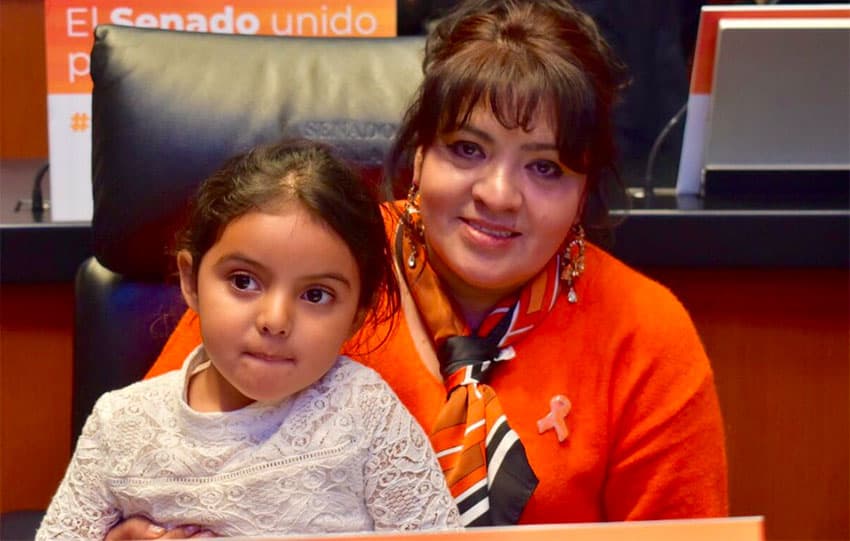
The Senate voted unanimously Tuesday to ban corporal punishment of children and teenagers.
Sponsored by Senator Nestora Salgado, the bill reforms the General Law of the Rights of Girls, Boys and Teenagers, which previously did not explicitly prohibit the practice.
Salgado has been a consistent advocate in the Senate against various forms of violence against minors.
Her initiative was backed up by global data from the United Nations Children’s Fund (UNICEF), which said in its 2017 annual report that six out of every 10 children aged 1-14 have experienced some type of violence in the home.
One out of every 15 children was reported to have experienced severe forms of physical punishment, such as ear pulling, slaps, punches or strong beatings as a form of discipline.
“The school and public spaces are two environments in which eight of every 10 aggressions against girls, boys and teenagers between 10 and 17 years old take place . . . the home is the third place where they are exposed to violence,” reported the UNICEF study.
It also found that girls and female adolescents are the most affected, as seven of every 10 are subjected to violence in the home.

National Action Party (PAN) senator and head of the childhood and adolescence rights committee, Josefina Vázquez Mota, said the law will deter extreme punishments, which often cause serious injuries and sometimes death.
A mother and her partner were arrested this month and charged with murder after her four-year-old son died from injuries sustained when they beat him for crying.
“According to data from the National Institute of Statistics and Geography, between 2012 and 2017 nearly 2,600 children aged 15 or under were killed, 42% at the hands of a family member in the home or by mistreatment. Corporal and other humiliating forms of punishment are still used as modes of discipline and correction for girls, boys and teenagers,” Vázquez told the Senate.
Only Zacatecas, Durango and Mexico City have laws prohibiting corporal punishment, while 14 Mexican states legally justify the practice as a way for parents to discipline their children. However, the regulations go against the UN Convention of the Rights of the Child, which Mexico signed in 1990.
By passing the law — it goes before the lower house of Congress next — Mexico would join 61 other countries that have completely prohibited child corporal punishment, including Brazil, Argentina, Peru, Costa Rica and Spain.
The United States and Canada are not among them. The only U.S. state that does not explicitly give parents the right to use a form of “moderate physical discipline” against their children is Minnesota.
In Canada, parents can use “reasonable” force to discipline children, but the practice has seen its challenges, most notably by a 2004 “spanking case” in which the Supreme Court voted to uphold the practice by a 6-3 vote.
Sources: Sin Embargo (sp), Milenio (sp)