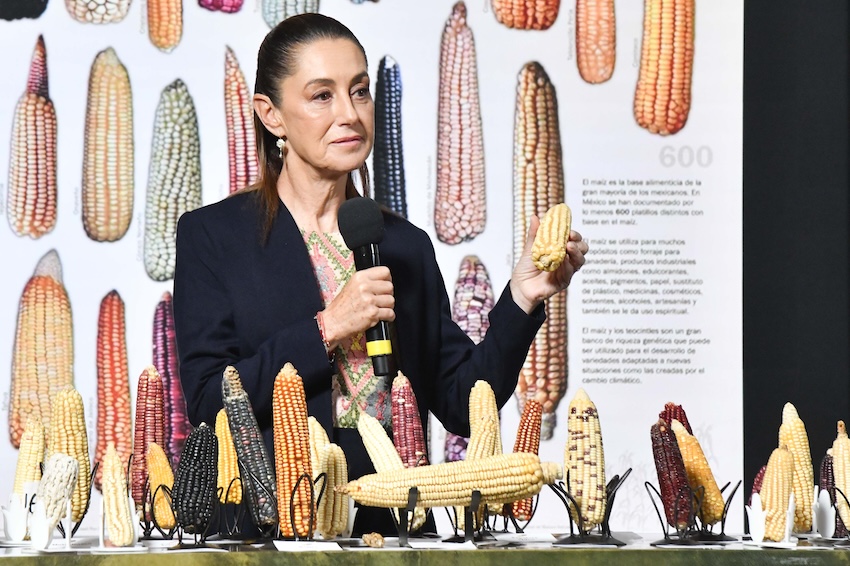
President Claudia Sheinbaum has announced the strengthening of germplasm or seed banks to further safeguard the genetic varieties of Mexican corn as part of her policy to protect a grain that is considered a national and cultural heritage.
The federal initiative follows a recent constitutional reform that prohibits the planting of genetically modified corn in Mexico. The ban seeks to ensure that native varieties are not at risk of disappearing as a result of contamination from modified corn crops.
A germplasm bank or seed bank is a repository where the seeds and hereditary material of plant varieties are preserved to protect their distinct genetic makeup. Sheinbaum’s plan is to fortify the existing corn germplasm bank system to safeguard all 64 varieties existing in Mexico, 59 of which are native. Those varieties of corn (or maize in English and maíz in Spanish) are considered vital to Mexico’s food security as well as its cultural identity.
“For each variety of corn that exists in Mexico, we need a bank to store that corn, those corn kernels, that germplasm, so it doesn’t get lost,” Sheinbaum said during her morning press conference on Monday, Sep. 29, which is National Corn Day.
The germplasm bank is part of a larger agricultural program dubbed Sin maíz no hay país (Without corn there is no country), which aims to support corn producers.
Congress to consider constitutional ban on growing GM corn in Mexico

Mexico is already home to several germplasm or seed banks focused on the conservation of seeds and genetic diversity of different crops, including some dedicated to corn. During the morning press conference, Mexico City Environment Minister Julia Álvarez Icaza reminded reporters that Mexico already houses the world’s largest maize germplasm bank, making the protection of the country’s corn a matter of global food security.
Called the International Maize and Wheat Improvement Center (CIMMYT), this germplasm bank is located in Texcoco and houses the largest and most diverse collections of maize and wheat in the world.
Dr. Carlos H. Avendaño, Director of the National Center for Genetic Resources (CNRG), has said that the most important objective of the conservation strategy is to ensure the preservation and availability of seeds and other species for the future.
He explained that germplasm banks play a crucial role in safeguarding Mexico’s existing genetic resources, as they ensure agri-food sovereignty. For instance, in the event of a pest problem, these banks can provide resistant strains that may resolve the issue.
Finally, Sheinbaum noted that this program will also include the distribution of free fertilizers and direct financial support to strengthen the cultivation of native corn in Mexico.
With reports from El Sol de México and La Jornada Maya