President Claudia Sheinbaum’s daily press conferences set much of the week’s agenda, moving from children’s social media use to a government transparency decree, a high-profile murder, fracking policy and a diplomatic breakthrough with Peru. Economic data told a mixed story too, with a strengthening peso set against a sharp drop in Pemex profit and a battered Sinaloa economy.
Security developments also kept pace, including the arrest of a former Guerrero governor on Ayotzinapa-related charges, a jump in U.S. rewards tied to CJNG’s new leadership, and a fresh U.S. suspension of avocado certifications in Michoacán. On the public health and safety front, a UNAM cheating scandal, a UNESCO deadline to protect the vaquita and a cyclosporiasis scare linked to Riviera Maya travel all drew attention.
Didn’t have time to catch this week’s top stories? Here’s what you missed.
Economy: Peso strengthens and avocado trade swings
Mexico’s currency extended a 10-day rally to reach its strongest level since February, helped by the Bank of Mexico holding its benchmark rate at 6.5% and a weaker US dollar following a soft American jobs report. The gains came even as Pemex reported a 70% annual drop in second-quarter net profit, which the state oil company attributed to higher financial costs, tax obligations and an unfavorable exchange rate. Economic disparities varied widely by region, with Sinaloa’s economy posting the worst quarterly contraction of any Mexican state, a result economists linked to the ongoing cartel conflict in the region.
Tourism data added to the mixed picture: Tourism GDP fell 0.8% quarter-over-quarter in the first three months of the year, according to INEGI, driven by a 5.9% quarterly drop in spending by foreign visitors, even as domestic tourism consumption rose 0.5%.
Mexico’s avocado trade also had a volatile week. New data showed exports to the U.S. jumped 35% in the first quarter compared to the previous year, according to Sader. Days later, however, the United States suspended avocado export certifications in Michoacán, citing an unspecified “threat against U.S. interests” — the third such suspension in just over four years. Michoacán’s governor deployed additional state security operatives and the Defense Ministry sent more than 1,500 soldiers to the region in response.
US suspends avocado imports from Mexico over unspecified ‘threat against US interests’

Energy: Government edges toward fracking while banning it in Mexico’s top basin
A government expert committee tasked with assessing “sustainable fracking” recommended prohibiting hydraulic fracturing in the Tampico-Misantla basin, Mexico’s largest-potential shale region, citing environmental, social and biodiversity concerns. Sheinbaum said her government would respect that recommendation, which she reaffirmed at Friday’s mañanera.
However, the committee recommended continued evaluation of two other northern basins. Reuters reported that pilot projects in Coahuila and Tamaulipas could begin as soon as next month if approved, as Mexico looks to reduce its reliance on natural gas imports from the United States.
Security: Pressure builds on cartels and past officials
U.S. authorities raised the reward for CJNG’s new leader, Juan Carlos Valencia González, to $25 million following the February death of cartel founder “El Mencho,” as part of more than $100 million in reward offers and new visa restrictions. Domestically, federal agents dismantled four illicit fuel processing centers in San Luis Potosí, Hidalgo and Morelos, seizing roughly 1 million liters of fuel. In Sinaloa, Sheinbaum acknowledged the murder of content creator César Gastélum, the ninth social media personality killed in the state since 2024. And in a case tied to one of Mexico’s most notorious unsolved crimes, federal authorities arrested former Guerrero Governor Ángel Aguirre on charges of concealing video evidence related to the 2014 disappearance of 43 Ayotzinapa students; Sheinbaum said the arrest was not politically motivated.
Public health, environment and education
Sheinbaum laid the cornerstone for a new IMSS hospital in Oaxaca, part of a three-facility “Health City” complex the government frames as a step toward its planned Universal Health Service. And after the U.K. reported dozens of cyclosporiasis cases among travelers, Mexico stepped up health inspections at Riviera Maya hotels, while officials said the country has not been identified as the outbreak’s source.
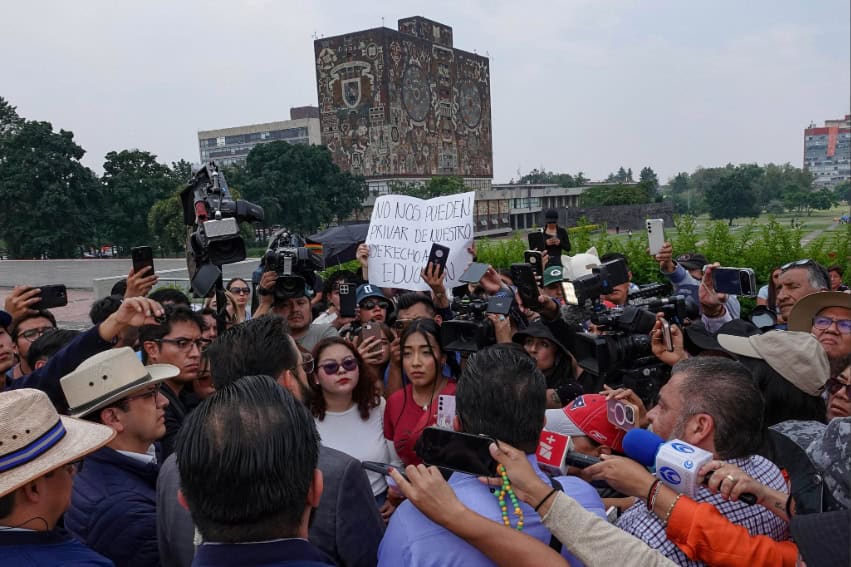
Officials at the National Autonomous University of Mexico (UNAM) confirmed that nearly 60,000 applicants must retake its entrance exam after widespread cheating undermined its first-ever online exam.
Separately, UNESCO gave Mexico until February to show concrete action to protect the critically endangered vaquita porpoise, of which only seven to 10 are believed to remain.
Diplomacy and governance
Sheinbaum signed a decree aimed at strengthening federal government transparency, which officials said would compel departments to disclose more information following the 2024 elimination of the INAI watchdog agency.
On the diplomatic front, Sheinbaum announced that Mexico and Peru would restore relations severed since November, after former Peruvian Prime Minister Bettsy Chávez was granted safe passage from asylum in Mexico’s Lima embassy.
Looking ahead
The coming weeks will test several threads left open this week: whether Mexican and U.S. officials can resolve the security concerns behind the avocado certification suspension, whether President Sheinbaum’s panel of experts finds acceptable conditions in northern Mexico to move fracking pilot projects forward, and how UNAM’s rescheduled in-person exams — set for mid-to-late August — play out after the cheating controversy. Mexico also faces UNESCO’s February deadline on vaquita protections and continued scrutiny of Sinaloa’s cartel-driven economic slowdown.
Also in the news this week
- Estadio Azteca’s owner, Grupo Ollamani, reported an estimated $47 million loss tied to World Cup costs, even as FIFA posted record tournament revenue.
- Embraer officially began operations at its first manufacturing plant in Mexico, located in Chihuahua’s state capital.
- Taiwanese tech firm Inventec announced a US $450 million expansion in Ciudad Juárez that’s expected to create up to 6,000 jobs.
- UNAM is installing 58 new seismic monitoring stations to expand earthquake tracking across Mexico’s historically under-instrumented northern states.
- UNAM chemistry researchers are experimenting with food waste like overripe bananas and pumpkin to brew more nutritious beer.
- Tulum was named the world’s happiest travel destination in a new analysis of over a million travel reviews.
Mexico News Daily
This story contains summaries of original Mexico News Daily articles. The summaries were generated by Claude, then revised and fact-checked by a Mexico News Daily staff editor.