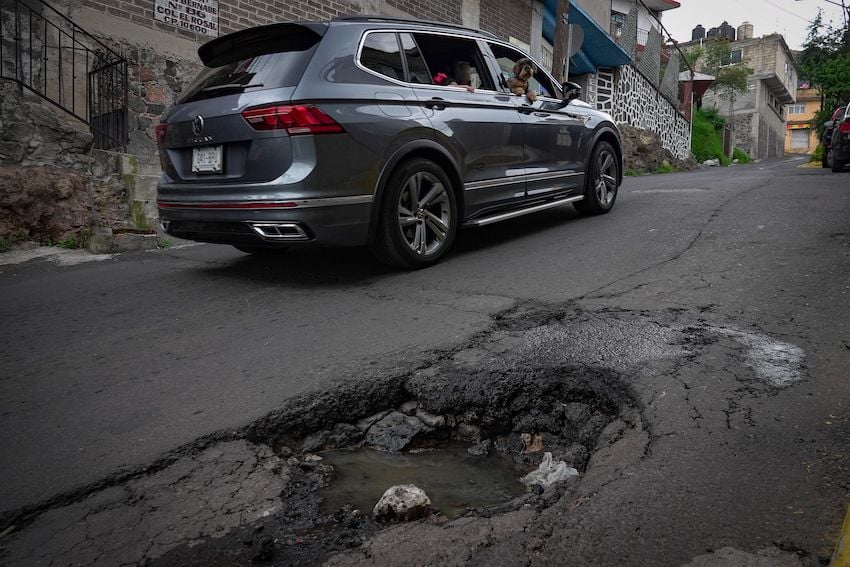
President Sheinbaum announced a major national road repair program on Wednesday, pledging 50 billion pesos (US $2.86B) to tackle Mexico’s crumbling federal highways through an intensive resurfacing campaign dubbed the “Mega Bachetón” (Mega Pothole-thon).
The announcement, made during the president’s morning news conference at the National Palace, represents one of the most significant infrastructure investments of her administration and directly responds to widespread complaints about road conditions across the country.
View this post on Instagram
“We conducted a thorough review of the highways and gathered requests from citizens during our travels throughout the country,” Sheinbaum said.
The National Highway Conservation and Mega Bachetón Program 2026 will cover 18,000 kilometers of toll-free federal highways, or just under half (42%) of the country’s toll-free roadways. The initiative expects to create approximately 100,000 jobs throughout 2026.

Regional breakdown
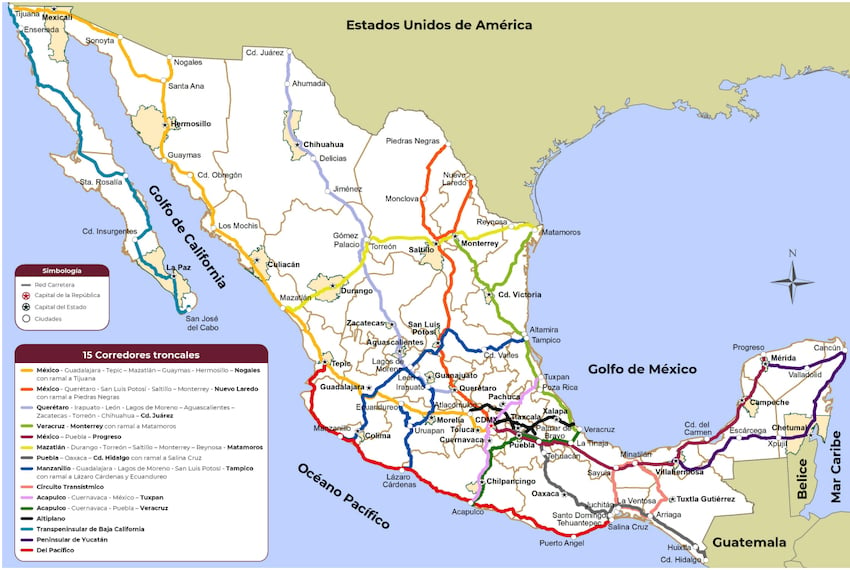
The program divides the country into five operational regions, each targeting key transportation corridors:
Northwest (Baja California, Baja California Sur, Chihuahua, Durango, Sonora and Sinaloa): 8.659 billion pesos to repair 3,170 kilometers covering the Pacific Corridor, Mexico-Nogales and Mazatlán-Matamoros and Gulf-North routes.
Northeast (Coahuila, Nuevo León, San Luis Potosí and Zacatecas): Covering the Mexico-Nuevo Laredo, Querétaro-Ciudad Juárez, Veracruz-Monterrey and Gulf-Huasteca routes.
Central-West (Aguascalientes, Colima, Guanajuato, Jalisco, Michoacán, Nayarit and Querétaro): Including the Manzanillo-Tampico and Guadalajara-Zacatecas routes.
Central Region (México state, Guerrero, Hidalgo, Morelos, Puebla and Tlaxcala): Targeting the Acapulco-Tuxpan, Center-Gulf, Acapulco-Veracruz, Mexico-Veracruz and High Plateau Corridor highways.
South-Southeast (Campeche, Chiapas, Oaxaca, Quintana Roo, Tabasco, Veracruz and Yucatán): Addressing the Puebla-Progreso, Puebla-Tapachula, Trans-Isthmus Circuit and Yucatán Peninsula routes.
Technology and efficiency
To optimize resources and reduce costs, the government has invested in state-of-the-art repaving equipment. The program will deploy 31 paving trains and 62 specialized pothole repair units.
Ten paving trains began operations in 2025, with another 10 set to start work between January and February 2026. An additional 11 machines will be purchased to ensure each region has dedicated equipment.
The modern machinery can advance up to one kilometer per day, significantly improving efficiency. The government is purchasing materials directly and using its own equipment to strengthen the program’s technical capacity and control costs.
A key innovation is a digital monitoring system designed to detect and repair potholes within 72 hours across the 43,000-kilometer toll-free network.
Timeline
The program officially runs from January through December 2026, with work already underway in some regions. The initiative includes both routine maintenance — filling potholes, leveling surfaces, clearing vegetation and cleaning drainage systems — and more extensive periodic conservation involving milling and applying five-centimeter asphalt layers.
The massive undertaking represents a significant test for the Sheinbaum administration’s ability to deliver on infrastructure promises. With Mexico preparing to co-host the 2026 FIFA World Cup alongside the United States and Canada, improved highway conditions will be critical for both domestic travel and international visitors navigating between host cities.
Mexico News Daily