
An activist teachers’ union with a history of disruptive protests has threatened a national strike that could block access to Mexico City’s main public square just 10 days before the World Cup opening ceremony, some 15 kilometers away.
In calling for the strike over what they considered an inadequate 9% salary raise offer from the Education Ministry, the National Coordinating Committee of Education Workers (CNTE) left no doubt that the threatened action’s proximity to the World Cup opener is no coincidence.
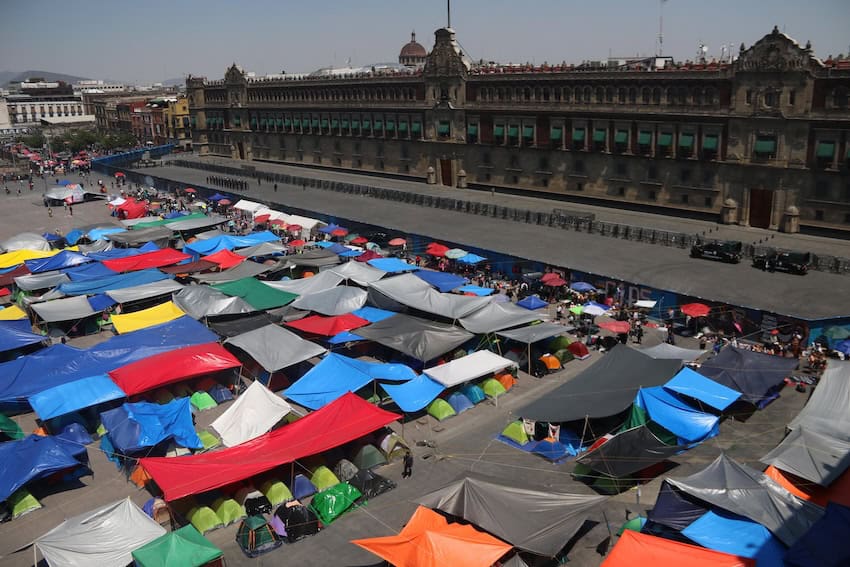
“As has been announced, the national strike coincides with the World Cup,” one CNTE member told the press. “The eyes of the world will be on Mexico City, and we will be there, showing our discontent and fighting for justice.”
The strike announcement appears to be as much a negotiating ploy as a definite plan.
CNTE representative Elvira Meleces Morales said what action the strike includes — and apparently whether there will be one at all — will depend on President Claudia Sheinbaum’s response to their list of demands.
“Our actions don’t depend on this movement; they depend on the will of the federal government, because what we are seeking is to make the struggle visible,” Meleces said.
If left unsatisfied, the CNTE says it will mobilize its sections where it has a presence — mainly Oaxaca, Michoacán, Mexico City, Chiapas and Guerrero — and bring them to the capital. There, on June 1, after a mass protest march in the morning, an encampment will be set up in the Zócalo.

“If the authorities are unwilling, access to the Zócalo will be blocked,” Mereces said.
Beyond disrupting World Cup logistics, the CNTE’s aggressive posture could jeopardize the school calendar, as public schools with CNTE representation may have to suspend classes. That would create an ironic situation in which teachers themselves would accomplish what Education Minister Mario Delgado tried but failed to do: truncate the school year by more than a month.
What are teachers asking for?
According to CNTE representatives, the offered 9% (salary plus benefits) increase is too low to offset inflation.
Beyond a salary raise, the teachers demand a review of education reforms and changes to the pension system.
“These crumbs thrown to education workers are unacceptable,” representative Pedro Hernández Morales said.
Other demands include the repeal of the 2007 ISSSTE Law, which changed the federal pension scheme from pooled to individual and which President Sheinbaum previously pledged to reverse. CNTE teachers protested against this law in June last year.
The CNTE does not represent the majority of teachers. The rival SNTE is older, with a larger membership and broader distribution.
With reports from El País and El Financiero