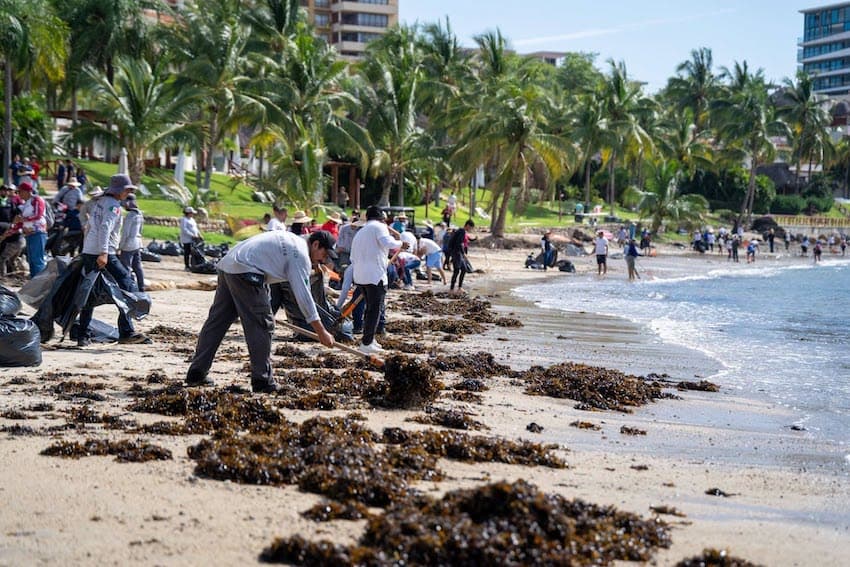
What looked like an unprecedented sargassum invasion on a popular beach in the western state of Nayarit has instead been identified as a harmless Pacific macroalgae — not the same seaweed that has become the scourge of Quintana Roo’s Caribbean shores.
For the past couple of weeks, beachgoers and residents in Rincón de Guayabitos have observed clumps of brown muck covering the shoreline.
An especially large accumulation Sunday morning led to Facebook and other social media posts, including by the municipal government of Compostela which the Guayabitos beach is part of, describing a “sargazo” invasion.
“This has never happened before,” residents and boatmen told the newspaper La Jornada as they joined cleanup efforts.
But researchers from the Autonomous University of Nayarit (UAN) said the material is not sargassum — which typically affects Mexico’s Caribbean coast — but Hypnea, a naturally occurring macroalgae.
In an interview on Radio UAN, marine researchers Ubisha Hernández Almeida and María Alcántara said the accumulation is tied to seasonal changes in ocean currents, water temperature and nutrient loads.

Unlike Atlantic sargassum — which can cause respiratory irritations and skin rashes as it decomposes — Hypnea is not linked to large transoceanic blooms and does not pose health risks, though it can be considered an unsightly nuisance and produce odors as it decomposes.
The distinction is significant.
Sargassum influxes have battered Quintana Roo for years, and the 2026 season remains severe. State officials report 79,476 tonnes collected as of July 6, with Playa del Carmen and Cancún accounting for roughly 60% of the total.
Extensive containment and cleanup operations are ongoing along the Caribbean coast.
In contrast, Pacific coast events such as the one in Guayabitos are typically localized and temporary. Residents said smaller arrivals have occurred before, including in 2021, but not at this scale.
“From one day to the next, the sargassum invaded … it had never arrived in such quantities before,” a vendor told La Jornada, reflecting widespread confusion over the phenomenon.
It is also not a “red tide,” the toxic microscopic algal blooms that periodically discolor the water and prompt shellfish warnings in places such as Zihuatanejo Bay. Instead of a harmful bloom of single-celled microalgae, Guayabitos is seeing mats of larger, multicellular seaweed that are unsightly and smelly when they pile up, but so far have not triggered health advisories.
Local authorities and volunteers have launched cleanup campaigns, while tourism operators express confidence that the event will be short-lived and far less disruptive than sargassum blooms battering the Yucatán Peninsula.
With reports from La Jornada and 24 Horas Quintana Roo