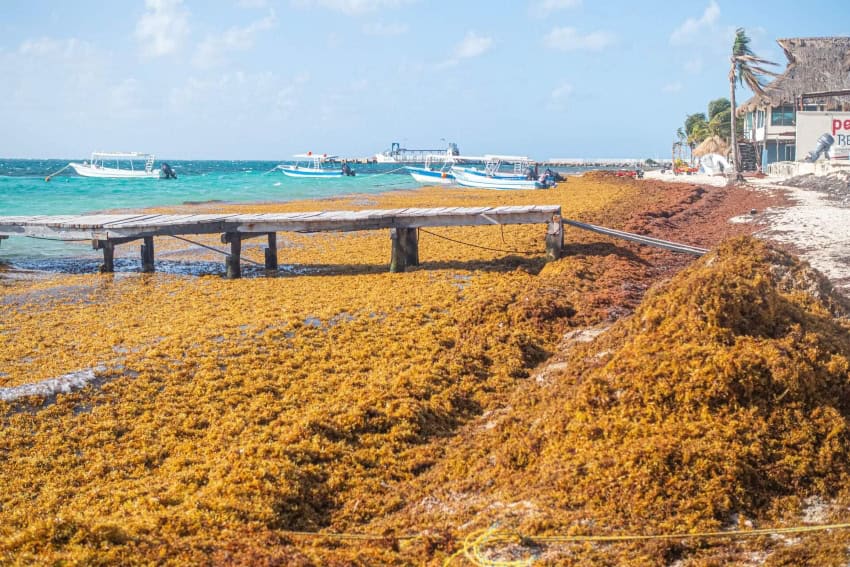
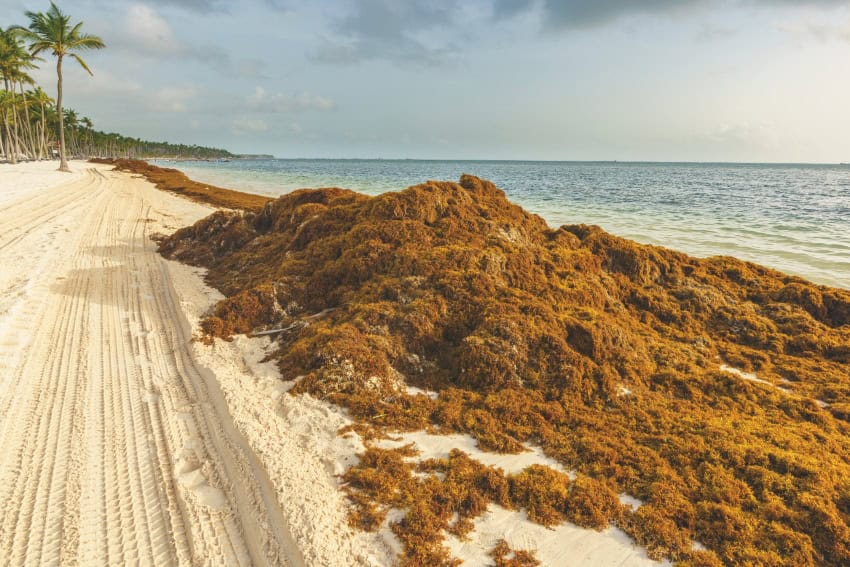
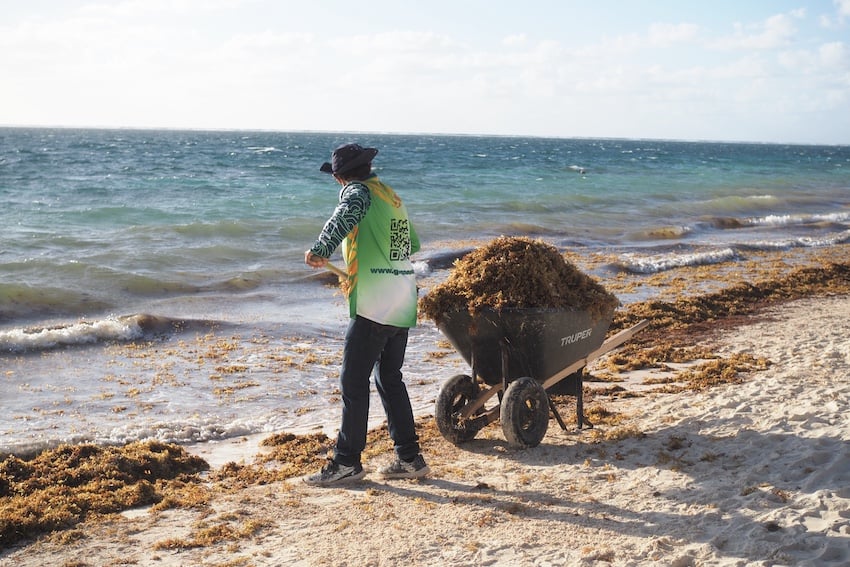
By early morning in Puerto Morelos, the beach is already buried — thick mats of sargassum stretch to the waterline, the air tinged with the smell of sulfur as the seaweed begins to decay. By breakfast time, crews are hauling it away by the truckload. But for every ton removed, many more remain.
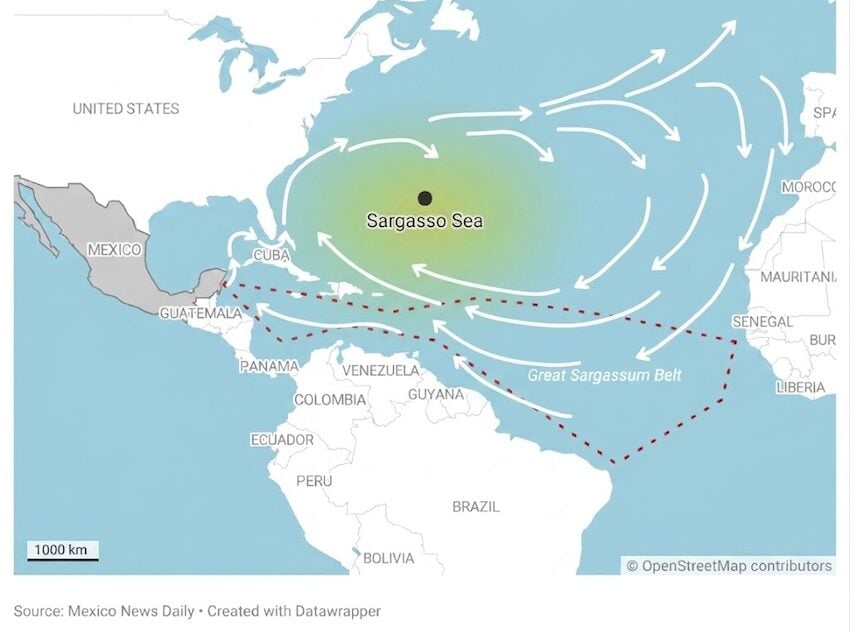
Another record-breaking year is unfolding for the smelly brown algae. The Great Atlantic Sargassum Belt surpassed 38 million tons in July 2025, a 40% increase over the previous record set just two years earlier. The seaweed washes ashore across Mexico, Puerto Rico, the Virgin Islands and beyond, blanketing beaches in mats that can reach several feet deep overnight.
The sargassum crisis
The economic stakes are enormous. Hotels in Quintana Roo alone spent an estimated US $150 million last year clearing sargassum from their beaches, while broader government estimates put total damages from a major bloom at more than US $275 million. Even modest declines in visitor numbers can ripple through a tourism economy that generates more than $16 billion annually in the region; one analysis showed that tourism locations experiencing sargassum blooms see a 10% drop in total GDP during the blooms.
Most of the sargassum collected from popular tourist areas still ends up in landfills — but that is beginning to change. As sargassum piles up in ever-increasing volumes, a growing number of companies are racing to turn the invasive seaweed into something useful. The harder question is whether any of them can scale fast enough to match the crisis.
Longer seasons, uncertain science
For years, the leading explanation for the sargassum explosion was agricultural runoff — nutrients pouring off Brazilian farmland into the Amazon River and feeding the algae. That theory has since been complicated by newer research.
A 2025 study published in Nature Geoscience pointed instead to equatorial upwelling of phosphorus from deeper ocean layers as the primary driver, with cyanobacteria living on the sargassum, then fixing nitrogen and accelerating its growth. Separately, recent climate modeling suggests that shifts in the Atlantic ocean currents – including the slowing of the Atlantic Meridional Overturning Circulation, the vast conveyor belt of ocean currents — may be allowing more surface nutrients to accumulate rather than being pulled into the deep, potentially supercharging future blooms through mid-century.
What is becoming increasingly clear is that the season itself is expanding. Sargassum traditionally peaks between May and August in the Caribbean. Now it is arriving in January. “We are seeing major shifts in sargassum arrivals,” said Sara Santiago, Marketing Manager at Carbonwave, speaking from Puerto Morelos. “Our season used to start in April and end in August, but this year we started collecting sargassum in January. As sargassum arrivals start to expand into tourist season, we expect the local impacts to be even more significant.”

Allen McGonagill, Carbonwave’s chief strategy officer, put it in starker terms: “Sargassum is one of the biggest visual indicators of climate change in the region. When it’s sargassum season, it is everywhere. It’s an every-year reminder of how rapidly our planet is changing.”
A startup takes on the tide
Among the companies trying to turn the problem into a product, Carbonwave stands out for its size. The U.S.-based startup, operating primarily along the Riviera Maya and in Puerto Rico, employs about 75 full-time workers and collected roughly 20,000 metric tons of sargassum last year — by McGonagill’s estimate, the largest operation of its kind in the world.
Carbonwave was founded in 2020 to build sustainable industries around seaweed. As the founders evaluated different feedstocks, the sargassum crisis kept asserting itself as too big to ignore.
“If we’re going to create sustainable long-term industries around seaweed that can scale and really have impact,” McGonagill said, “we have to be solving the most tangible problem of seaweed — which, by 2020, was unmistakably the sargassum inundation.”
Collecting sargassum
The company’s collections operations run through a subsidiary called Grupo Ensol. Collection crews work the beaches from Playa del Carmen in the north down to Akumal and the edges of Tulum, using a combination of mechanical equipment, manual labor and floating boom barriers that corral sargassum into collection containers. On an average processing day, the facility handles around 20 tons; a recent record hit 27.
On big delivery days, the company is pulling in 60 tons or more just from its collection zones. In high summer, that can reach hundreds. All of this has to be weighed in context, however. Across the broader Quintana Roo coast, estimates of what actually hits the beaches each year range from 50,000 to 200,000 tons — meaning Carbonwave may be capturing somewhere between an eighth and a half of the regional total, depending on the year.
On most days, McGonagill said, virtually all of what they collect gets processed and sold. But on the days when sargassum arrives overnight in quantities that swamp collection capacity, some still ends up in landfill — “the default for what happens with sargassum across the region,” he said.
Turning seaweed into a product
Processing sargassum is not as simple as scooping it off the beach and sending it to a factory. The raw material arrives full of sand, plastic debris and naturally occurring arsenic and heavy metals that make it unsuitable for most uses without significant treatment.
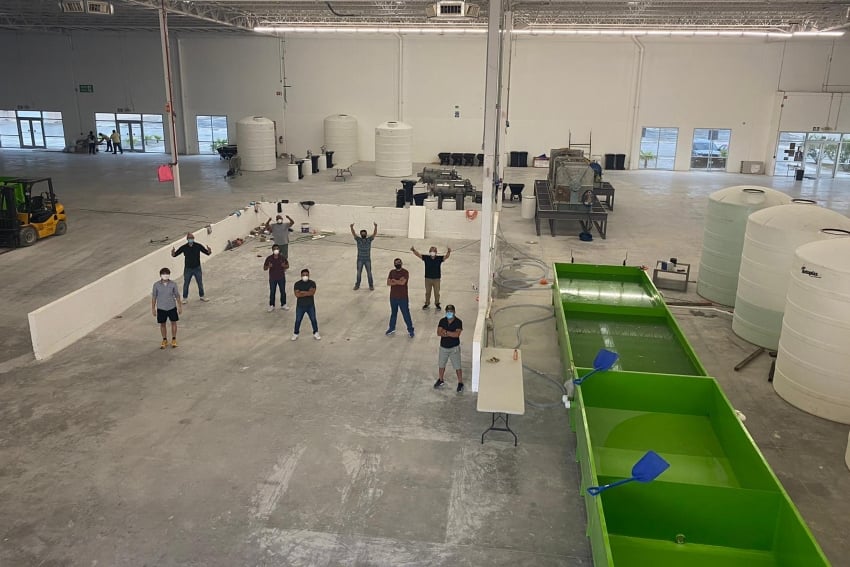
At Carbonwave’s Puerto Morelos facility, freshly collected sargassum goes through multiple rinse cycles and a conveyor-belt quality check before reaching a screw press — a large automated device that separates the seaweed’s liquid and solid components. The liquid is then concentrated through an ultrafiltration system that removes salts and arsenic while concentrating compounds that are valuable for agriculture. The solid pulp feeds a separate product stream. “You have to make use of everything,” McGonagill said.
The liquid fraction becomes the foundation for what Carbonwave sells as an agricultural extract under the brand Sarga Agriscience. Seaweed-based biostimulants are not new, but McGonagill argues that Carbonwave’s concentration process gives it an edge. Most commercially available seaweed extracts sell the cellulose-heavy outer material. Carbonwave’s process concentrates what it says are more bioactive compounds — particularly mannitol, an alcohol sugar, along with amino acids — to levels that exceed many competing products.
In field trials conducted over the past four years, the company says the product has increased crop yields by up to 18% when used as an additive alongside conventional fertilizer. That translates to an additional 15% return on investment for the farmer. It can also, in some formulations, reduce fertilizer use by around 10%, though McGonagill notes that yield gains have proven to be the more compelling sales pitch for farmers.
A turning point in interest
The product has been certified for sale in Mexico, where uptake has been relatively fast. But this year marks a turning point: major corporate agricultural buyers in the United States and Europe, after years of their own internal testing, are beginning to sign distribution contracts. “This is probably our first year where the United States will be bigger than Mexico,” McGonagill said.
From the solid fraction, Carbonwave produces a cosmetic emulsifier called SeaBalance, which it describes as the first seaweed-derived emulsifier strong enough to stand alone in cosmetic formulations without synthetic additives. The company says it is now present in 60 commercial products, with stronger market traction in Europe, South Korea and India than in Mexico.
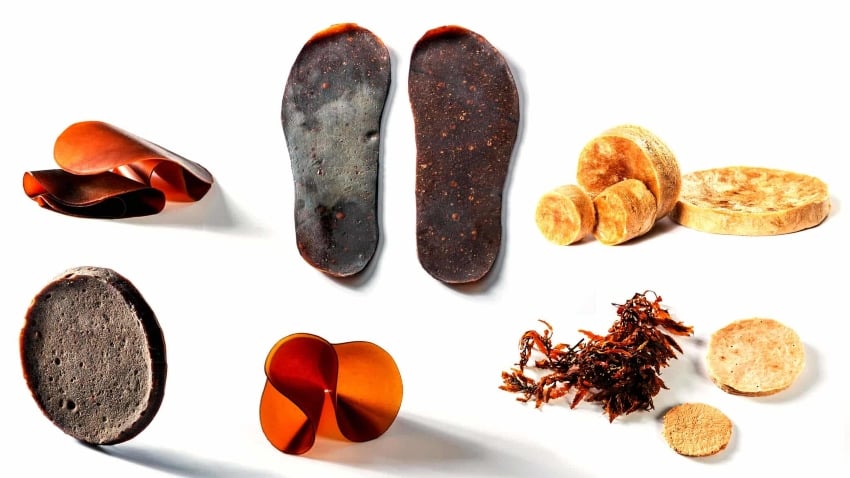
The third product line is the most speculative but potentially the most striking: Obalt, a leather-like textile made from polymers extracted from the solid sargassum pulp. Seaweed-based leather is an emerging field — companies including North Carolina-based Keel Labs and Namibia’s Kelp Blue are developing their own seaweed-derived textiles — but most are working with farmed seaweed.
Carbonwave’s pitch is that it can do the same thing with a waste stream that is already overwhelming Caribbean beaches. The company says it has engineered Obalt to form films stronger than the raw sargassum it comes from, to compete with other vegan leather alternatives. For now, it remains what the agricultural extract once was: a prototype looking for a market.
Scaling it up
A dozen or more organizations are working on ways to turn sargassum into useful materials, ranging from university spin-offs to small startups compressing the seaweed into building materials or extracting alginate for industrial uses. The field is lively, but McGonagill is candid about its limitations.
“The challenge is that sargassum doesn’t specialize,” he said. Most commercial seaweed industries are built around specific chemical properties — high alginate content, for instance, or suitability as a food crop. Sargassum does neither particularly well. Finding applications that are genuinely cost-competitive with conventional materials has been a years-long slog.
“Early things that we never really advertised — we created a rubber foam, we created foam packaging. These are things that are possible to make out of seaweed, but they’re very expensive compared to conventional materials.”
An interconnected business model
What sets Carbonwave’s model apart is how the two sides of the business reinforce each other. Through its local collection subsidiary, Grupo Ensol, the company charges hotels to remove sargassum — functioning, in effect, as a waste hauler. But because that same sargassum becomes the raw material for its agricultural and cosmetic products, it can charge more competitive rates for collection than a conventional waste disposal company.
“A hotel usually chooses between a waste disposal company and Carbonwave,” McGonagill said. That dual structure, he argues, is what makes the model replicable without depending on grants or municipal contracts to stay afloat.
The more pressing bottleneck, he says, is not collection capacity or product development but something more logistical: what to do with sargassum on the days when it arrives in overwhelming quantities that cannot be processed immediately. Bioactive compounds in fresh sargassum degrade quickly, and cold storage at scale would be prohibitively expensive.
This year, for the first time, Carbonwave is also looking to expand geographically. The company plans to open one or two new facilities beyond Quintana Roo within the next year. Whether that expansion will keep pace with a bloom that scientists say could continue accelerating through 2050 — as Atlantic currents reorganize under climate change — is a question the company, and the wider industry, is racing to answer.
“In accessible beaches that are having the problem today, we believe that we can address a lot of that,” McGonagill said. But he was also clear-eyed about the scope: the bloom does not wait, and the infrastructure to meet it does not yet exist.
Tracy L. Barnett is a Guadalajara-based freelance writer and the founder of The Esperanza Project.