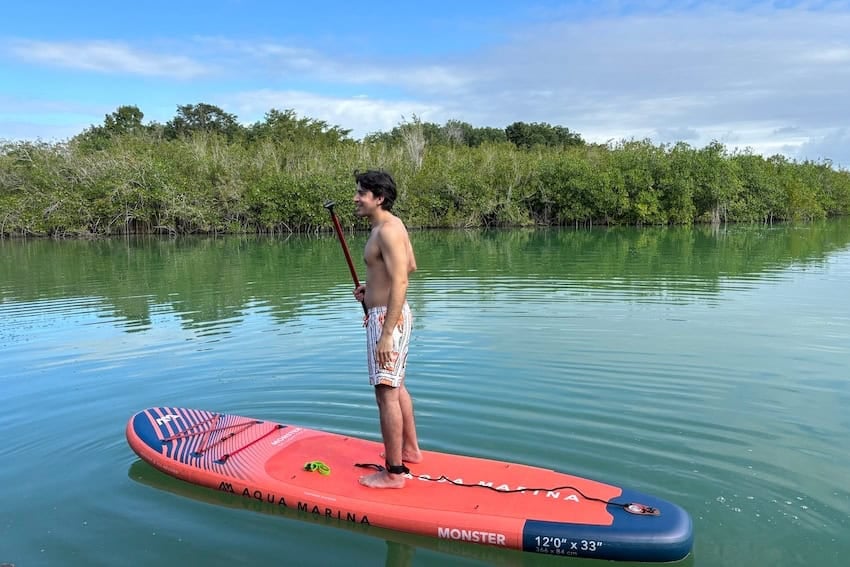
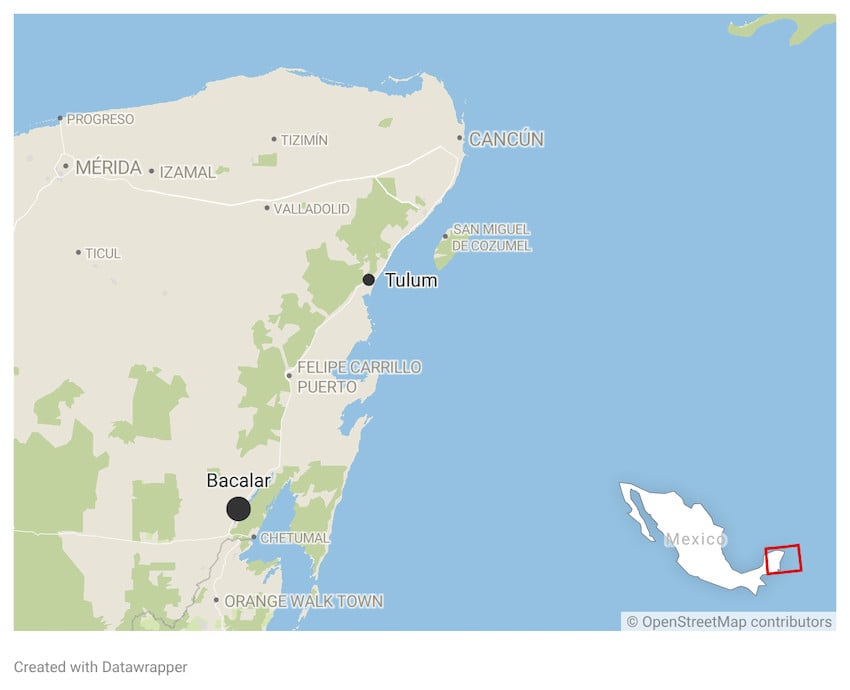
When we first arrived in Bacalar, the idyllic lagoon deep in the heart of Quintana Roo, I had mixed feelings.
My partner remembered Bacalar for its paradisiacal lagoon, nestled in the southeastern state of Quintana Roo, with calm waters in deep shades of sky blue. I had never been. The lagoon is home to stromatolites, a very ancient form of life that thrives only in the remotest places on Earth. Now, that precious environment is increasingly endangered due to irresponsible tourism. I wanted to find out how damaged the ecological panorama was — and dive deep into the heart of the Maya jungle.
A breath of Huay Pix
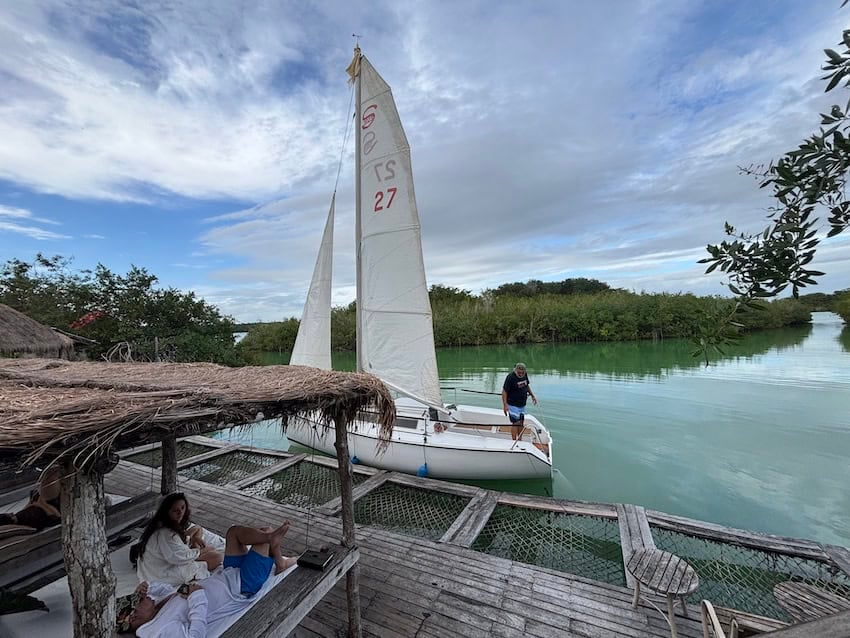
Bacalar seemed like a wonderful destination to do exactly nothing. As one of Mexico’s wellness hotspots, we were looking for a place to take a morning yoga class, possibly do some kayaking and eat local seafood. That’s when we came across La Embajada Universal, an eco-friendly hostel in the Milagros Lagoon in Huay Pix, a small Maya town minutes away from Bacalar.
We booked a four-night stay on Airbnb, just between Christmas Day and New Year’s. As we arrived in Chetumal, we headed for Huay Pix, where the hostel’s private pier is located. Once we arrived, Gustavo, a dark-haired man in his thirties, picked us up in an impressively large paddleboard. We hopped on board and he rowed softly for about half an hour, as if he were caressing the surface of the lagoon. Everything was silent. The iguanas watched us, perched on the roots of centuries-old mangroves.
This was exactly what we were looking for.
Fading splendor in Bacalar
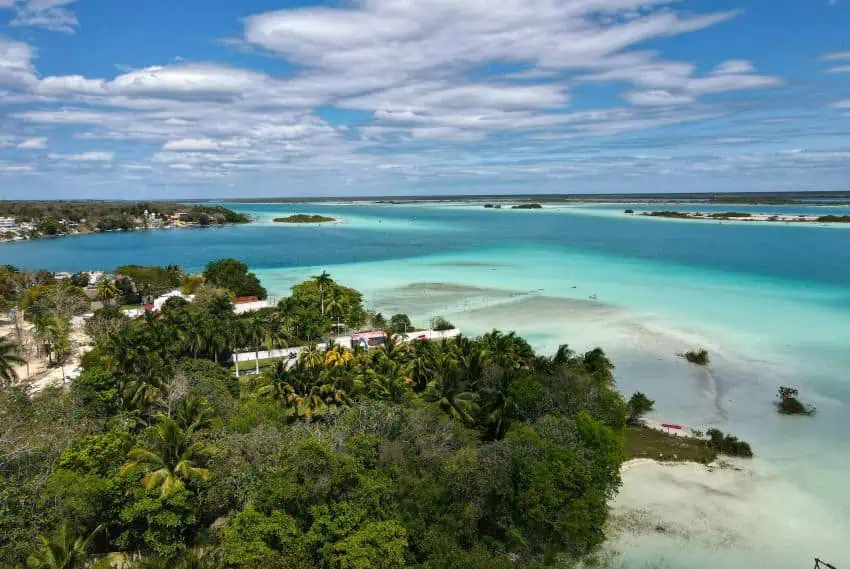
However impressive Bacalar still is, tourism, real estate and agricultural waste have caused its splendor to fade. “Because this body of water is part of the hydrological basin,” explains UNAM ecologist Dr. Luisa Falcón, “large quantities of nitrogen and phosphorus are now being discharged from intensive agriculture and lack of wastewater treatment, which favors the growth of plankton.” These microorganisms have caused Bacalar to lose its multiple shades of blue rapidly.

Falcón cites the “Bacalar Report Card” which reports an 800% increase in tourists to the area between 2008 and 2019. This influx has altered approximately 35% of the lagoon’s shoreline due to the loss of riparian vegetation. Furthermore, the report indicates that recreational and nautical activities have further damaged the area’s native mangroves.
Garbage, deforestation and agricultural activities have altered “the biogeochemical conditions of the lagoon,” the biologist says, “promoting the growth of primary producers in the water column, which changes its color.”
Although Bacalar is currently described as a new global wellness capital by both international and local real estate companies, Dr. Falcón says the growing demand for real estate and tourism is taking a heavy toll on the local fauna and flora. Both UNAM researchers and global organizations, such as Greenpeace, agree: they have incessantly denounced the devastating ecological impact that human activity has had on the lagoon.
So, how does one visit Bacalar in a sustainable way?
Visiting Bacalar sustainably
“Mexico is home to a great diversity of modern microbialites,” notes Dr. Falcón, which have lived here for less than 10,000 years. Currently, they are found in “communities of living microorganisms, both in desert pools, lagoons, rivers and cenotes.”
These microscopic communities “are sensitive to water quality,” she said. Therefore, to prevent their disappearance, “we must not disturb them.” Furthermore, the ecologist points out, “the tourism industry must respect the guidelines for proper wastewater treatment.”
Instead of adapting the ecosystem to tourism, tourism should adapt “to the karst nature of the Yucatán Peninsula,” to ensure that this and other native ecosystems survive. To guarantee the ecosystem’s survival, Dr. Falcón suggests these simple steps:
- Choose only organic products.
- Choose accommodations that have wastewater treatment systems.
- Avoid using loudspeakers that could disturb the wildlife.
- Use the restroom before entering the lagoon.
- Wear sun protection to avoid using sunscreens and products that take a long time to decompose.
“Bacalar Lagoon is a unique and irreplaceable ecosystem that reflects the beauty of the Maya aquifer,” Falcón concludes. “It is our responsibility to protect it.”
Andrea Fischer contributes to the features desk at Mexico News Daily. She has edited and written for National Geographic en Español and Muy Interesante México, and continues to be an advocate for anything that screams science. Or yoga. Or both.