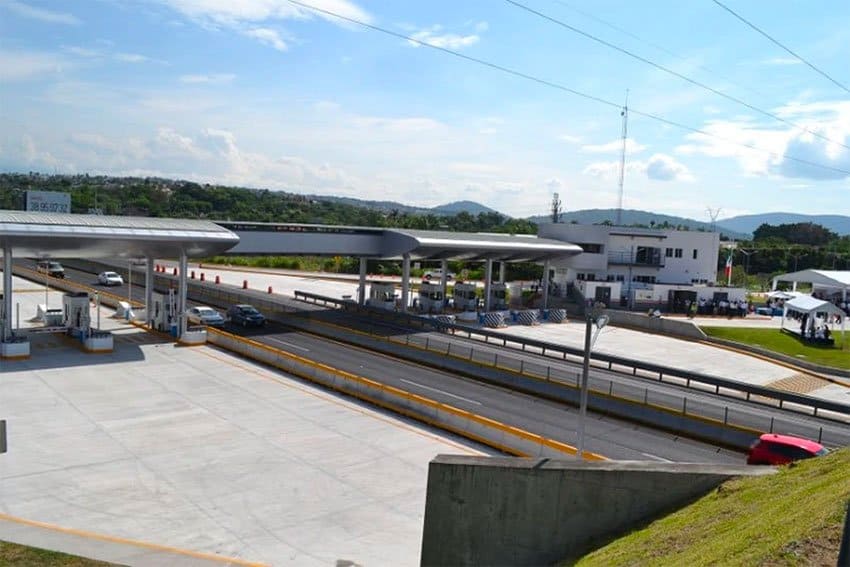
Capufe toll booths will not accept credit cards as of January 1

The agency responsible for federal highways and bridges will stop accepting credit and debit card payments at toll booths starting January 1.

Capufe, part of the Secretariat of Communications and Transportation (SCT), said the change will reduce wait times at the booths.

“This measure is to provide a better service and streamline the movement of users through the network of bridges and highways the agency runs throughout the country,” said Capufe in a statement.

The agency said that by accepting only cash and its own electronic payment solution, called TAG-IAVE, the time spent by motorists at toll booths will be “significantly reduced.”

It takes six times as long to process a card payment as it does to accept cash, it said.

One pundit saw it as a step backward.

“I do not understand it. It’s in clear opposition to the promotion of banking services in the country,” said Javier Risco of broadcaster W Radio.

Thousands of Mexican and foreign vacationers will soon hit the roads and many will find out about the new accepted payment methods while traveling. But the federal Tourism Secretariat has announced a traveler care program consisting of 34 assistance units that will operate 24/7 throughout the Christmas holiday season. It officially started yesterday and will conclude on January 4.

With Capufe’s TAG IAVE cards motorists can transfer funds from their bank accounts, set up monthly recurring payments or let the TAG-IAVE system debit their bank accounts directly.

More information can be found at Capufe’s dedicated website or by calling toll free 01-800-111-0088.

Source: Infobae (sp)

Have something to say? Paid Subscribers get all access to make & read comments.
Manzanillo, Colima, México, 13 de marzo de 2026. La doctora Claudia Sheinbaum Pardo, presidenta Constitucional de los Estados Unidos Mexicanos en conferencia de prensa matutina, “Conferencia del Pueblo” desde Colima. La acompañan Indira Vizcaíno Silva, gobernadora Constitucional del Estado de Colima; Omar García Harfuch, secretario de Seguridad y Protección Ciudadana (SSPC); Raymundo Pedro Morales Ángeles, secretario de Marina (Semar); Bulmaro Juárez Pérez, divulgador de lenguas originarias, presentador de la sección “Suave Patria”; Ricardo Trevilla Trejo, secretario de la Defensa Nacional (Sedena); Jesús Antonio Esteva Medina, secretario de Infraestructura, Comunicaciones y Transportes; Bryant Alejandro García Ramírez, fiscal general del Estado de Colima; Fabián Ricardo Gómez Calcáneo; Rocío Bárcena Molina, subsecretaria de Desarrollo Democrático, Participación Social y Asuntos Religiosos de la Secretaría de Gobernación; Efraín Morales López, director general de la Comisión Nacional del Agua (Conagua); Marcela Figueroa Franco, secretaria ejecutiva del Sistema Nacional de Seguridad Pública (SESNSP) y Guillermo Briseño Lobera, comandante de la Guardia Nacional (GN). Foto: Saúl López / Presidencia

Mexico’s week in review: Congress deals Sheinbaum her first legislative defeat

1
The week of March 9 in Mexico was marked by standoffs between allies in Congress and adversaries at the airport. Here's what you missed.
A soldier displays seized handguns

The US and Mexico, growing together and growing apart: A perspective from our CEO

1
From a historic drop in homicides to opposite bets on electric vehicles, Mexico News Daily's CEO breaks down where the U.S. and Mexico are converging — and where they're not.
Veracruz Gov.

Veracruz governor blames private vessel for 200-kilometer Gulf Coast oil spill

1
The spill, which has spread to over 200 kilometers of Mexico's Gulf Coast beaches, has been traced to a private oil tanker off the coast of Tabasco.
BETA Version - Powered by Perplexity