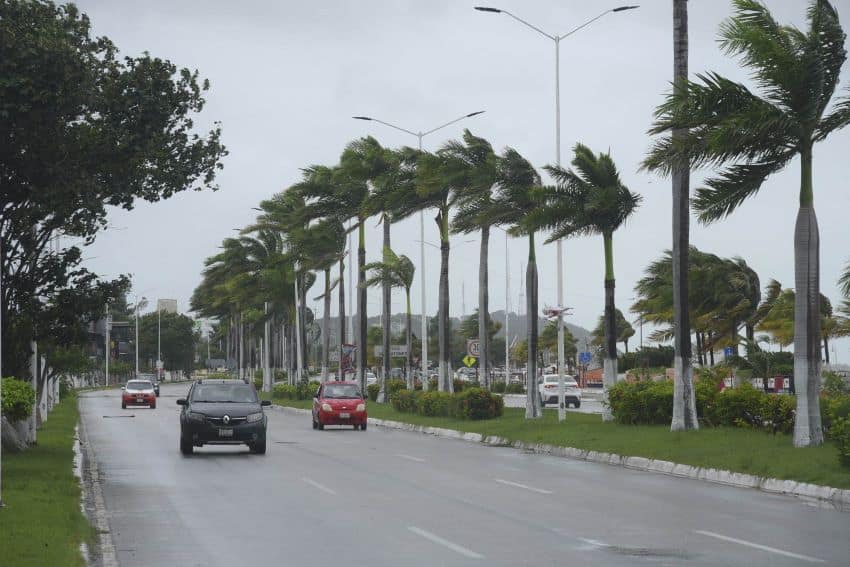
Due to its geography, tropical cyclones hit Mexico along both coasts every year. This year, the Naval Ministry (Semar) forecasts that the country will see a total of 18 hurricanes throughout the 2025 summer hurricane season.
According to the United States National Hurricane Center (NHC), the tropical cyclone season begins on May 15 in the Northeast Pacific Ocean and on June 1 in the Atlantic Ocean. On both coasts, the season ends on November 30.

These are the tropical cyclones and hurricanes forecast for Mexico’s Pacific and Atlantic coasts this 2025 summer season.
Hurricanes forecast for Mexico’s Pacific coast in 2025
| Tropical Depressions | 1 |
| Tropical Storms | 8 |
| Strong Hurricanes (Category 1 and 2) | 6 |
| Intense Hurricanes (Category 3, 4 and 5) | 4 |
| Total | 19 |
Hurricanes forecast for Mexico’s Atlantic coast in 2025
| Tropical Depressions | 2 |
| Tropical Storms | 7 |
| Strong Hurricanes (1 and 2) | 4 |
| Intense Hurricanes (3, 4 and 5) | 4 |
| Total | 17 |
What’s the difference between a tropical cyclone and a hurricane?
Tropical cyclones are either dubbed hurricanes or typhoons, depending on the region in which they originate.
Tropical cyclone is a generic term used by weather forecasters to describe a rotating, organized system of clouds and thunderstorms that develops over tropical or subtropical regions. A cyclone’s wind circulates counterclockwise in the Northern Hemisphere and clockwise in the Southern Hemisphere.

The weakest tropical cyclones are known as tropical depressions. If a tropical depression causes winds of up to 39 miles per hour, the tropical cyclone becomes a tropical storm. If a tropical cyclone reaches sustained winds of 74 miles per hour or more, it becomes a named hurricane in the North Atlantic, central North Pacific, and eastern North Pacific, or typhoon in the Northwest Pacific.
In the South Pacific and Indian Ocean, a hurricane is known as a tropical cyclone.
About 97% of tropical cyclone activity happens during the hurricane season. Yet, hurricanes can and do happen outside of the established six-month season.
What’s the rainfall forecast for the 2025 rainy season?
Meteorologists predict that Mexico will see an average rainy season in 2025, particularly in the central-southern half of the country.
Mexico’s central, eastern, southern and Pacific coast states could see more rainfall at the start of the season, between May and June. Northwestern states are likely to see less rainfall, while the southeast will receive normal rainfall.
The Mexican monsoon, an annual weather pattern bringing increased thunderstorms, can arrive quickly, bringing abundant rain to mountainous areas of Sonora, Chihuahua, Sinaloa and Durango.
With reports from Meteored