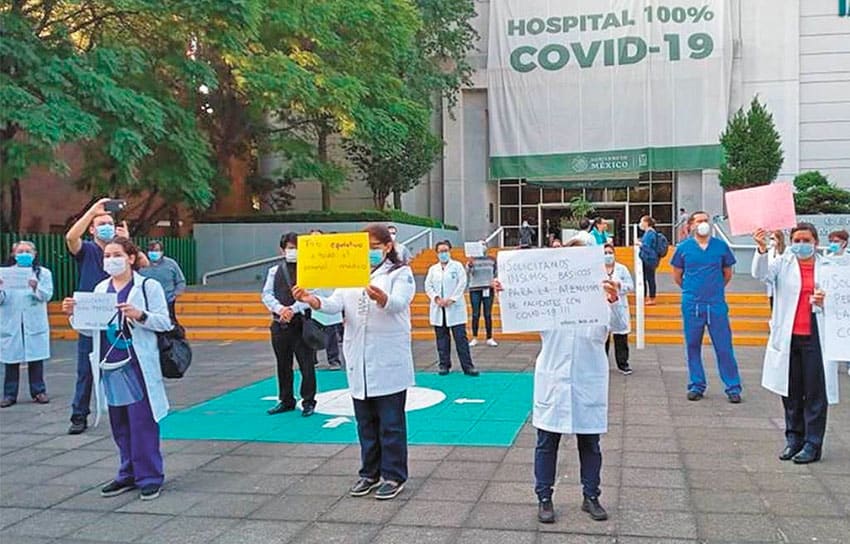
Health workers at a Mexico City hospital protested on Thursday against a lack of personal protective equipment (PPE) and a shortage of staff to attend to a growing number of coronavirus patients.
Doctors and other personnel from the Mexican Social Security Institute (IMSS) Regional Hospital No. 1 in the Del Valle neighborhood protested outside the facility Thursday morning, demanding supplies to treat Covid-19 patients and additional staff.
Coronavirus patient numbers began rising at the hospital three weeks ago, the health workers said, explaining that they have been overwhelmed with work and lack the PPE to do it safely. They said they have had no response to their demands from hospital management.
Later on Thursday, IMSS officials met with the disgruntled workers and committed to ensuring that there is sufficient supply of PPE.
“The safety of workers is a priority for the Mexican Social Security Institute. Sufficient supply of materials to provide timely and quality care is guaranteed,” IMSS said in a statement.
The institute also said that it provided a commitment to the protesting medical personnel that the deployment of workers would be prioritized “where there is greatest demand.”
Health workers across Mexico held numerous protests early in the pandemic to demand more PPE and other equipment and supplies to treat Covid-19 patients.

But the federal government’s purchase of supplies abroad, especially in China, remedied the situation and there have been few protests in recent months.
Still, thousands of Mexican health workers have contracted the coronavirus and more have died of Covid-19 here than in any other country, according to an Amnesty International analysis published in September.
New coronavirus case numbers are on the rise again, meaning that hospitals, health workers and supplies of PPE are set to come under increasing pressure. Several hospitals in Chihuahua and Durango are already at or near capacity due to aN increase in numbers.
In Mexico City, the country’s coronavirus epicenter, 54% of general care beds set aside for coronavirus patients are currently occupied, according to data presented at the federal Health Ministry’s Thursday night press conference, and 44% of those with ventilators are in use.
While there is still significant capacity for hospitals in the capital to treat Covid-19 patients, hospitalizations have risen recently, prompting Mayor Claudia Sheinbaum, who tested positive this week, to flag the possibility of implementing tighter restrictions.
As of Wednesday, there were 2,878 coronavirus patients in Mexico City hospitals including 740 on ventilators.
The capital recorded 1,262 new confirmed cases on Thursday, increasing its accumulated tally to 159,680. One in six confirmed cases in Mexico since the start of the pandemic was detected in Mexico City.
The capital’s official Covid-19 death toll rose to 15,047 on Thursday with 60 additional fatalities reported.
Meanwhile, Mexico’s national case tally increased to 912,811 with 5,948 new cases registered while the death toll rose to 90,773 with 464 additional fatalities.
Mexico City currently has the largest active outbreak in the country, according to Health Ministry estimates, followed by México state, Nuevo León, Guanajuato and Coahuila.
Source: Reforma (sp), El Universal (sp)